Facts
The petitioner claimed title and possession over the disputed land, originally purchased by his father in 1959 and subsequently devolved upon the petitioner and his brothers through partition. He alleged that the private respondents had trespassed upon the land and relied upon a forged and fabricated Mahdanama to obstruct his possession.
Source reference: p.2, para. 3In Land Dispute Case No. 57 of 2012, the Land Reforms Deputy Collector, Manjhaul, passed an order dated 13 December 2012 recognising the petitioner’s title and possession and restraining the private respondents. The order was upheld in appeal by the Divisional Commissioner, Munger, who also directed initiation of criminal proceedings concerning the allegedly forged document.
Source reference: p.2, para. 3In Execution Case No. 02 of 2017–18, an order dated 19 April 2018 directed restoration of possession to the petitioner, removal of encroachment and police protection. The petitioner alleged continued non-compliance, including failure to remove the entire construction and failure to lodge an FIR against the private respondents.
Source reference: pp.2–4, paras. 3–5The State submitted that the land had been measured, that encroachment of 0.14 decimal and encroachment upon the Survey Sarak had been identified, and that possession was ultimately delivered to the petitioner on 7 May 2026 in the presence of a Magistrate and police personnel, supported by a spot report and photographs.
Source reference: p.4, paras. 6–7Issues
Whether the respondents had fully complied with the order dated 19 April 2018 passed in Execution Case No. 02 of 2017–18, particularly concerning restoration of possession and removal of encroachment and construction?
Source reference: p.5, paras. 8–9Whether the authorities were required to take further steps to ensure complete implementation of the execution order in accordance with due process of law?
Source reference: p.5, para. 9Law Applied
The Court applied the principle that a final order of a competent statutory authority must be effectively and completely implemented by the administrative authorities concerned.
Source reference: no citationWhere an execution order directs restoration of possession and removal of encroachment, partial compliance does not discharge the authorities’ obligation; all consequential steps must be taken in accordance with law and due process.
Source reference: no citationReasoning
The Court considered the State’s submission that possession had been delivered to the petitioner on 7 May 2026 and that steps had been taken to identify and remove the encroachment.
Source reference: p.4, paras. 6–7However, it found that the encroachment had not been removed completely despite the specific execution order dated 19 April 2018.
Source reference: p.5, para. 8Thus, even though possession had allegedly been restored and some remedial steps had been undertaken, the Court treated such action as incomplete compliance.
Source reference: p.5, para. 9It consequently directed the concerned authorities to take all positive and expeditious steps necessary to implement the execution order, subject to following the due process of law.
Source reference: p.5, para. 9Holding
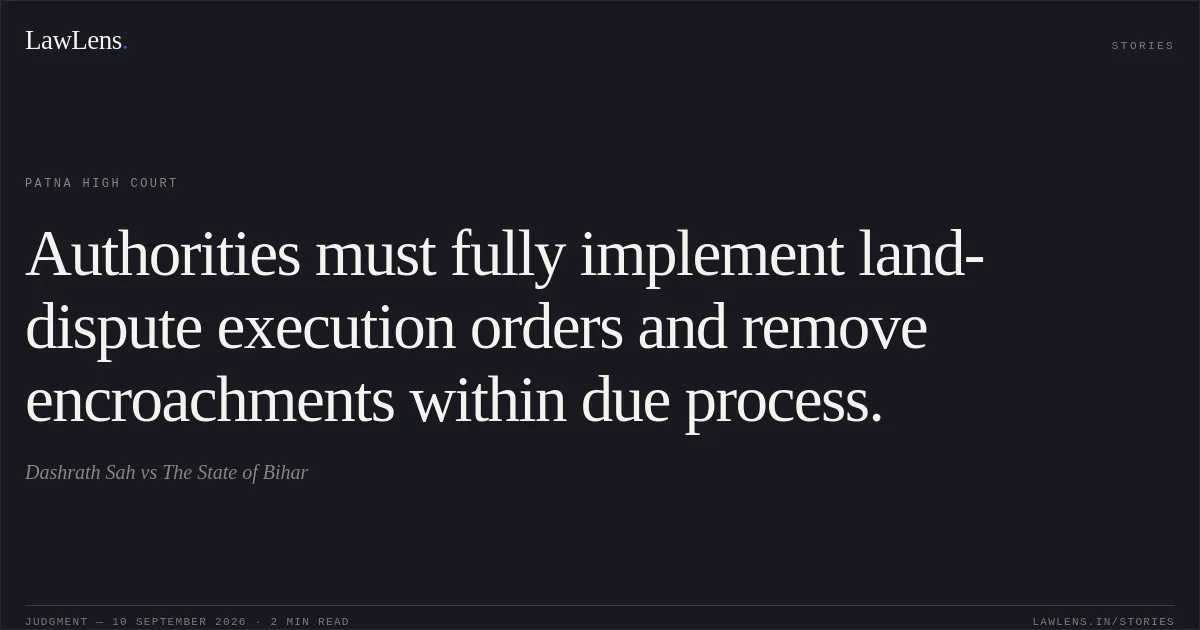
The Court held that the authorities had not fully complied with the order dated 19 April 2018 because the encroachment had not been completely removed.
The respondents were directed to ensure compliance with that order and to take all necessary steps, preferably within three months from receipt of the certified copy of the judgment, after following due process of law.
Source reference: p.5, para. 9The writ petition was accordingly disposed of on those terms.
Source reference: p.5, para. 10Original Court PDF
Dashrath SahvsThe State of Bihar
Click to open original judgment
Original judgment, available to read, download and summarize on LawLens.in