Facts
Respondent No. 2 was employed as a Salesman by the appellant-Society and was subsequently made In-charge of its Consumer Cell.
Source reference: para. 2Following closure of the Consumer Cell, his services were terminated pursuant to a resolution dated 24 May 1999.
Source reference: para. 2He raised an industrial dispute under the Industrial Disputes Act, 1947 (“ID Act”).
Source reference: para. 2By award dated 15 September 2011, the Labour Court held the retrenchment illegal and contrary to the mandatory provisions of the ID Act, directing reinstatement with continuity of service and 50% back wages.
Source reference: para. 2The appellant’s writ petition challenging the award was dismissed by the learned Single Judge on 28 April 2025.
Source reference: para. 1The Society thereafter filed the present intra-court appeal under Clause X of the Letters Patent, principally contending that the Labour Court lacked jurisdiction because the workman had already availed a remedy under the Punjab State Cooperative Agricultural Service Societies Service Rules, 1997 (“1997 Rules”).
Source reference: paras. 1, 3Issues
Whether a workman having more than one statutory remedy can be precluded from invoking the jurisdiction of the Labour Court under the ID Act merely because he has already pursued a remedy under the 1997 Rules?
Source reference: para. 5Whether the doctrine of election of remedies barred the workman from pursuing the remedy under the ID Act?
Source reference: paras. 3, 5–6Whether the appellant could challenge the Labour Court’s grant of reinstatement and 50% back wages for the first time in the intra-court appeal, when no argument on the merits of the award had been advanced before the learned Single Judge?
Source reference: para. 7Law Applied
The Court applied the provisions and scheme of the Industrial Disputes Act, 1947 concerning adjudication of industrial disputes and statutory protection against illegal retrenchment.
Source reference: para. 6It considered the Punjab Cooperative Societies Act and the 1997 Rules, holding that neither expressly excludes the jurisdiction of the Labour Court or Industrial Tribunal over disputes involving retrenchment or violation of labour laws.
Source reference: para. 6Relying on Andhra Pradesh State Road Transport Corporation v. M. Ramadevi, (2008) 3 SCC 379, and Premier Automobiles Ltd. v. Kamlekar Shantaram Wadke of Bombay, (1976) 1 SCC 496, the Court held that the existence of an alternative remedy under cooperative service regulations does not oust the jurisdiction under the ID Act unless there is a specific statutory exclusion.
Source reference: para. 6It further followed the Division Bench ruling in Savitri Devi v. Presiding Officer, Industrial Tribunal-cum-Labour Court and Others, LPA No. 1908 of 2018, decided on 12 September 2024, which held that a workman possessing multiple statutory remedies is free to choose the remedy pursued and cannot be compelled to exhaust an alternative departmental remedy before invoking the ID Act.
Source reference: para. 5The doctrine of election of remedies applies only where the available remedies are inconsistent; the remedy under the ID Act, including reinstatement, back wages and other labour-law reliefs, is distinct from and not inconsistent with the remedy under departmental rules.
Source reference: para. 6Reasoning
The Court held that the workman’s pursuit of a remedy under the 1997 Rules did not deprive the Labour Court of jurisdiction under the ID Act.
Source reference: paras. 5–6The cooperative legislation and the 1997 Rules contained no express bar excluding industrial adjudication, and the remedies under the two regimes were not inconsistent: the ID Act provided statutory labour-law relief, including reinstatement and back wages, which could not necessarily be granted under the departmental rules.
Source reference: paras. 5–6The Court also noted that the jurisdictional issue had already been settled by the binding Division Bench decision in Savitri Devi, and that the parties had proceeded before the learned Single Judge on the basis that the issue stood so decided.
Source reference: para. 6As to the reinstatement and back-wage directions, the appellant had not challenged the award on merits before the learned Single Judge; therefore, it could not raise that challenge for the first time in the Letters Patent Appeal.
Source reference: para. 7No illegality, perversity, or jurisdictional error was established in the Single Judge’s judgment.
Source reference: para. 7Holding
The Court answered the jurisdictional issue against the appellant and held that the workman was entitled to invoke the remedy under the ID Act notwithstanding his pursuit of a remedy under the 1997 Rules.
The doctrine of election of remedies did not bar the industrial dispute, as the two remedies were not inconsistent and there was no statutory exclusion of the Labour Court’s jurisdiction.
Source reference: paras. 5–6The challenge to reinstatement and 50% back wages was also rejected because it had not been raised before the learned Single Judge.
Source reference: para. 7The Letters Patent Appeal was dismissed as meritless, with no order as to costs, and all pending civil miscellaneous applications were disposed of.
Source reference: paras. 8–9Original Court PDF
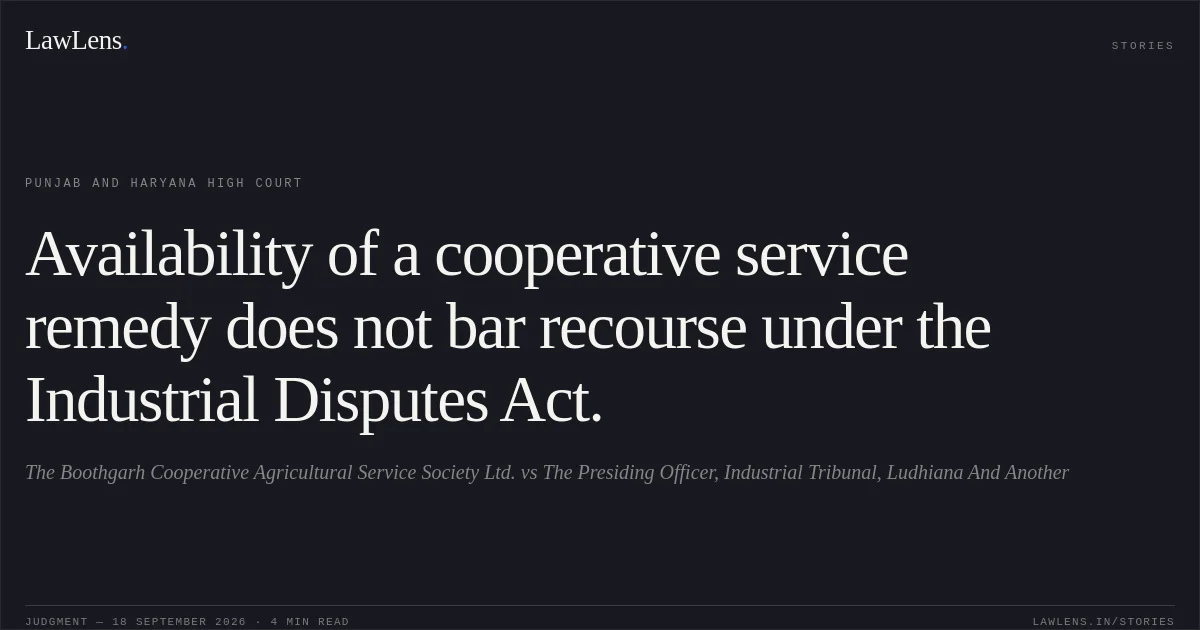
The Boothgarh Cooperative Agricultural Service Society Ltd.vsThe Presiding Officer, Industrial Tribunal, Ludhiana And Another
Click to open original judgment
Original judgment, available to read, download and summarize on LawLens.in