01Facts
The petitioner, an Armed Police Constable, was implicated in Crime No. 122 of 2016 under various IPC sections, including 307 and 366.
¶ 3.1He was placed under suspension on 29.12.2016 and a departmental enquiry was initiated under Rule 6 of the Karnataka State Police (Disciplinary Proceedings) Rules, 1965.
¶ 3.2The Enquiry Officer held the charges proved, and the petitioner was dismissed from service on 30.04.2019.
¶ 3.3His appeal and revision were rejected, although the police had by then filed a B-report in the criminal case.
¶ 3.4On 03.03.2022, the revisional authority set aside the dismissal. It treated the suspension period as duty but treated the dismissal-to-reinstatement period (reinstated 14.04.2022) as spent on duty for all benefits except salary.
¶ 3.5The petitioner approached the Karnataka State Administrative Tribunal (KSAT), which partly allowed his application. It directed that the suspension period be treated as "period on duty," and that the dismissal period count for pensionary/retiral benefits and seniority, but denied salary for that period.
¶ 3.7The petitioner challenged only the denial of back wages under Articles 226 and 227 of the Constitution.
¶ 1, 3.802Issues
i.1. Whether the petitioner is entitled to back wages for the period from dismissal (30.04.2019) to reinstatement (14.04.2022) despite the dismissal being set aside.
¶ 6ii.2. Whether the Tribunal's denial of back wages warrants interference in writ jurisdiction under Articles 226 and 227.
¶ 1, 603Law Applied
The Court applied the general "no work, no pay" principle as the default rule, which would ordinarily bar salary for a period when the employee did not work.
¶ 7The "no work, no pay" principle is not applied rigidly where the foundation of the disciplinary action has fallen away, as with the B-report filed in the criminal case and the rejection of the complaint, both now final.
¶ 7The absence of a chargesheet filed by the disciplinary authority was relied on to justify denying all relief.
¶ 8Section 19 of the Administrative Tribunals Act, 1985 forms the basis of the Tribunal petition.
¶ 3.6Rule 6 of the Karnataka State Police (Disciplinary Proceedings) Rules, 1965 governed the departmental enquiry.
¶ 3.2Authority for the balancing of equities in back-wages relief is not cited.
Provisions in the judgment · 8 · Linked ones open on LawLens
Indian Penal Code, 1860 Section 109Section 506Section 504Section 143Section 149Section 366Section 307
Administrative Tribunals Act, 1985 Section 19
04Reasoning
The petitioner argued that back wages should follow automatically on reinstatement because he was willing to work and the dismissal was quashed by an administrative authority, not a court.
¶ 4The State argued that full service benefits had already been granted and no salary was warranted.
¶ 5The Court rejected both extremes. It held that "no work, no pay" would normally apply, but that its application was diluted here because the criminal foundation of the suspension and enquiry had collapsed through the B-report and the final rejection of the complaint.
¶ 7The absence of any chargesheet further weakened the disciplinary authority's position for denying relief.
¶ 8The Court declined to award full back wages, which would have "put a premium" on the petitioner, and also declined to deny salary entirely, which would have "mulcted" the respondents. It granted 40% back wages as a balanced remedy.
¶ 9The Court did not expressly decide whether the Tribunal committed a jurisdictional error. Its interference rests on the equitable modification of the Tribunal's order.
¶ 1005Holding
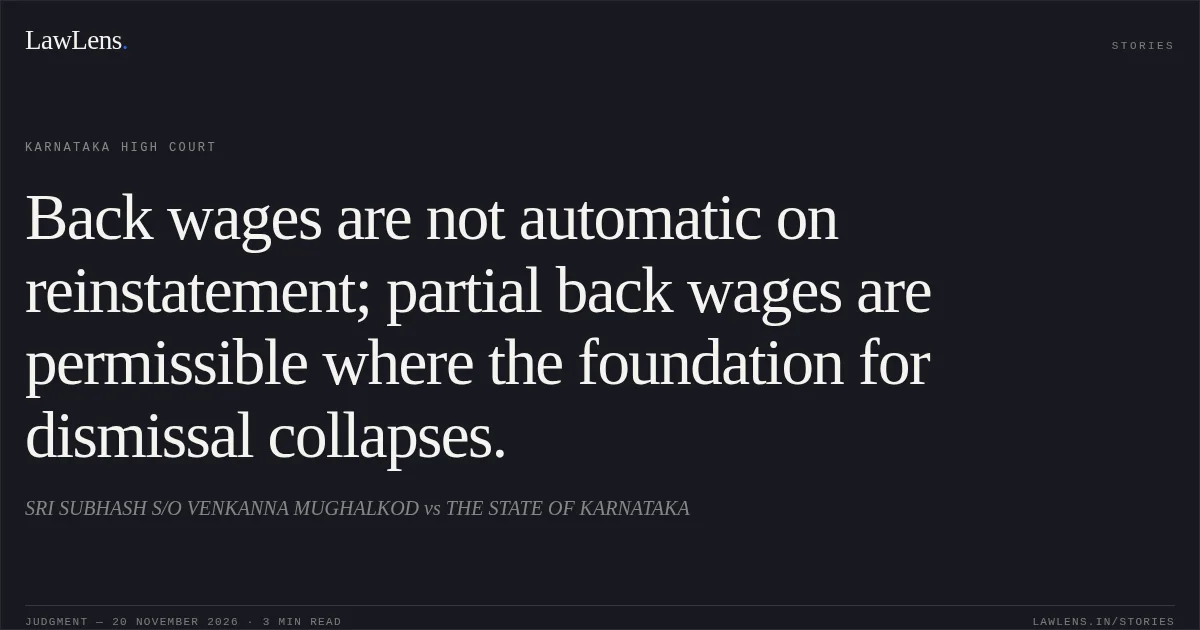
The Court held that the petitioner is not entitled to automatic full back wages on reinstatement.
¶ 8–9Given the collapse of the criminal foundation for the action and the absence of any chargesheet, the petitioner is entitled to 40% back wages for the period from dismissal (30.04.2019) to reinstatement (14.04.2022).
¶ 8–9The Tribunal's order is modified accordingly, and the writ petition is disposed of in these terms.
¶ 10Original Court PDF
SRI SUBHASH S/O VENKANNA MUGHALKODvsTHE STATE OF KARNATAKA
Click to open original judgment
Original judgment, available to read, download and summarize on LawLens.in