Facts
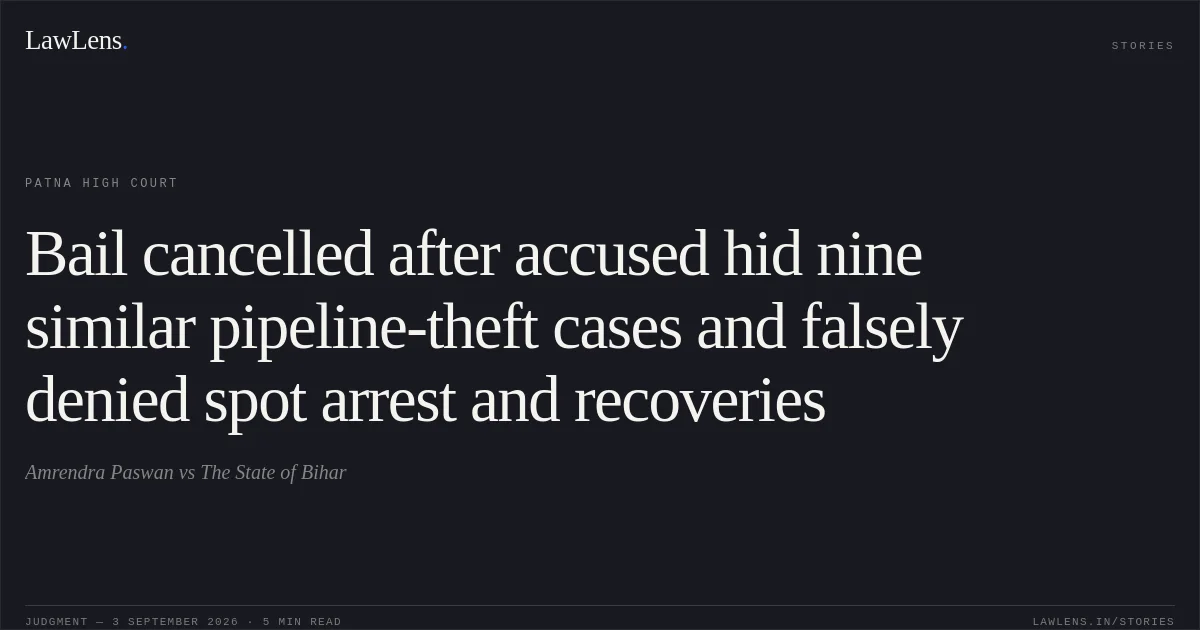
The petitioner, Chief Manager (T&I), Eastern Region Pipeline, Indian Oil Corporation Ltd., filed an application under Section 439(2) CrPC seeking cancellation of the regular bail granted to Sudarshan Lal, Aryan Raj and Pramod Kumar by the Additional District & Sessions Judge-I, Barh, in Athmalgola P.S. Case No. 45 of 2024.
Source reference: para. 1; p. 1The case alleged that, on 8 February 2024, the accused were apprehended near an IOCL pipeline while attempting to flee from the spot where a pit was being dug. Mobile phones and digging implements were allegedly recovered from the accused, while other tools and a motorcycle were found nearby.
Source reference: paras. 4–6; pp. 3–4The FIR was registered under Sections 285, 379, 511 and 120-B IPC and Sections 15(2) and 15(4) of the Petroleum and Minerals Pipelines (Acquisition of Right of User in Land) Act, 1962; the charge-sheet subsequently added Section 7 of the Essential Commodities Act and Sections 3 and 4 of the Explosive Substances Act.
Source reference: para. 6; p. 4The accused’s first bail application was rejected on 13 February 2024. In their subsequent bail petition, they asserted that they had no criminal antecedents, had not been arrested at the spot and had no incriminating articles recovered from them.
Source reference: para. 7; p. 5Bail was granted on 13 March 2024. The petitioner produced material showing that the accused were involved in nine other similar petroleum-theft cases and that the statements in the bail petition were contrary to the FIR and seizure lists.
Source reference: paras. 9–13; pp. 7–11The bail order neither recorded the accused’s antecedents nor referred to, or applied, the statutory restrictions under Section 16C of the 1962 Act.
Source reference: paras. 20–23; pp. 17–21Issues
1. Whether bail granted to the accused was liable to be annulled under Section 439(2) CrPC because it had been procured through false statements and suppression of material criminal antecedents?
Source reference: para. 17; p. 132. Whether the bail order was perverse and unsustainable for ignoring the FIR, seizure material, criminal antecedents and the direction in Anil Baitha v. State of Bihar?
Source reference: paras. 21–23; pp. 19–213. Whether bail granted for an offence under Section 15(4) of the Petroleum and Minerals Pipelines (Acquisition of Right of User in Land) Act, 1962, without recording the mandatory twin satisfactions under Section 16C, was legally sustainable?
Source reference: paras. 20, 23; pp. 17–21Law Applied
The Court applied Section 439(2) CrPC, which empowers the High Court to direct that a person released on bail be arrested and committed to custody.
Source reference: para. 18; pp. 14–15It distinguished ordinary cancellation of a validly granted bail for supervening misconduct, governed by the stringent standard in Dolat Ram v. State of Haryana, from annulment of a bail order that is illegal, perverse, passed in ignorance of material facts or procured by fraud, as recognized in Puran v. Rambilas, Neeru Yadav v. State of U.P., Vipan Kumar Dhir v. State of Punjab, Ajwar v. Waseem and State of Karnataka v. Sri Darshan.
Source reference: para. 18; pp. 14–15The Court further relied on Himanshu Sharma v. State of Madhya Pradesh, holding that bail may be cancelled where it was granted in ignorance of a statutory restriction or obtained by misrepresentation or fraud.
Source reference: para. 19; p. 15Suppression of material facts, including criminal antecedents, attracts the principle suppressio veri, expressio falsi and vitiates the order, as held in A.V. Papayya Sastry v. Government of A.P., Kusha Duruka v. State of Odisha, Kaushal Singh v. State of Rajasthan and Zeba Khan v. State of U.P.
Source reference: para. 19; pp. 15–17Under Section 16C of the 1962 Act, where the Public Prosecutor opposes bail for an offence under Section 15(4), the Court must record reasonable grounds for believing both that the accused is not guilty and that he is not likely to commit any offence while on bail.
Source reference: para. 20; pp. 17–18The Court also applied the direction in Anil Baitha v. State of Bihar requiring disclosure and specific recording of the accused’s complete criminal antecedents in bail orders.
Source reference: paras. 13, 20; pp. 10–18Reasoning
The Court held that the accused had made materially false statements in their bail petition. Their claim of having no criminal antecedents was contradicted by nine pending cases involving substantially similar allegations of petroleum theft, and their assertion that they were not arrested at the spot and that nothing was recovered was contradicted by the FIR and seizure lists.
Source reference: para. 21; pp. 19–20The suppression was material because the bail court did not have the case diary, did not record the antecedents and relied on the absence of recovery of stolen petroleum and the allegedly ordinary nature of the digging implements in granting bail.
Source reference: para. 22; pp. 20–21The subsequent rejection of bail applications of co-accused, after the case diary became available, further demonstrated that the earlier order had been passed on an incomplete and misleading factual foundation.
Source reference: para. 22; p. 20Independently, the bail court failed to consider Section 16C and did not record either of its mandatory twin satisfactions, despite the prosecution opposing bail for an offence under Section 15(4).
Source reference: para. 23; p. 21The Court therefore treated the order as having been vitiated at inception by fraud, suppression and disregard of mandatory statutory requirements; the absence of subsequent misuse of bail was irrelevant because the application concerned annulment of an invalid bail order rather than cancellation for supervening misconduct.
Source reference: para. 24; pp. 22–23Holding
The application under Section 439(2) CrPC was allowed. The bail order dated 13 March 2024 was set aside and the bail granted to Sudarshan Lal, Aryan Raj and Pramod Kumar was cancelled; their bail bonds also stood cancelled.
As the accused were already in judicial custody in another case, no surrender direction was issued. They were not to be released in Athmalgola P.S. Case No. 45 of 2024 except pursuant to a fresh bail order passed in accordance with law.
Source reference: para. 26; p. 24The Trial Court was directed to conclude the trial expeditiously, without being influenced by the observations made in the judgment, which were expressly confined to the bail-cancellation proceedings.
Source reference: paras. 27–28; p. 25Acts & Sections Cited
11 provisions across 6 statutes referred to in this judgment. Each provision opens on LawLens.
Code of Criminal Procedure, 19732
Indian Penal Code, 18604
Petroleum and Minerals Pipelines (Acquisition of Right of User in Land) Act, 19621
Essential Commodities Act, 19551
Narcotic Drugs and Psychotropic Substances Act, 19851
Original Court PDF
Amrendra PaswanvsThe State of Bihar
Click to open original judgment
Original judgment, available to read, download and summarize on LawLens.in