Facts
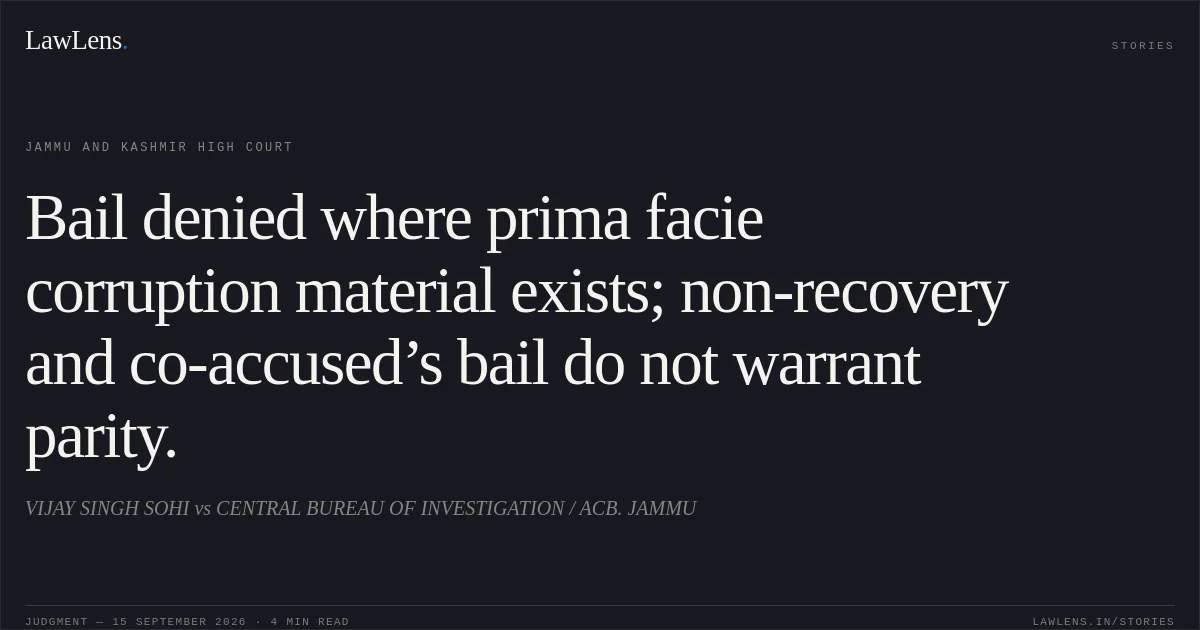
The applicant sought regular bail under Section 483 of the Bharatiya Nagarik Suraksha Sanhita, 2023, in FIR No. RC0042026A0007 registered by the CBI/ACB, Jammu, for an offence under Section 7 of the Prevention of Corruption Act, 1988, read with Section 61 of the Bharatiya Nyaya Sanhita, 2023.
Source reference: para. 1The prosecution alleged that the applicant, a public servant, demanded ₹15,000 from the complainant for conducting a mandatory physical inspection of his clinic in connection with the release of a ₹5 lakh subsidy.
Source reference: para. 2During the trap proceedings, the applicant allegedly demanded and accepted the bribe in a Maruti Baleno vehicle while accompanied by co-accused Mukesh Kumar.
Source reference: paras. 2–3The applicant allegedly fled upon seeing the CBI Trap Team, while Mukesh Kumar was apprehended and the tainted currency was recovered from his possession.
Source reference: para. 3The vehicle was subsequently located on the basis of information allegedly furnished by the applicant, and phenolphthalein traces were reportedly detected in its dashboard compartment.
Source reference: para. 3The applicant surrendered on 25 July 2026, and his application for regular bail was rejected by the Special Judge, Anti-Corruption (CBI Cases), Jammu, on 1 August 2026.
Source reference: para. 4The co-accused had previously been granted bail on 29 July 2026.
Source reference: para. 4Issues
Whether the applicant was entitled to regular bail where the tainted money was recovered from the co-accused rather than from his personal possession, but the prosecution relied on material indicating demand, presence during the trap, association with the co-accused, the recorded conversation, and discovery of the vehicle containing phenolphthalein traces?
Source reference: paras. 21–22, 33Whether the applicant could claim bail on the ground of parity with the co-accused who had already been released on bail, despite the allegedly distinct role attributed to the applicant as the public servant who demanded and accepted the gratification?
Source reference: paras. 34–35Whether the stage of investigation, the alleged flight from the trap spot, and the apprehension of interference with witnesses or the investigation justified continued custody?
Source reference: paras. 28–30, 37Whether any material change in circumstances had been shown after the applicant’s bail application was rejected by the Trial Court?
Source reference: paras. 8–9, 35Law Applied
The Court applied Section 483 of the Bharatiya Nagarik Suraksha Sanhita, 2023, governing the High Court’s power to grant regular bail, along with Section 7 of the Prevention of Corruption Act, 1988, read with Section 61 of the Bharatiya Nyaya Sanhita, 2023.
Source reference: para. 1At the bail stage, the Court must examine whether there are reasonable or prima facie grounds for believing that the accusation has substance, without conducting a meticulous appreciation of evidence or determining guilt.
Source reference: paras. 16, 19–20Relying on Prasanta Kumar Sarkar v. Ashis Chatterjee, (2010) 14 SCC 496, and Central Bureau of Investigation v. V. Vijay Sai Reddy, (2013) 7 SCC 452, the Court considered the nature and gravity of the accusation, severity of punishment, likelihood of absconding, possibility of witness tampering, and the broader interests of justice.
Source reference: paras. 17–20The Court also relied on Nimmagadda Prasad v. Central Bureau of Investigation, (2013) 7 SCC 466, regarding the serious treatment warranted by economic and financial offences; Mohd. Ishaq Bhat v. Central Bureau of Investigation, Bail App. No. 131/2024, concerning the possibility of influence in corruption cases; Darbara Singh v. Union Territory of J, Bail App. No. 39/2021, concerning bail at the nascent stage of investigation; and Mahipal v. Rajesh Kumar @ Polia, (2020) 2 SCC 118, concerning prima facie assessment and balancing of bail considerations.
Source reference: paras. 24–25, 28, 31Reasoning
The Court held that the absence of recovery of the tainted money from the applicant was not decisive because the prosecution alleged that he was the public servant who made the principal demand and participated in the transaction.
Source reference: paras. 21–22, 33The recorded conversation, his alleged presence at the trap, association with the co-accused, discovery of the vehicle on the basis of his information, and the reported phenolphthalein reaction constituted prima facie material that could not be disregarded at the bail stage.
Source reference: paras. 21–22, 33The allegation also involved abuse of public office for private gain, making the nature of the accusation particularly serious.
Source reference: paras. 23, 26–27Parity was rejected because the applicant’s alleged role was materially different from that of the co-accused: the applicant was the public servant allegedly demanding and accepting gratification, whereas the co-accused was alleged to have assisted or accompanied him.
Source reference: para. 34Further, the co-accused’s bail order was already available when the Trial Court rejected the applicant’s bail application; therefore, its existence did not constitute a subsequent change in circumstances.
Source reference: para. 35Since the investigation remained at an early stage, material witnesses were yet to be examined, and the applicant had allegedly fled from the trap spot before later surrendering, the apprehension of interference with the investigation or witnesses was found to be substantiated.
Source reference: para. 29The applicant’s lack of antecedents, period of custody, and the maximum punishment of seven years were considered but were insufficient to outweigh the prima facie material, seriousness of the allegations, distinct role, and investigative concerns.
Source reference: para. 36Holding
The Court answered the issues against the applicant. It held that non-recovery of the tainted money from the applicant did not negate the prima facie case; parity with the co-accused was unavailable because of the applicant’s distinct role; and the early stage of investigation and risk of interference justified continued custody.
Finding no material change in circumstances or ground warranting interference with the Trial Court’s order, the Court dismissed the application for regular bail.
Source reference: paras. 38–39The observations were expressly confined to the bail proceedings and were not to affect the merits of the trial.
Source reference: paras. 38–39Acts & Sections Cited
3 provisions across 3 statutes referred to in this judgment. Each provision opens on LawLens.
Bharatiya Nagarik Suraksha Sanhita, 20231
Prevention of Corruption Act, 19881
Bharatiya Nyaya Sanhita, 20231
Original Court PDF
VIJAY SINGH SOHIvsCENTRAL BUREAU OF INVESTIGATION / ACB. JAMMU
Click to open original judgment
Original judgment, available to read, download and summarize on LawLens.in