Facts
The Lokayukta Police registered Crime No. 4 of 2026 against the petitioner for an alleged offence under Section 7(a) of the Prevention of Corruption Act, 1988.
Source reference: pp. 2–4The complainant alleged that the petitioner demanded a bribe of ₹7,00,000, later reduced to ₹6,50,000, for making entries in revenue records concerning land.
Source reference: pp. 2–4The complainant stated that he recorded an earlier conversation and approached the Lokayukta Police on 24 August 2026.
Source reference: pp. 2–4During the trap on 25 August 2026, the complainant allegedly placed ₹3,00,000 in a cover on the petitioner’s table and signalled the police, who entered and apprehended him.
Source reference: pp. 2–4The petitioner was arrested and remanded to judicial custody; the Sessions Court rejected his bail application on 31 August 2026.
Source reference: pp. 2–4He then sought regular bail before the High Court under Section 483 of the Bharatiya Nagarik Suraksha Sanhita, 2023.
Source reference: pp. 2–4Issues
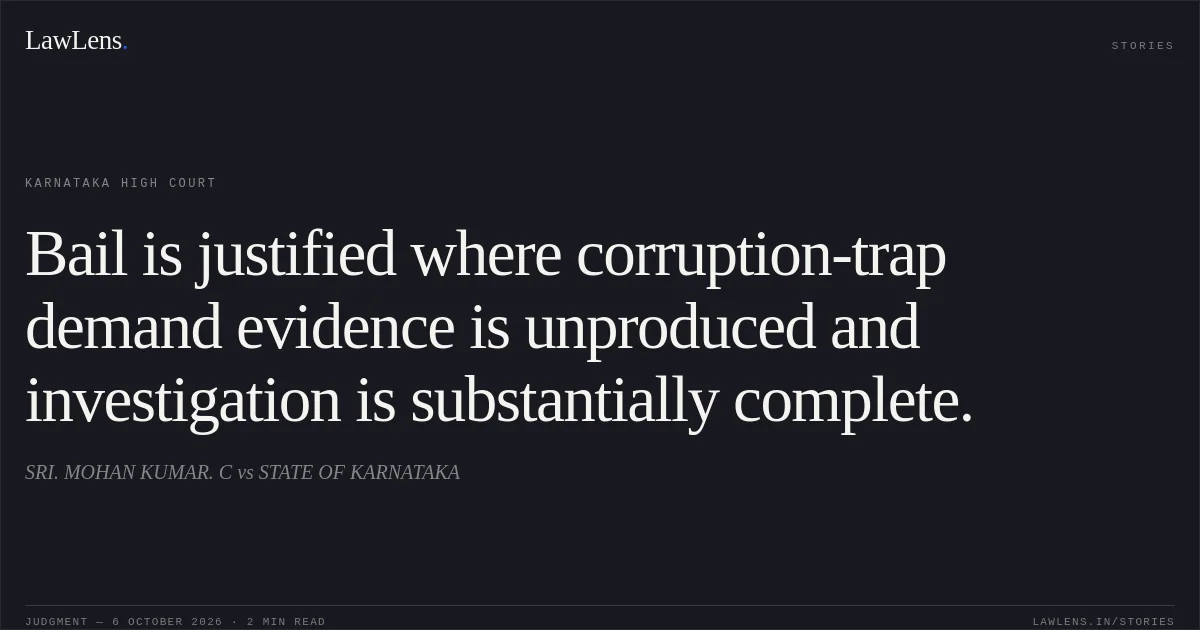
Whether the petitioner should be enlarged on regular bail in the case alleging an offence under Section 7(a) of the Prevention of Corruption Act, 1988
Source reference: pp. 2, 6–7Whether the circumstances of the alleged trap, the available recorded evidence, the stage of investigation, and the petitioner’s period in custody supported granting bail
Source reference: pp. 5–6Law Applied
The Court considered the petitioner’s application for regular bail under Section 483 of the Bharatiya Nagarik Suraksha Sanhita, 2023, in a prosecution under Section 7(a) of the Prevention of Corruption Act, 1988 (as amended in 2018).
Source reference: pp. 2, 6It noted that the maximum punishment for the alleged offence was seven years’ imprisonment and considered the circumstances of the trap, the investigation’s progress, and the petitioner’s custody in deciding whether to grant bail
Source reference: pp. 2, 6The order cites no precedents or further doctrinal test
Source reference: no citationReasoning
The Court observed that, according to the remand application, the complainant had left the money on the petitioner’s table and signalled the police after leaving the office.
Source reference: pp. 5–6The conversation between the complainant and the petitioner inside the office on the day of the trap had not been recorded, and the Court had not been provided with a transcription of the earlier recording said to capture the alleged demand.
Source reference: pp. 5–6The Court also considered that much of the investigation in a trap case is completed on the day of the trap, the maximum punishment was seven years, and the petitioner had been in custody for more than a month.
Source reference: pp. 5–6On those circumstances, it found bail appropriate
Source reference: pp. 5–6Holding
The High Court allowed the petition and directed that the petitioner be released on bail in Crime No. 4 of 2026.
Conditions included executing a personal bond of ₹1,00,000 with two sureties for the like sum, regularly attending trial, not threatening or tampering with prosecution witnesses, and not becoming involved in similar offences.
Source reference: pp. 6–7Acts & Sections Cited
3 provisions across 3 statutes referred to in this judgment. Each provision opens on LawLens.
Code of Criminal Procedure, 19731
Bharatiya Nagarik Suraksha Sanhita, 20231
Prevention of Corruption Act, 19881
Original Court PDF
SRI. MOHAN KUMAR. CvsSTATE OF KARNATAKA
Click to open original judgment
Original judgment, available to read, download and summarize on LawLens.in