01Facts
The petitioner, Member Secretary of the Town Planning Authority, Manvi, is accused No. 1 in Crime No. 5/2026 of Raichur Lokayukta Police, registered for an offence under Section 7(a) of the Prevention of Corruption Act, 1988.
p. 2The complainant and his brother sought conversion of their land from garden area to commercial use before the Authority, which published a notification on 27.06.2026.
pp. 3–4The prosecution alleges that on 06.10.2026 and 13.10.2026 the petitioner demanded ₹3,50,000 as illegal gratification to process the pending work.
pp. 4–5The complainant lodged a complaint on 15.10.2026. During a trap, he handed ₹3,00,000 to accused No. 2 on the petitioner's instruction, and both were arrested.
pp. 5–6The petitioner has been in judicial custody since 16.10.2026, about one month as of the order.
p. 8The Special Judge granted anticipatory bail to accused No. 2 by order dated 07.11.2026 in Crl. Misc. No. 685/2026.
pp. 7–8The petitioner filed this petition under Section 483 BNSS seeking regular bail. The Special Public Prosecutor filed objections seeking dismissal.
p. 302Issues
i.1. Whether the petitioner is entitled to regular bail under Section 483 BNSS, pending completion of investigation, in a case under Section 7(a) of the PC Act where the offence is not punishable with death or life imprisonment.
¶ 5–6 · pp. 6–7ii.2. Whether the parity of bail granted to co-accused No. 2 and the petitioner's permanent employment and lack of antecedents warrant bail, and whether the prosecution's apprehensions can be met by conditions.
¶ 7–8 · pp. 7–8 · ¶ 10 · p. 903Law Applied
Section 483 of the BNSS, 2023, which governs the grant of bail by the High Court and Sessions Courts, was applied as the procedural basis for the petition.
p. 2The settled principle that "bail is rule and jail is an exception," and that an accused should not remain in judicial custody at the pre-trial stage as punishment.
p. 8The gravity of the offence under Section 7(a) of the Prevention of Corruption Act, 1988, noting that the maximum punishment is seven years' imprisonment and that the offence is triable by the Special Judge, so it is not punishable with death or life imprisonment.
pp. 6–7The absence of antecedents and the petitioner's permanent employment within the Special Court's jurisdiction are relevant to bail.
p. 7The principle of parity, treating bail granted to co-accused No. 2 as a factor.
p. 8The prosecution's apprehensions may be met by imposing suitable conditions under the bail framework.
p. 9The judgment cites no specific precedents.
Provisions in the judgment · 2 · Linked ones open on LawLens
Bharatiya Nagarik Suraksha Sanhita, 2023 Section 483
Prevention of Corruption Act, 1988 Section 7
04Reasoning
The prosecution's contention that the investigation is at an initial stage, and the petitioner's denial of guilt, did not warrant detailed consideration at the bail stage, since the existence of a prima facie case was assumed for argument's sake.
¶ 5 · p. 6Because the offence carries a maximum of seven years and the petitioner was not shown to have prior antecedents, the court found no reason to continue pre-trial detention.
¶ 6–7 · pp. 6–7The allegation against accused No. 2 is materially similar, and the Special Judge had already granted him anticipatory bail, so denying bail to the petitioner would be inconsistent.
¶ 8 · pp. 7–8The remand record showed that custodial interrogation was no longer required for further investigation, which weighed against continued custody.
¶ 9 · p. 8The prosecution's concerns about tampering with witnesses or hampering investigation could be met through conditions, and the Respondent disclosed no special ground to deny bail.
¶ 10 · p. 905Holding
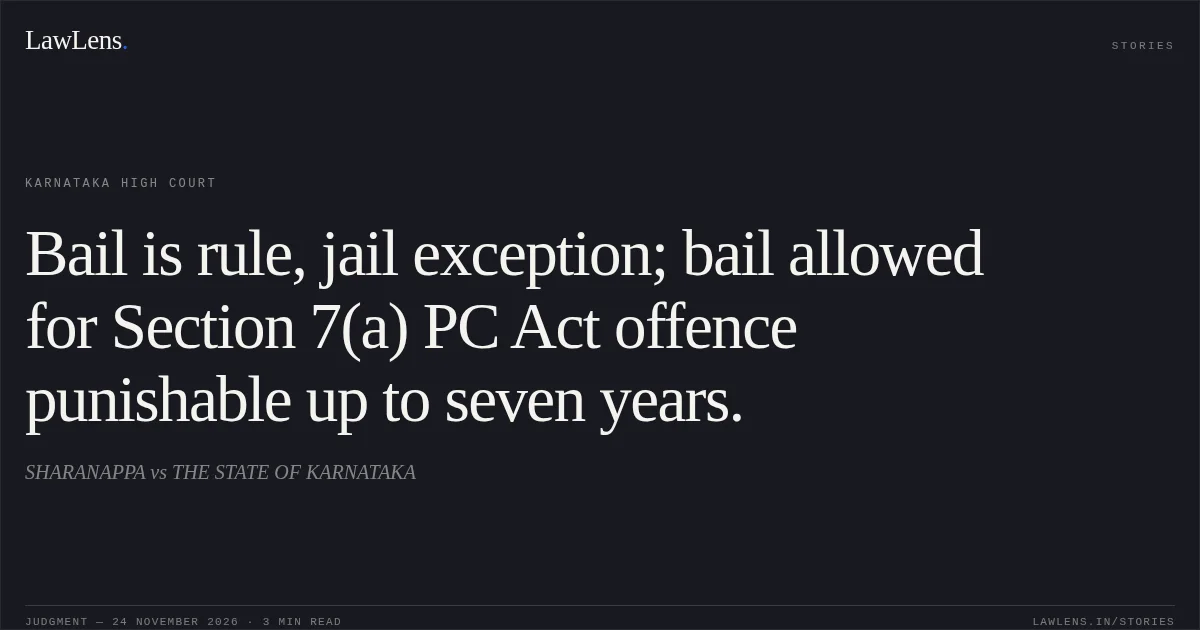
The petitioner had made out sufficient grounds for regular bail, and the petition is allowed.
¶ 10–11 · p. 9The petitioner is to be enlarged on bail in Crime No. 5/2026 on executing a personal bond for ₹2,00,000 with two sureties of the same amount, to the satisfaction of the Special Judge, Raichur. The bail is subject to conditions that the petitioner: (a) appear before the Investigating Officer as required until the final report is filed and assist in further investigation; (b) appear before the trial court as directed and assist in the trial; (c) not tamper with prosecution witnesses or hamper the investigation; and (d) not commit similar or any offence during the pendency of the case. Any breach of these conditions will result in cancellation of bail.
¶ 11(a)–(d) · pp. 9–10 · p. 10Original Court PDF
SHARANAPPAvsTHE STATE OF KARNATAKA
Click to open original judgment
Original judgment, available to read, download and summarize on LawLens.in