Facts
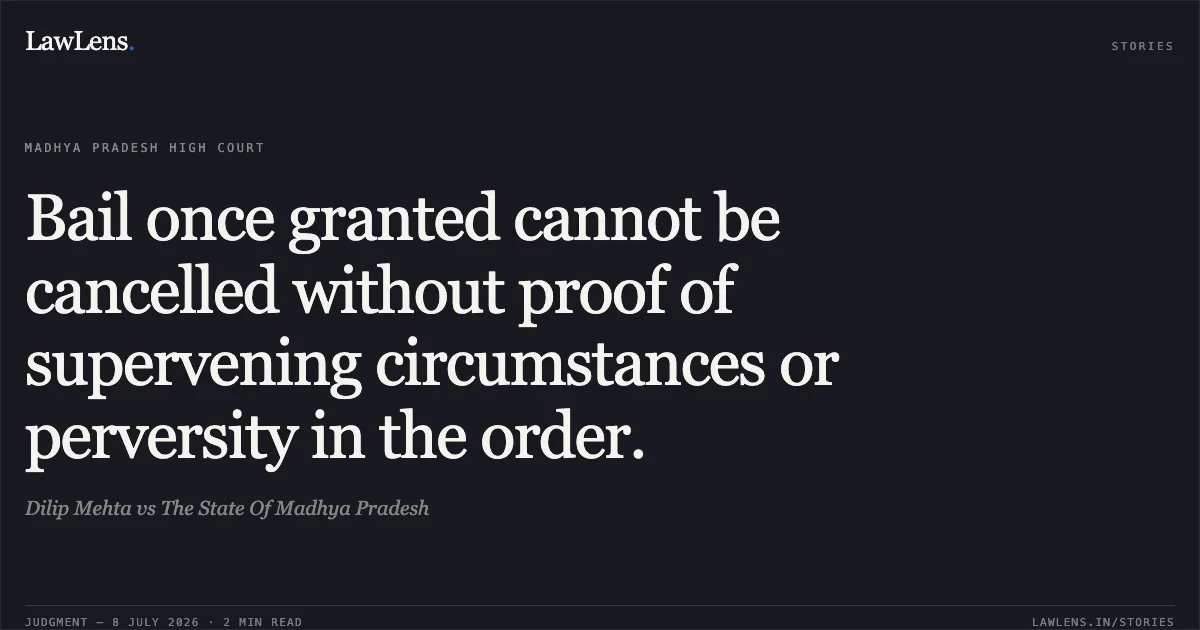
The applicant, Dilip Mehta, filed a petition under Section 439(2) of the Cr.P.C. seeking the cancellation of bail granted to respondent No. 2, Virendra Patel, by the Sessions Court on February 9, 2024.
Source reference: para 1The prosecution alleged that respondent No. 2 conspired to execute a forged power of attorney and agreement to sale dated January 21, 2009, by impersonating the actual landowner's identity through forged PAN and Voter ID cards.
Source reference: para 2The applicant contended that the Sessions Court failed to consider the respondent's criminal history (FIR No. 243/2011) and the fraudulent nature of the documents used to secure a decree for specific performance in a Lok Adalat.
Source reference: para 4, 6Procedurally, the respondent was arrested on September 20, 2023, and granted bail after the final report was filed, on the grounds that the dispute appeared primarily civil in nature.
Source reference: para 2, 5Issues
1. Whether the Sessions Court exercised its discretion in a perverse or irrational manner by granting bail while allegedly ignoring the gravity of the fraud and the respondent’s criminal antecedents.
Source reference: para 62. Whether there exist any supervening circumstances or evidence of misuse of liberty that warrant the cancellation of the bail already granted.
Source reference: para 14Law Applied
The court applied Section 439(2) of the Cr.P.C. regarding the cancellation of bail.
Source reference: para 1It relied on the principles established globally in Deepak Yadav v. State of Uttar Pradesh [para 9], Dolat Ram v. State of Haryana [para 11], and Ajwar v. Waseem [para 13]. These precedents establish that: (a) there is a distinct difference between the criteria for rejecting bail and cancelling it; (b) bail once granted should not be cancelled in a mechanical manner unless there are "very cogent and overwhelming circumstances"; and (c) cancellation is justified if the order is "perverse," "unreasoned," ignores "relevant material," or if the accused "misuses the liberty".
Source reference: para 9-13Reasoning
The High Court examined whether the Sessions Court’s order suffered from non-application of mind. It noted that the learned Additional Sessions Judge had indeed considered the history of civil litigation between the parties, the completion of the investigation, and the fact that the respondent is a permanent resident of Jabalpur with no immediate risk of absconding.
Source reference: para 14The court found that because both parties were actively litigating the title and the validity of the documents across various civil forums up to the Supreme Court, the Sessions Court’s observation that the matter had a "civil nature" was not perverse or irrelevant.
Source reference: para 7, 14Furthermore, the court observed that the applicant failed to demonstrate any "supervening circumstances," such as the respondent tampering with evidence, threatening witnesses, or violating bail conditions post-release.
Source reference: para 14Holding
The court held that no case was made out for the cancellation of bail, as the impugned order dated February 9, 2024, was based on a reasoned assessment of the case diary and the completed investigation.
The court emphasized that the power to cancel bail must be exercised with "extreme care and circumspection" and cannot be used as a disciplinary proceeding. Consequently, the application (M.Cr.C. No. 9066/2024) was dismissed.
Source reference: para 12, 16Acts & Sections Cited
6 provisions across 2 statutes referred to in this judgment. Each provision opens on LawLens.
Code of Criminal Procedure, 19732
Indian Penal Code, 18604
Original Court PDF
Dilip MehtavsThe State Of Madhya Pradesh
Click to open original judgment
Original judgment, available to read, download and summarize on LawLens.in