Facts
The complainant alleged that, on 29 May 2025, several persons including accused No. 2 trespassed onto his property, kidnapped him, stole articles and assaulted him. A case was registered and investigation was ongoing.
Source reference: p.3Accused No. 2 first obtained anticipatory bail on 12 May 2026 and later regular bail under Section 483 of the Bharatiya Nagarik Suraksha Sanhita, 2023, by an order dated 25 June 2026.
Source reference: pp.3–5The complainant challenged the regular-bail order, contending that the Special Court had granted bail without notifying him or hearing his objections, as required by the SC/ST (Prevention of Atrocities) Act, 1989.
Source reference: pp.4–6Issues
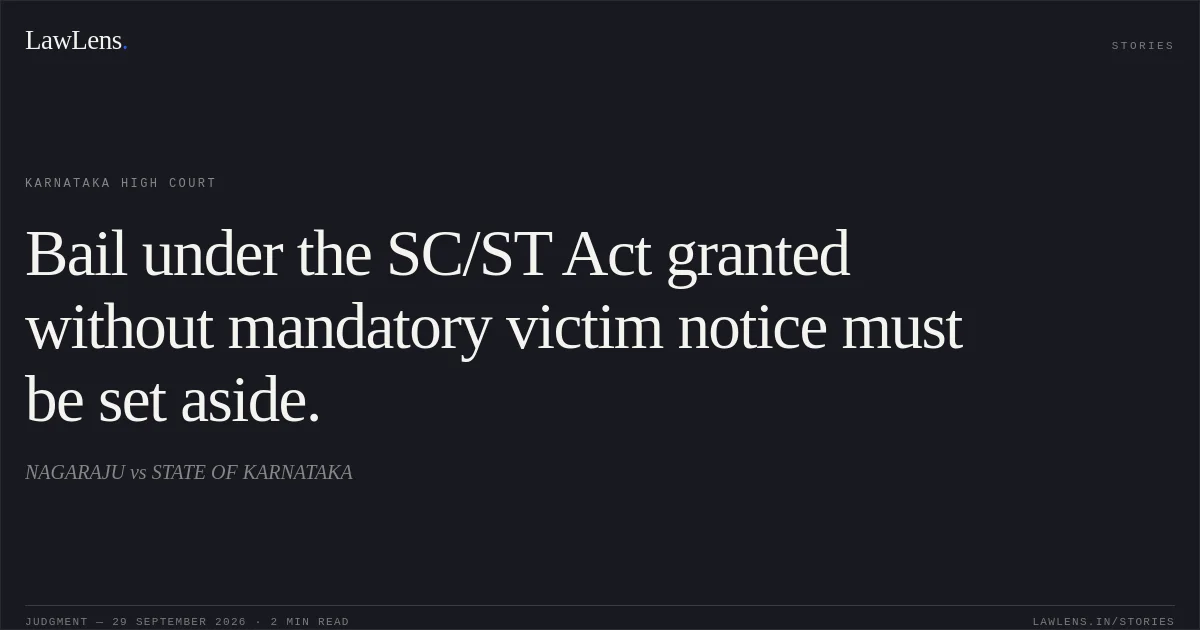
Whether the Special Court’s regular-bail order should be set aside because the complainant was not notified and heard before bail was granted under the SC/ST (Prevention of Atrocities) Act, 1989
Source reference: pp.4–5, 9Whether the order was liable to be annulled as procedurally unlawful, notwithstanding the principle that bail should not be interfered with mechanically
Source reference: pp.9–10, 18Law Applied
Sections 15A(3) and 15A(5) of the SC/ST (Prevention of Atrocities) Act, 1989, require the victim or dependent to be notified of relevant proceedings and afford the victim an opportunity to be heard, including in bail proceedings.
Source reference: pp.3–4, 9Section 14A(2) of that Act provides the appellate route invoked in this case.
Source reference: p.2The Court relied on Lakshmanan v. State Through the Deputy Superintendent of Police and Others, 2025 Live Law (SC) 1245, for the distinction between cancellation of bail, generally based on supervening circumstances or post-bail misconduct, and annulment of a bail order that is vitiated by illegality, arbitrariness, perversity or non-application of mind.
Source reference: pp.9–10An order granting bail may be set aside where the court has failed to consider a mandatory legal requirement or relevant material.
Source reference: pp.12–18Reasoning
The High Court found from the order dated 25 June 2026 that notice had not been issued to the complainant before regular bail was considered.
Source reference: p.9It treated notification and an opportunity to object as mandatory under Sections 15A(3) and 15A(5), and, applying Lakshmanan, held that setting aside an order vitiated by procedural illegality is distinct from cancelling bail because of later misconduct.
Source reference: pp.9–10, 18The Court therefore set aside the order on the notice-related ground; it did not determine the merits of the competing claims concerning the property or the allegations against accused No. 2.
Source reference: pp.6–8, 18–19Holding
The appeal was allowed, and the Special Court’s order dated 25 June 2026 granting regular bail to accused No. 2 was set aside.
Accused No. 2 was permitted to file a regular-bail application, and the Special Court was directed to notify the complainant and then pass an appropriate order in accordance with law.
Source reference: p.19Acts & Sections Cited
21 provisions across 4 statutes referred to in this judgment. Each provision opens on LawLens.
Scheduled Castes and the Scheduled Tribes (Prevention of Atrocities) Act, 19892
Bharatiya Nyaya Sanhita, 2023
Code of Criminal Procedure, 19731
Original Court PDF
NAGARAJUvsSTATE OF KARNATAKA
Click to open original judgment
Original judgment, available to read, download and summarize on LawLens.in