Facts
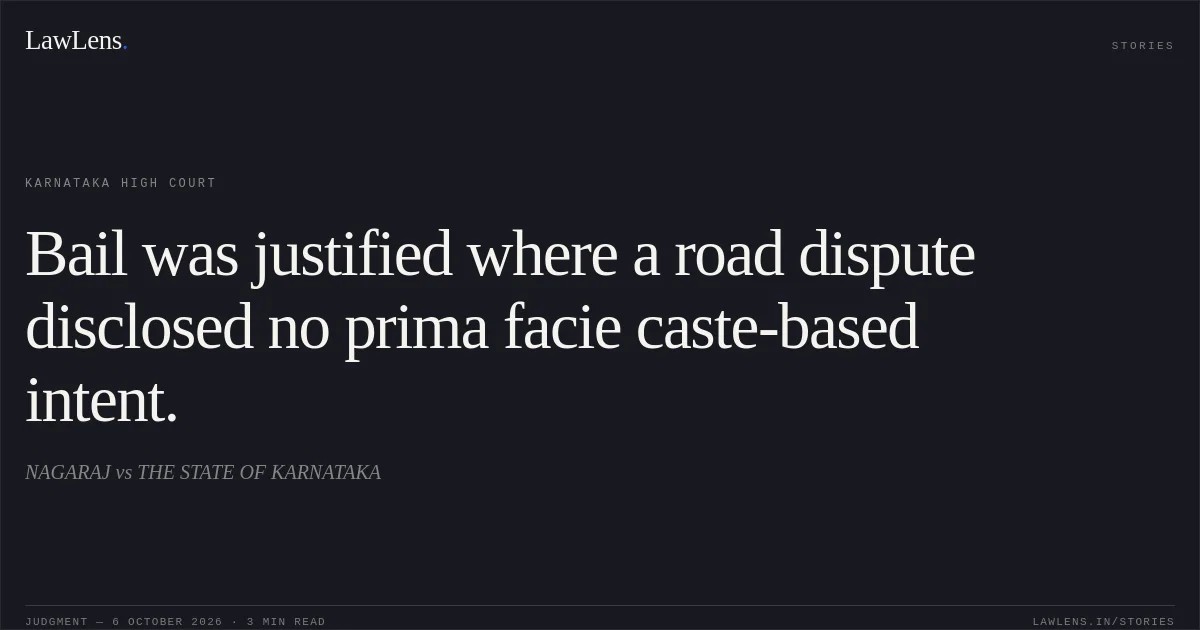
The appellant, accused No. 2, appealed under Section 14A(2) of the Scheduled Castes and Scheduled Tribes (Prevention of Atrocities) Act, 1989, challenging the Sessions Court’s refusal to grant regular bail in Crime No. 139/2026.
Source reference: p. 2–3, para. 2The case arose from a dispute over road widening and alleged encroachments.
Source reference: p. 3–5, para. 3The complainant alleged that the appellant and others assaulted him, his brother, and others with weapons, caused injuries, and used caste slurs.
Source reference: p. 3–5, para. 3The State and complainant opposed bail, citing the seriousness of the allegations, the ongoing investigation, and concerns about witness intimidation.
Source reference: p. 5–7, paras. 4–6The appellant relied on the road-widening dispute, the absence of an intention to humiliate anyone on caste grounds, a counter-case, and the grant of anticipatory bail to co-accused.
Source reference: p. 7–8, paras. 7–8Issues
1. Whether the material at the bail stage disclosed a prima facie case under the SC/ST (Prevention of Atrocities) Act against the appellant.
Source reference: p. 9, para. 92. Whether the appellant had established grounds for setting aside the refusal of bail and being released on regular bail, notwithstanding the ongoing investigation and the objections raised by the State and complainant.
Source reference: p. 9–13, paras. 10–17Law Applied
Section 14A(2) of the SC/ST (Prevention of Atrocities) Act provides for an appeal against an order concerning bail under the Act.
Source reference: p. 2–3, para. 2The Court considered the offences alleged under Sections 109(1), 115(2), 118(1), 118(2), 189(2), 190, 191(2), 191(3), 329(4), 351(2), 351(3), 352 and 54 of the Bharatiya Nyaya Sanhita, 2023, and Sections 3(1)(r), 3(1)(s), 3(1)(w)(i) and (ii), and 3(2)(v) of the SC/ST Act.
Source reference: p. 2–3, para. 2The Court applied the principles that bail is the rule and jail the exception, that pre-trial custody is not to operate as punishment, and that risks to investigation or witnesses may be addressed through appropriate bail conditions.
Source reference: p. 11–12, paras. 14–15It also considered the absence of a death-punishable offence, the appellant’s lack of known antecedents, and parity with co-accused who had been granted anticipatory bail.
Source reference: p. 9–10, paras. 10–11; p. 12–13, paras. 16–17Reasoning
The Court considered the road-widening dispute to be the apparent genesis of the incident and found no prima facie material at that stage showing that the appellant intended to insult or humiliate the complainant or others by reason of caste; it therefore found no reason to believe that the SC/ST Act offences were made out against him for purposes of the bail decision.
Source reference: p. 9, para. 9It also noted that the appellant was a permanent resident within the trial court’s jurisdiction, had no disclosed antecedents, and that the injured persons had been discharged from hospital.
Source reference: p. 10, para. 11; p. 10–11, para. 12Although investigation remained incomplete, the State had shown no special ground requiring continued detention; the Court considered that the concerns about cooperation and witness interference could be met by conditions.
Source reference: p. 11–12, paras. 13–14The similar allegations against co-accused who had received anticipatory bail further supported release on parity.
Source reference: p. 12–13, paras. 16–17Holding
The Court allowed the appeal and set aside the Sessions Court’s order dated 12 August 2026.
It directed that the appellant be released on bail on executing a personal bond of ₹2,00,000 with two sureties for the like sum.
Source reference: p. 13–14, para. 18Bail was subject to conditions requiring cooperation with the investigation, appearance before the relevant courts when directed, non-interference with the investigation or prosecution witnesses, and no commission of similar or other offences during the case; the complainant or police may seek cancellation if the conditions are violated.
Source reference: p. 14–15, para. 18Acts & Sections Cited
12 provisions across 3 statutes referred to in this judgment. Each provision opens on LawLens.
Scheduled Castes and the Scheduled Tribes (Prevention of Atrocities) Act, 19891
Bharatiya Nagarik Suraksha Sanhita, 20231
Bharatiya Nyaya Sanhita, 2023
Original Court PDF
NAGARAJvsTHE STATE OF KARNATAKA
Click to open original judgment
Original judgment, available to read, download and summarize on LawLens.in