Facts
The petitioner, a U.S. citizen, and respondent No. 4, an Indian citizen, married in Washington, where their son was born in February 2024 and acquired U.S. citizenship.
Source reference: pp. 3–5, 12–13When the child was nine months old, respondent No. 4 brought him to India; the petitioner alleged this was contrary to Washington court orders, including subsequent directions for the child’s return and the petitioner’s exclusive care.
Source reference: pp. 3–5, 12–13Respondent No. 4 disputed the alleged unlawful removal, relied on the child’s welfare and her caregiving, and noted that custody proceedings were pending before the Bengaluru Family Court.
Source reference: pp. 8–12The petitioner sought habeas corpus for the child’s production and return to the United States.
Source reference: pp. 3–5Issues
Whether the child’s continued custody with respondent No. 4 in India warranted habeas corpus and an order for his return to the United States, having regard to the child’s welfare and the Washington court orders.
Source reference: pp. 13–14, 18–20Whether the pending custody proceedings before the Bengaluru Family Court precluded the High Court from directing the child’s return to the United States.
Source reference: pp. 18–20Law Applied
In child-custody habeas proceedings, the child’s welfare and best interests are paramount and must be assessed on the totality of the circumstances; comity of courts does not, by itself, determine custody (Nithya Anand Raghavan v. State of NCT of Delhi).
Source reference: p. 13The court also considered the principle that custody of a child below five would ordinarily be with the mother, subject to the child’s welfare and the circumstances of the case (Roxann Sharma v. Arun Sharma).
Source reference: p. 14The authorities discussed further recognize that a foreign custody order is relevant but does not displace the welfare inquiry (Sarita Sharma v. Sushil Sharma; Nithya Anand Raghavan).
Source reference: pp. 10, 13Decisions including Yashita Sahu v. State of Rajasthan, Mrs. Elizabeth Dinshaw v. Arvand M. Dinshaw, and Lahari Sakhamuri v. Sobhan Kodali address return of children removed across borders, the significance of the child’s original residence and foreign proceedings, and the court’s duty to decide by reference to the child’s welfare.
Source reference: pp. 15–18The petition was brought under Articles 226 and 227 of the Constitution.
Source reference: p. 2Reasoning
The Court acknowledged that welfare, rather than comity alone, governed the inquiry.
Source reference: p. 13It nevertheless found the child had been born in the United States, was a U.S. citizen, and had been taken from that country to India while foreign custody proceedings were underway; respondent No. 4 was participating in those proceedings, and the Washington court had considered her position.
Source reference: pp. 12–13, 18–19The Court found no material indicating imminent danger to the child from his father and held that respondent No. 4’s Bengaluru custody petition did not alter the circumstances of the child’s removal or make India his ordinary residence.
Source reference: pp. 18–20On those facts, it concluded that the child and respondent No. 4 should return to the United States so that the custody dispute could be pursued before the competent court there.
Source reference: pp. 19–21Holding
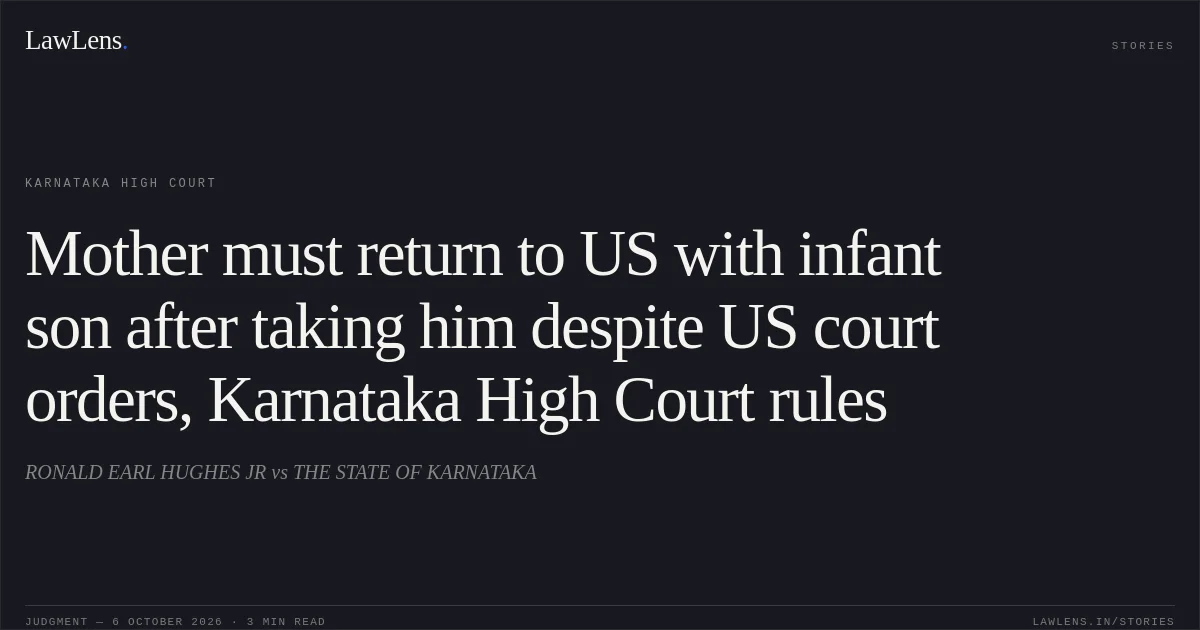
The High Court allowed the writ petition and directed respondent No. 4 to return to the United States with the child to pursue her rights before the competent court there.
The petitioner was directed to arrange and pay for their travel, visa-related expenses, and respondent No. 4’s necessary expenses until she obtained suitable employment and accommodation in the United States; he was also to file an affidavit undertaking those obligations.
Source reference: p. 20The parties’ remaining contentions were left open for determination by the competent U.S. court.
Source reference: p. 21Original Court PDF
RONALD EARL HUGHES JRvsTHE STATE OF KARNATAKA
Click to open original judgment
Original judgment, available to read, download and summarize on LawLens.in