01Facts
The Police Inspector, Gandhi Nagar Police Station, Ballari, applied under Section 55(A) of the Karnataka Police Act, 1963 (“KP Act”) for action against the petitioner, alleging that she procured women from other States for sexual activities.
p. 2 · ¶ 2–3Following a show-cause notice, the Superintendent of Police and Special Executive Magistrate, Ballari, made an externment order dated 29 July 2026, directing the petitioner to reside in the jurisdiction of Bantwal Police Station, South Kanara District.
p. 2 · ¶ 2–3The petitioner challenged the order, contending, among other things, that the Superintendent of Police lacked statutory authority to make it.
pp. 3–5 · ¶ 4–9The State opposed the petition and relied on the criminal cases registered against her.
pp. 3–5 · ¶ 4–902Issues
i.Whether the Superintendent of Police and Special Executive Magistrate was statutorily competent to pass the externment order under the KP Act.
p. 6 · ¶ 1503Law Applied
The Court considered Section 55(A) of the KP Act, under which the impugned externment order had been made, and the requirement that the order be made by an authority possessing the statutory power to do so.
p. 2, 6 · ¶ 1, 15Relying on Chandrakant Shankar Vaddar v. State of Karnataka, W.P. No. 104096/2026, and Mahesh S/o Pandu Rathod v. State of Karnataka, W.P. No. 204081/2026, the Court applied the principle that an executive notification cannot enlarge a statutory description of an authority to include an officer outside the class contemplated by the legislature; an officer lacking the requisite statutory authority cannot make an externment order under the KP Act.
pp. 5–6 · ¶ 10–13Provisions in the judgment · 7 · Linked ones open on LawLens
Code of Criminal Procedure, 1973 Section 397Section 401
Bharatiya Nagarik Suraksha Sanhita, 2023 Section 4Section 38Section 442
KARNATAKA POLICE ACT, 1963. Section 55Section 58
04Reasoning
The petitioner’s jurisdictional objection was supported by the cited decisions concerning the limits of an officer’s statutory authority.
pp. 6–7 · ¶ 14–16The Court held that those principles applied to the circumstances of this case and accepted the contention that respondent No. 2 lacked the requisite statutory authority.
pp. 6–7 · ¶ 14–16Since the externment order was made by an authority without jurisdiction, it could not be sustained.
pp. 6–7 · ¶ 14–16The Court did not decide the petitioner’s separate procedural objections concerning the notice and inquiry.
pp. 6–7 · ¶ 14–1605Holding
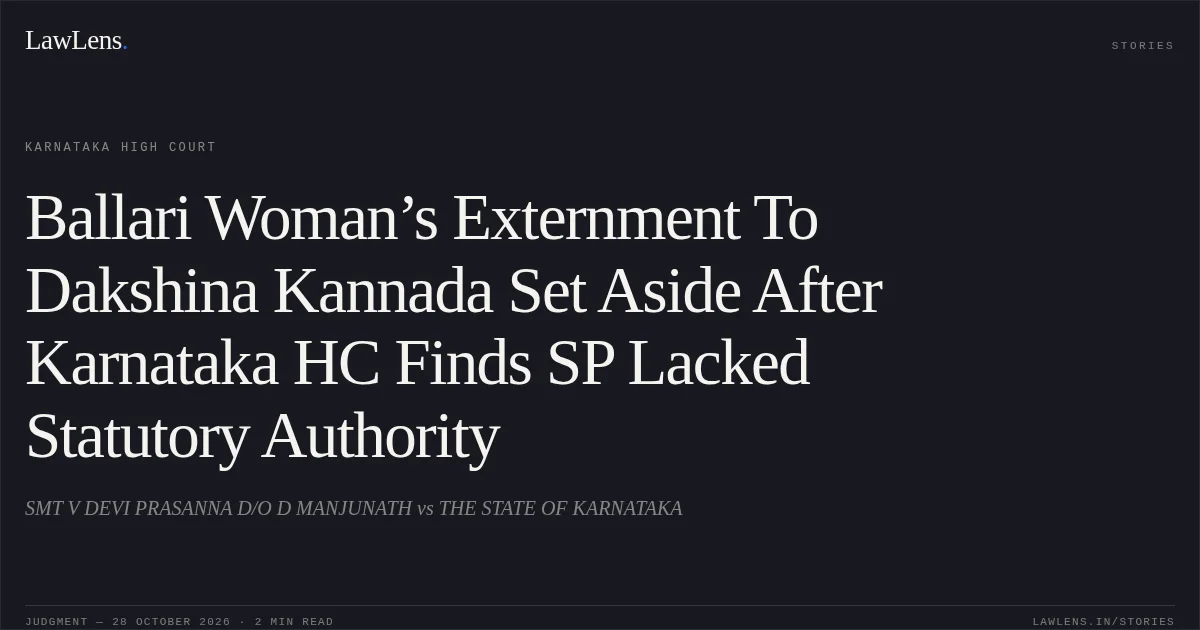
The Court answered the question of competence against the State, allowed the petition, and set aside the externment order dated 29 July 2026.
p. 7, orderIt clarified that the order did not prevent the competent statutory authority from taking action in accordance with the KP Act and its applicable requirements.
p. 8, orderOriginal Court PDF
SMT V DEVI PRASANNA D/O D MANJUNATHvsTHE STATE OF KARNATAKA
Click to open original judgment
Original judgment, available to read, download and summarize on LawLens.in