Facts
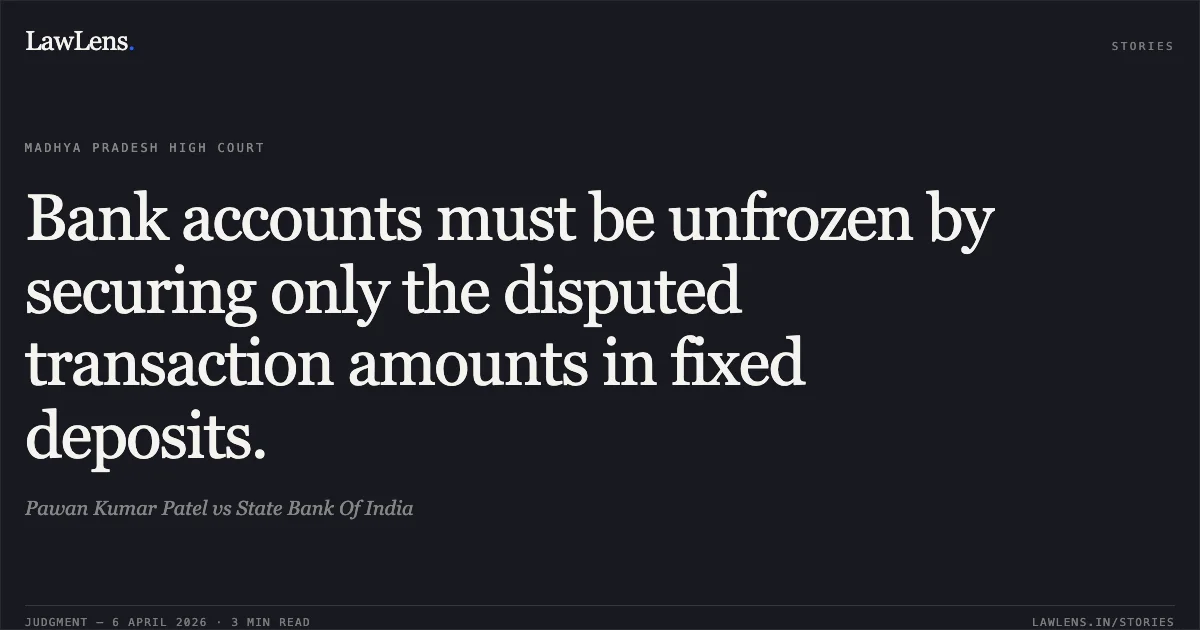
The petitioner, Pawan Kumar Patel, filed a writ petition under Article 226 of the Constitution of India seeking a writ of mandamus to de-freeze his service bank account (No. 10238082515) held at the State Bank of India, SME Naya Gaon, Jabalpur
Source reference: para. 1The petitioner argued that his case was identical to the matter of Malcolm Murayis & Ors. v. State Bank of India and Others (W.P. No. 1100 of 2024), wherein bank accounts were frozen by cyber cells of various police stations across different states on allegations of cyber fraud without issuing prior notice to the account holders or complying with statutory procedures
Source reference: para. 2-3The procedural history of the relied-upon precedent indicated that despite court notices, investigative agencies often failed to respond or show compliance with the mandate of informing the Magistrate about such seizures
Source reference: para. 3Issues
1. Whether the petitioner’s bank account should be de-frozen based on the parity of the decision rendered in Malcolm Murayis & Ors. v. State Bank of India
Source reference: para. 42. What conditions should be imposed on disputed funds within a frozen account to balance investigative requirements with the account holder's rights
Source reference: para. 5Law Applied
The Court applied the principles of Article 226 of the Constitution of India concerning the High Court's power to issue directions for the protection of legal rights
Source reference: para. 1It relied heavily on the procedural requirements of Section 102 of the Code of Criminal Procedure (Cr.P.C.), now substituted by relevant provisions of the Bharatiya Nagarik Suraksha Sanhita (BNSS), which requires investigating officers to report seizures to a Magistrate
Source reference: para. 3, 5The Court followed the judicial precedent set in Malcolm Murayis & Ors. v. State Bank of India, which established a middle-path remedy of segregating disputed funds into fixed deposits while allowing the operation of the remainder of the account
Source reference: para. 3Reasoning
The Court found that the petitioner’s grievances were squarely covered by the Malcolm Murayis precedent
Source reference: para. 4In that case, the Court had observed an "irresponsible approach" by cyber crime cells that directed banks to freeze accounts via email but failed to respond to judicial inquiries or follow the mandate of Section 102 Cr.P.C.
Source reference: para. 3The Court reasoned that to prevent indefinite financial hardship to the petitioner while still securing the alleged proceeds of crime, the disputed amounts—as identified by the investigating agencies—should be placed in fixed deposits
Source reference: para. 3, 5By applying this reasoning "mutatis mutandis" to the present case, the Court determined that the petitioner’s account should be unfrozen, provided the specific disputed sums are secured until a Judicial Magistrate passes a formal order
Source reference: para. 5Holding
The High Court disposed of the writ petition with a direction to the respondent bank to unfreeze the petitioner's account (No. 10238082515)
The bank was ordered to keep the disputed amount in fixed deposits, which shall only be liquidated upon orders from a competent Judicial Magistrate within a three-month period
Source reference: para. 5The Court held that it is expected of the police agency to proceed in accordance with the BNSS or other relevant laws; failing such action within three months, the petitioner is entitled to withdraw the amounts kept in fixed deposits under intimation to the agency
Source reference: para. 5Acts & Sections Cited
1 provisions across 1 statute referred to in this judgment. Each provision opens on LawLens.
Code of Criminal Procedure, 19731
Original Court PDF
Pawan Kumar PatelvsState Bank Of India
Click to open original judgment
Original judgment, available to read, download and summarize on LawLens.in