01Facts
A 27-year-old bank employee died after a collision between the two-wheeler he was riding and a car on 20 November 2021.
pp. 1–2His legal heirs sought compensation from the car’s insurer.
pp. 1–2The Tribunal attributed 10% negligence to the deceased and 90% to the car driver, assessed monthly income at ₹32,824, awarded ₹51,10,000, and deducted ₹10 lakh received under an employer-provided policy.
pp. 1–2, 4The insurer appealed the negligence finding; the claimants challenged the award, including the deduction.
pp. 1–2, 402Issues
i.Whether the deceased’s contributory negligence should be increased, or the finding that he was 10% responsible set aside, in light of the evidence and the fact that he was not wearing a helmet.
pp. 2–3ii.Whether the ₹10 lakh received under a policy taken out by the deceased’s employer could be deducted from the compensation.
pp. 4–5iii.Whether the compensation required adjustment, including in respect of medical expenses.
pp. 3–603Law Applied
In motor-accident proceedings, a police charge-sheet against a driver may provide prima facie evidence of that driver’s negligence; the court assessed it alongside the witness evidence.
p. 2Failure to wear a helmet does not establish contributory negligence unless it contributed to the accident, though it may increase the risk or severity of injury.
p. 3Relying on Managing Director, KSRTC v. P. Chandramouli, reported in the judgment as “2926 SCC OnLine SC 375,” together with Helen C. Rebello v. Maharashtra State Road Transport Corporation, United India Insurance Company v. Patricia Jean Mahajan and Sebastiani Lakra v. National Insurance Company Limited, the Court held that employer-funded policy proceeds are not deductible from motor-accident compensation, even where the employee made no contribution.
pp. 4–5For assessment of compensation, the Court applied National Insurance Company Ltd. v. Pranay Sethi, (2017) 16 SCC 680, and adopted the stated income, future-prospects addition, multiplier, personal-expenses deduction and conventional heads.
p. 3, 604Reasoning
The Court set aside the 10% negligence attributed to the deceased. The police had charge-sheeted the car driver, while that driver admitted in cross-examination that he was unsure of the cause of the accident; the Court considered this evidence insufficient to support the Tribunal’s finding against the deceased.
pp. 2–3The absence of a helmet could not establish contributory negligence because it did not cause the collision.
pp. 2–3The Court also held that the employer-funded policy proceeds were not deductible, applying the Supreme Court’s ruling as described in the judgment.
pp. 4–5It calculated loss of dependency at ₹66,96,096 and retained ₹60,000 for medical expenses actually incurred by the claimants, but excluded ₹16.05 lakh in expenses paid by the insurer because the claimants had not incurred that expenditure.
pp. 3, 5–605Holding
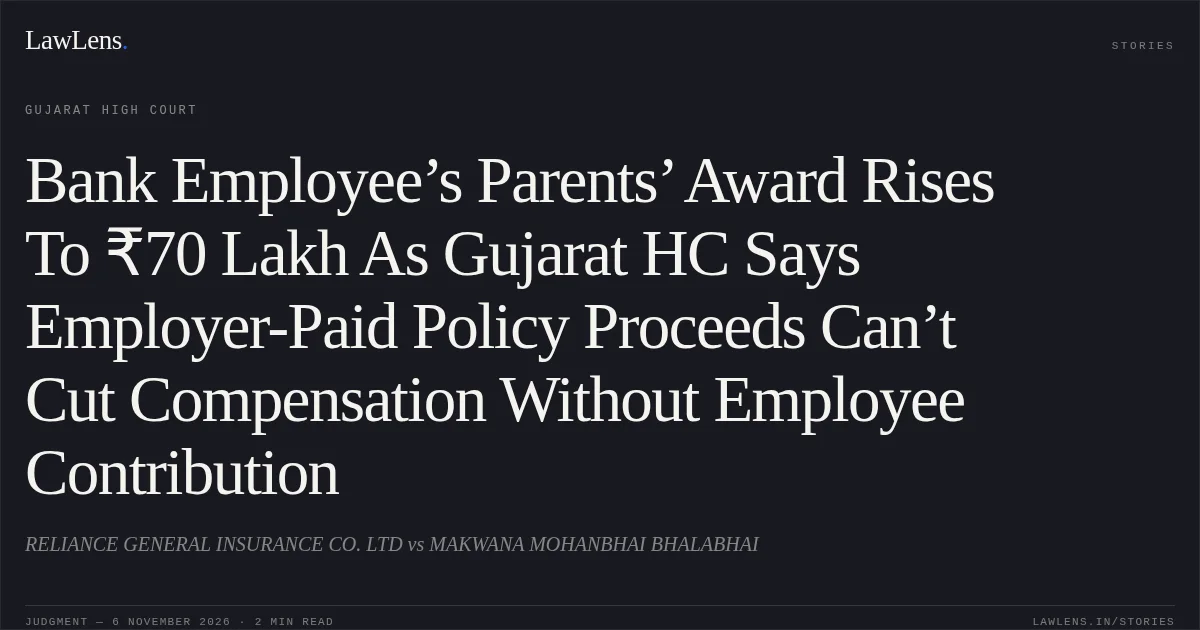
The Court set aside the finding that the deceased was 10% negligent and the deduction of the ₹10 lakh policy proceeds.
pp. 6–7It assessed total compensation at ₹70,03,096 and awarded an additional ₹18,93,096, with 9% interest from the date of the claim petition until realization.
pp. 6–7The insurer was directed to deposit the enhanced amount within ten weeks; the appeals were disposed of accordingly.
pp. 6–7Original Court PDF
RELIANCE GENERAL INSURANCE CO. LTDvsMAKWANA MOHANBHAI BHALABHAI
Click to open original judgment
Original judgment, available to read, download and summarize on LawLens.in