Facts
The petitioners challenged the judgment of the West Bengal Land Reforms and Tenancy Tribunal affirming orders of the Appellate Authority and the Bhag Chas Officer, which declared the private respondent a Bargadar and directed restoration of possession in his favour.
Source reference: paras. 1, 57The private respondent claimed that he had cultivated the subject land as a Bargadar and had been dispossessed on 23 August 1992.
Source reference: paras. 9–14He had earlier submitted a representation dated 8 September 1992 seeking recording of his name as a Bargadar, but did not specifically seek restoration of possession.
Source reference: paras. 9–14A subsequent application dated 7 April 1997 expressly sought restoration of possession under Section 19B of the West Bengal Land Reforms Act, 1955.
Source reference: paras. 12, 45The petitioners contended that the private respondent had produced no receipts proving delivery of his share of the produce, and that the 1997 application was barred by the statutory limitation period.
Source reference: paras. 2–17The authorities below relied principally on field-enquiry reports and earlier records to conclude that the private respondent was a Bargadar.
Source reference: paras. 24, 34Issues
Whether the private respondent established the essential ingredients of Bargadar status under Section 2(2) of the West Bengal Land Reforms Act, 1955, particularly the delivery of a share of the produce to the landowner.
Source reference: paras. 27–36Whether the field-enquiry reports and other prior records could substitute documentary proof, such as receipts, of delivery of the share of produce.
Source reference: paras. 31–35, 41–43Whether the application for restoration of possession under Section 19B was barred by limitation, having been filed on 7 April 1997, more than two years after the alleged termination of cultivation on 23 August 1992.
Source reference: paras. 44–53Law Applied
Section 2(2) of the West Bengal Land Reforms Act, 1955 defines a “Bargadar” as a person who cultivates another’s land on the condition of delivering, or receiving, a share of the produce; therefore, actual cultivation and the crop-sharing condition are essential elements of Bargadar status.
Source reference: paras. 27–30Section 19B(1) provides a remedy for restoration of cultivated land to a Bargadar dispossessed without due process, while its second proviso requires the application to be made within two years from the termination of cultivation.
Source reference: paras. 46–48Relying on Shambhu Nath Ghosh and Others v. State of West Bengal and Others, (2014) 4 CHN 146, the Court held that the fact of crop-sharing must be established by documentary evidence, particularly receipts, and that a field-enquiry report cannot substitute such proof.
Source reference: paras. 31–32, 42The Court also noted that the Supreme Court had dismissed the challenge to that decision on merits.
Source reference: para. 16Reasoning
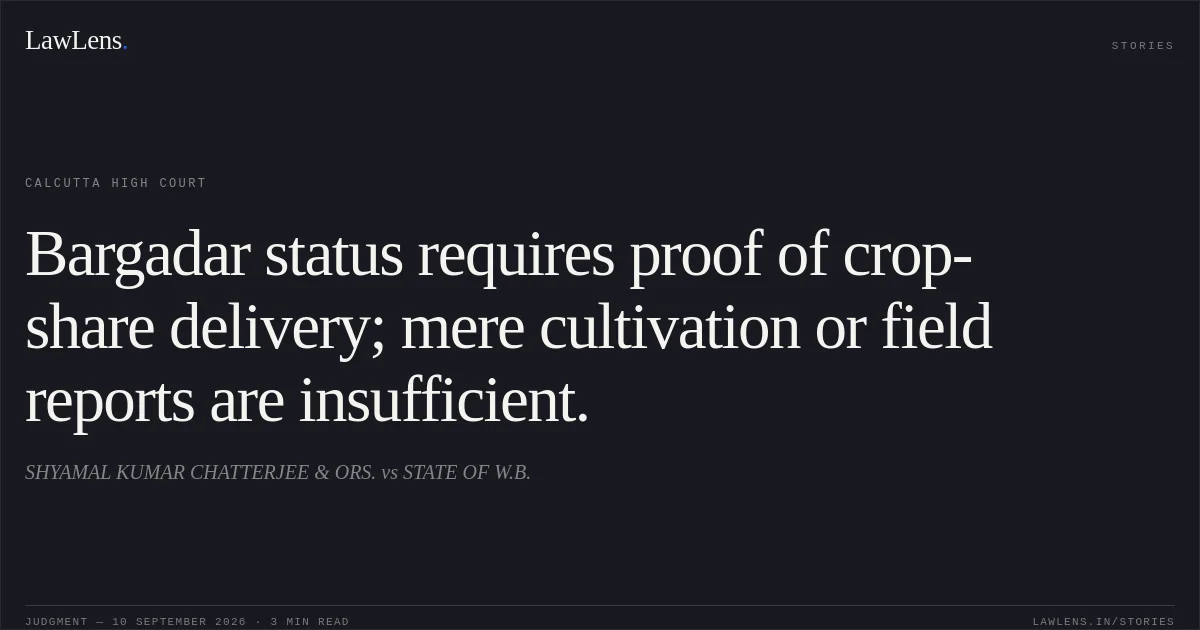
The Court held that the private respondent had failed to cross the threshold for establishing Bargadar status because no receipt or other documentary proof of delivery of the statutory share of produce had been produced before any authority.
Source reference: paras. 33–36Mere cultivation, even if supported by field-enquiry reports, was insufficient because the crop-sharing condition is a sine qua non under Section 2(2); the field reports were hearsay-like and could not prove actual delivery of produce.
Source reference: paras. 34, 42, 55The Tribunal’s dismissal of the objection as a “stock plea” was erroneous, particularly because the matter had previously been remanded for a fresh enquiry into all issues relevant to Bargadar status.
Source reference: paras. 37–43On limitation, the Court found that the proceeding under Section 19B was initiated only on the basis of the application dated 7 April 1997, which specifically sought restoration of possession, and not on the basis of the 8 September 1992 representation.
Source reference: paras. 44–52Since the 1997 application was filed more than two years after the alleged dispossession, it was barred under the second proviso to Section 19B.
Source reference: paras. 45–49Holding
The Court answered both principal issues in favour of the writ petitioners.
It held that the private respondent had neither proved the essential requirement of delivery of a share of the produce nor filed a timely application for restoration under Section 19B.
Source reference: paras. 53–55The writ petition was accordingly allowed on contest against the State and ex parte against the private respondent.
Source reference: paras. 56–60The Tribunal’s judgment dated 13 June 2003, together with the orders of the Appellate Authority and the Bhag Chas Officer, was set aside; any action taken pursuant to those orders was revoked and directed to be reversed where necessary.
Source reference: paras. 56–60No order was made as to costs.
Source reference: paras. 56–60Acts & Sections Cited
1 provisions across 1 statute referred to in this judgment. Each provision opens on LawLens.
west bengal land reforms act, 19551
Original Court PDF
SHYAMAL KUMAR CHATTERJEE & ORS.vsSTATE OF W.B.
Click to open original judgment
Original judgment, available to read, download and summarize on LawLens.in