Facts
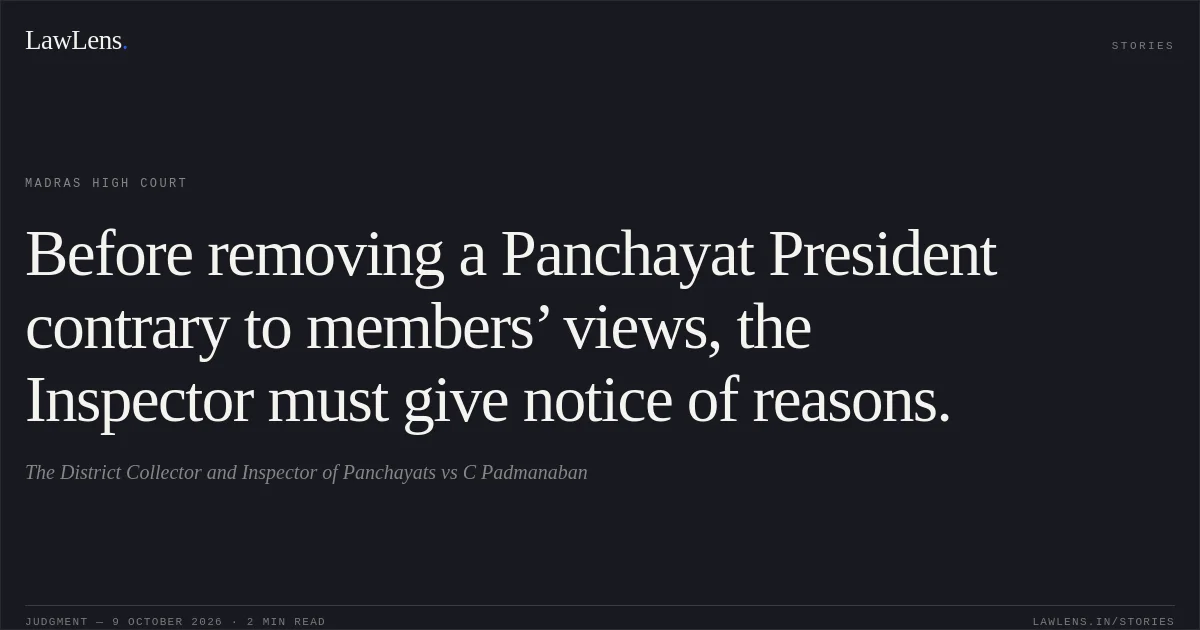
C. Padmanaban, President of Itchiputhur Village Panchayat, faced a complaint by a ward member alleging irregularities. Following an enquiry, the District Collector initiated proceedings under Section 205 of the Tamil Nadu Panchayats Act, 1994.
Source reference: p. 2–3At the meeting convened under Section 205(3), the majority of members opposed his removal; the Collector nevertheless removed him by order dated 27 July 2026, later gazetted on 29 July 2026.
Source reference: p. 2–3, 5–6The Single Judge set aside the removal for non-compliance with Section 205, and the State appealed.
Source reference: p. 2–3Issues
1. Whether the Collector, having differed from the majority view of the Village Panchayat, could remove the President without first giving him further notice and an opportunity to explain.
Source reference: p. 4–5, 7–82. Whether the availability of an appellate remedy barred the President from seeking writ relief where the required notice had not been given.
Source reference: p. 4–5, 83. Whether proceedings initiated following a ward member’s complaint could be treated as suo motu proceedings under Section 205(1). (The Court left this issue open.)
Source reference: p. 3, 6Law Applied
Section 205 of the Tamil Nadu Panchayats Act, 1994 governs proceedings for removal of a Village Panchayat President, including the recording and consideration of the Panchayat’s views under Section 205(10).
Source reference: p. 5–6Relying on the Full Bench decision in District Collector and Inspector of Panchayat v. Devi Parasuraman, 2009 (4) L.W. 778, the Court applied the rule that the Inspector’s action under Section 205 is quasi-judicial and that, when the Inspector differs from the Panchayat’s views and proposes to remove the President, the Inspector must record reasons for the difference and give the President further notice of those reasons, considering any response before issuing the removal notification.
Source reference: p. 7A breach of natural justice may justify writ intervention notwithstanding an alternative remedy.
Source reference: p. 8Reasoning
The Collector departed from the majority view opposing removal but, as the State conceded, did not give the President the further notice required by the Full Bench’s interpretation of Section 205.
Source reference: p. 6–8That omission denied the President the opportunity to respond to the Collector’s reasons for dissent and violated the applicable procedural safeguard.
Source reference: p. 8In those circumstances, the alternative remedy did not preclude the writ petition, and the Single Judge was justified in setting aside the removal.
Source reference: p. 8The Court did not decide whether the proceedings could qualify as suo motu proceedings, reserving that question for an appropriate case.
Source reference: p. 6Holding
The Court dismissed the writ appeal and affirmed the order setting aside the President’s removal for failure to provide the required notice.
It left open the question whether complaint-based proceedings may be treated as suo motu proceedings and noted that the Collector was not precluded from initiating fresh proceedings, if otherwise permissible in law.
Source reference: p. 6, 8There was no order as to costs; the interim application was closed.
Source reference: p. 9Acts & Sections Cited
1 provisions across 1 statute referred to in this judgment. Each provision opens on LawLens.
Tamil Nadu Panchayats Act,19941
Original Court PDF
The District Collector and Inspector of PanchayatsvsC Padmanaban
Click to open original judgment
Original judgment, available to read, download and summarize on LawLens.in