01Facts
The applicant, Kumari Itli, was accused in FIR No. 109/2026, P.S. Aanadpuri, District Banswara, under Sections 103(1), 238(A) and 61(2) BNS
¶ 1The FIR was initially registered against unknown persons on 30.05.2026 after the dead body of one Harshad was discovered. It apprehended a premeditated murder and disposal of the body in a well
¶ 2.1, 5The applicant was implicated during investigation along with co-accused
¶ 5She has been in judicial custody since 02.06.2026. The investigation is complete and the charge-sheet has been filed
¶ 2.5, 5.7The prosecution case is entirely circumstantial, with no eyewitness. The implication rests on Section 180 BNSS statements that the applicant and co-accused were seen drinking with the deceased on the evening of his death
¶ 2.2, 5.1, 5.2The prosecution also relies on information attributed to the applicant in the memo of place of incidence. No incriminating recovery was made at her instance
¶ 2.3, 5.4The post-mortem report records a lacerated wound on the temporal region, but the cause of death is asphyxia due to drowning
¶ 2.4, 5.5No specific motive or prior animosity was brought on record
¶ 5.3The applicant sought bail under Section 483 BNSS. The Public Prosecutor opposed on the ground that the allegations are grave
¶ 302Issues
i.1. Whether the applicant is entitled to bail under Section 483 BNSS where the case is wholly circumstantial and rests on last-seen evidence, with no motive or recovery connecting her to the offence.
¶ 5.1, 5.2, 5.3, 5.6, 5.8ii.2. Whether the information attributed to the applicant in the memo of place of incidence can be treated as substantive evidence against her.
¶ 5.4iii.3. Whether the medical evidence of a temporal lacerated wound corroborates the prosecution's case that the deceased was struck before being thrown into the well.
¶ 5.5iv.4. Whether the police report (charge-sheet) in the present case satisfies the statutory and judicially prescribed requirements, and what standards govern its preparation.
Post-Script paras I to IX03Law Applied
The Court applied Section 483 BNSS as the source of the High Court's power to grant bail.
¶ 1 · ¶ 6The Court relied on Section 480(1) BNSS, read with the beneficial consideration extended to women accused.
¶ 5.7For circumstantial cases, the Court applied the principle from Sharad Birdhichand Sarda v. State of Maharashtra, (1984) 4 SCC 116, that the circumstances must be firmly established, form a complete chain, be consistent only with guilt, and exclude every reasonable hypothesis of innocence. Motive, last seen, recovery, conduct and scientific evidence are the relevant links.
¶ 5.1Under Section 23 of the Bharatiya Sakshya Adhiniyam, 2023, a confession to a police officer or in police custody is inadmissible, save for the portion distinctly relating to a fact discovered in consequence.
¶ 5.4On the police report, the Court relied on Section 193 BNSS (corresponding to Section 173 CrPC) as explained in Dablu Kujur v. State of Jharkhand, (2024) 6 SCC 758, Sharif Ahmed v. State of U.P., (2024) 14 SCC 122, and Zakia Ahsan Jafri v. State of Gujarat, (2023) 13 SCC 54.
Post-Script paras III, IV, V, VIThese decisions hold that the police report must set out the role of each accused and the material connecting them to the offence, and must not be a mechanical reproduction of the FIR.
Post-Script paras II, VIIProvisions in the judgment · 16 · Linked ones open on LawLens
Bharatiya Nagarik Suraksha Sanhita, 2023 Section 483Section 180Section 480Section 193
Bharatiya Nyaya Sanhita, 2023 Section 103Section 238Section 61
Bharatiya Sakshya Adhiniyam, 2023 Section 23
Code of Criminal Procedure, 1973 Section 173Section 190Section 204Section 251Section 161Section 169Section 170
Indian Penal Code, 1860 Section 376
04Reasoning
The Court found that the FIR was lodged against unknown persons and that the applicant was implicated only during investigation.
¶ 5Because the case is circumstantial, the Court tested the prosecution's links against the Sharad Sarda standard. The Section 180 BNSS evidence of the applicant drinking with the deceased shows at most her presence in his company at a point of time, which alone does not attribute the offence to her.
¶ 5.2The absence of any motive or independent material further weakened the prosecution's nexus.
¶ 5.3The disclosure in the memo of place of incidence was confined by Section 23 BSA. It could not be used to narrate the manner of the offence, and there was no fact-discovery recovery to rely on.
¶ 5.4The medical evidence did not corroborate the assault theory. The death was attributed to drowning, and the head injury could have been caused by a fall into the well. The precise circumstances therefore required trial-stage examination.
¶ 5.5Weighing these factors with the applicant's gender, nearly complete investigation, filed charge-sheet, and the likely length of trial, the Court held that continued incarceration was not justified.
¶ 5.6, 5.7On the police report, the Court observed that the charge-sheet was a perfunctory one-page account that reproduced the FIR and stated a conclusion without reasoning. It was therefore a mechanical exercise that diminished its utility to the judicial process.
Post-Script para IIThe Court clarified that the report need not be a detailed analysis of evidence, but must show how the material connects each accused to the offence.
Post-Script paras VII, VIII05Holding
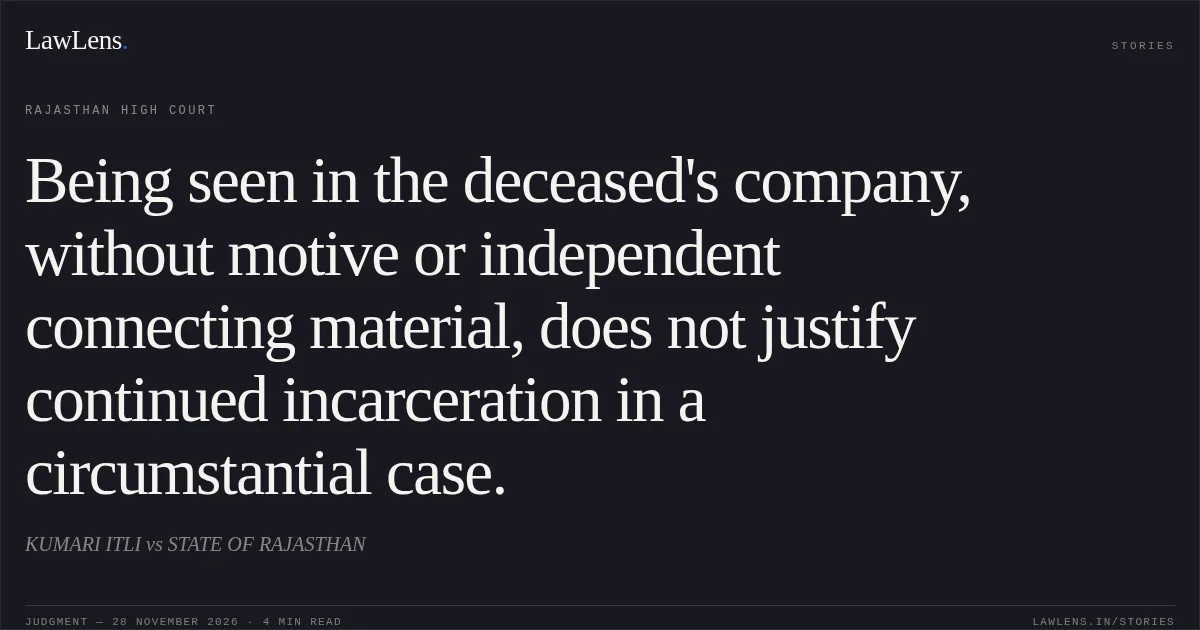
The Court held that the applicant's presence with the deceased, without motive or independent material, did not prima facie establish a nexus warranting her continued detention.
¶ 5.6, 5.8The bail application was allowed. The applicant is to be released on a personal bond of ₹50,000 with two sureties of ₹25,000 each, subject to conditions: no tampering with evidence or influencing witnesses, no criminal activity, and attendance before the Trial Court as directed. The Public Prosecutor may seek cancellation on breach. The Court stated that its observations are prima facie and do not bind the Trial Court. It directed that a copy of the order be forwarded to the Director General of Police, Rajasthan, to ensure that police reports are prepared with due diligence in accordance with Sharif Ahmed, Section 193 BNSS and the Police Manual. The Trial Court is to consider the police report independently.
¶ 6 · ¶ 5.8, 7, Post-Script paras VIII, IXOriginal Court PDF
KUMARI ITLIvsSTATE OF RAJASTHAN
Click to open original judgment
Original judgment, available to read, download and summarize on LawLens.in