01Facts
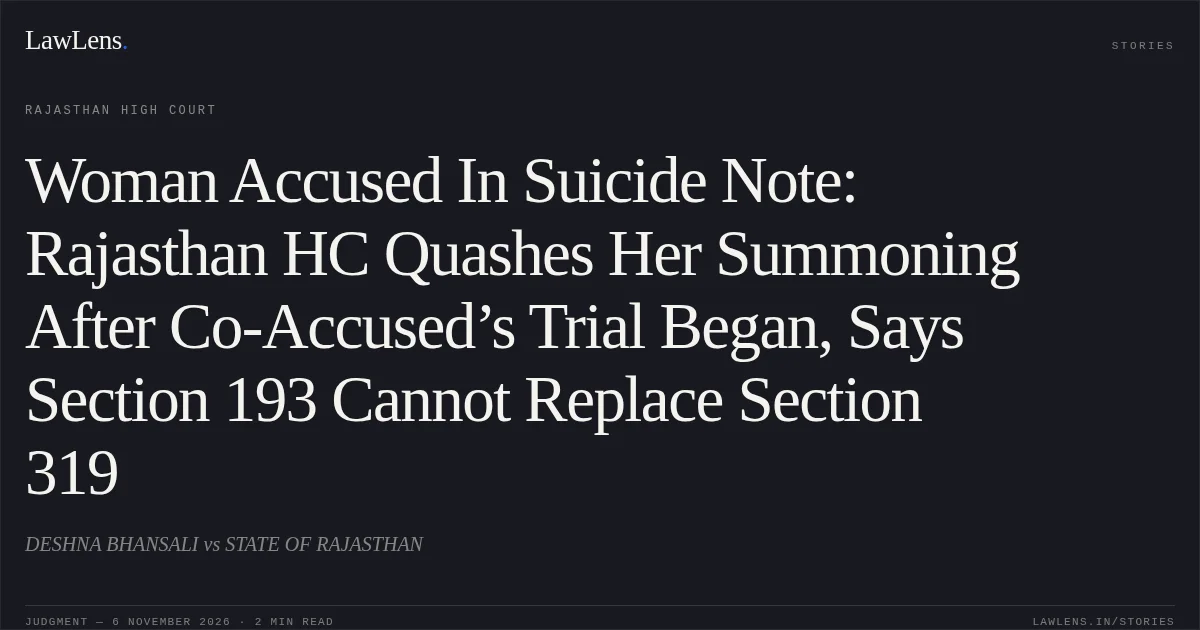
Narender Singh died by suicide on 13 June 2013, leaving a note naming three persons, including Deshna Bhansali.
¶ 2.1–2.5, 11–12She was initially included in the charge-sheet for an offence under Section 306 IPC, but, after further investigation, the police excluded her and applied under Section 169 CrPC.
¶ 2.1–2.5, 11–12The Magistrate accepted that application and discharged her bail bonds on 4 February 2014; the case was committed to the Sessions Court against the other two accused.
¶ 2.1–2.5, 11–12The Sessions Court framed charges against those accused on 14 May 2014.
¶ 2.6–2.10, 12The complainant later sought to arraign Bhansali under Section 193 CrPC; on 5 November 2019, the Sessions Court allowed the application and issued a warrant.
¶ 2.6–2.10, 12A further order dated 16 December 2021 directed steps to obtain information about her property to secure her presence.
¶ 2.6–2.10, 1202Issues
i.Whether the Sessions Court could invoke Section 193 CrPC to summon a person not sent up for trial after charges had been framed against the co-accused and the trial had commenced.
¶ 3, 12.1, 21ii.Whether the consequential order of 16 December 2021 could stand once the order summoning Bhansali was set aside.
¶ 1803Law Applied
Section 193 CrPC empowers the Court of Session, upon committal, to take cognizance as a court of original jurisdiction and proceed against a person not sent up for trial, where the police papers disclose that person’s involvement; the police’s opinion does not bind the court (*Dharam Pal v. State of Haryana*).
¶ 5, 7, 17Section 319 CrPC provides the mechanism for summoning an additional accused on the basis of evidence emerging during an inquiry or trial.
¶ 8*Hardeep Singh v. State of Punjab* recognises that trial commences upon framing of charges and distinguishes that stage from the preceding inquiry.
¶ 8The judgment held that, once charges have been framed and trial has commenced, Section 193 cannot be used as a substitute for Section 319 to summon an additional accused on the basis of investigative material.
¶ 9–10, 12.1Provisions in the judgment · 6 · Linked ones open on LawLens
Code of Criminal Procedure, 1973 Section 193Section 169Section 319Section 190Section 161
Indian Penal Code, 1860 Section 306
04Reasoning
The Sessions Court decided the Section 193 application nearly five years after framing charges against the co-accused.
¶ 12–15, 21The suicide note and Section 161 statements relied on to summon Bhansali were part of the investigation papers, not evidence emerging before the court during trial.
¶ 12–15, 21In the High Court’s view, Section 193 was therefore unavailable at that procedural stage; any later application to summon her had to satisfy Section 319 and be based on evidence brought before the court in the course of inquiry or trial.
¶ 12–15, 21The orders concerning her presence and property were consequential to the invalid summoning order and could not independently survive.
¶ 1805Holding
The High Court allowed the revision and quashed the orders dated 5 November 2019 and 16 December 2021 insofar as they concerned Bhansali.
¶ 22It left the merits of the allegations open and clarified that the trial court could proceed against her under Section 319 CrPC if the statutory requirements were met on the basis of evidence before it during the inquiry or trial.
¶ 22Original Court PDF
DESHNA BHANSALIvsSTATE OF RAJASTHAN
Click to open original judgment
Original judgment, available to read, download and summarize on LawLens.in