01Facts
A prosecution was instituted at the petitioner-complainant's instance against the accused-respondent.
¶ 2After a charge-sheet was filed and cognizance taken, the trial Magistrate framed charge under Section 498-A IPC.
¶ 2The accused challenged the charge by a revision under Section 397 CrPC but did not implead the complainant/victim.
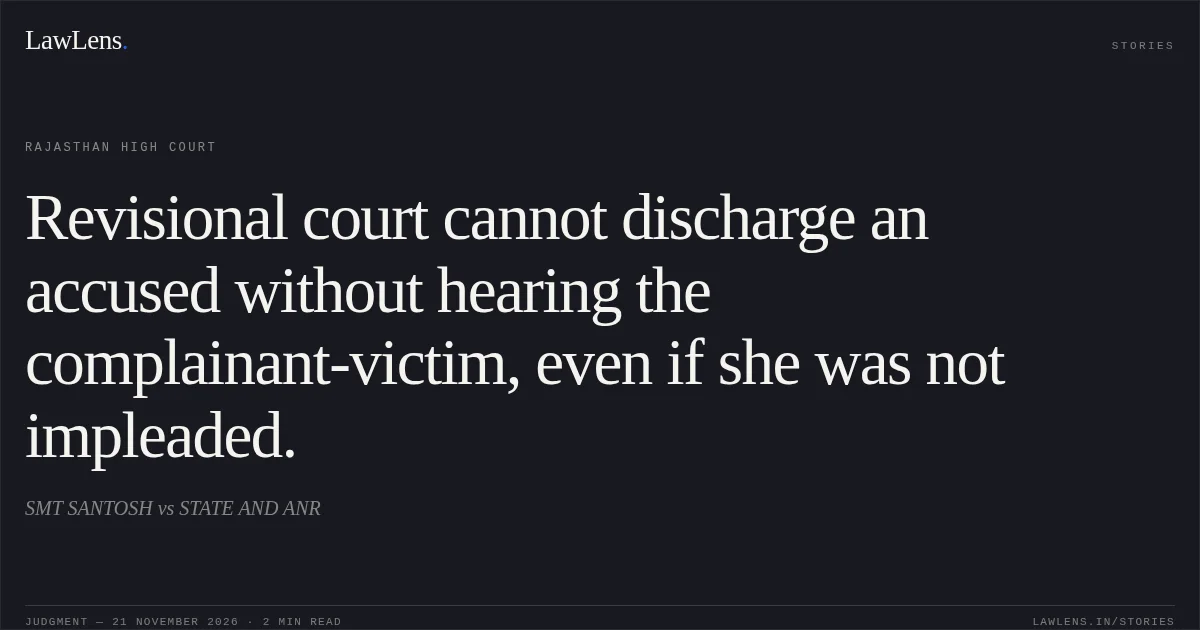
¶ 2 · ¶ 4.1The revisional Court, without issuing notice to or hearing the complainant, set aside the charge and discharged the accused.
¶ 2 · ¶ 4.1The complainant then filed the present revision petition under Section 397 CrPC.
¶ 202Issues
i.1. Whether a revisional court may set aside a charge and discharge the accused, an order prejudicially affecting the complainant, without impleading or hearing the complainant.
¶ 4 · ¶ 4.1ii.2. Whether the impugned revisional order, passed in breach of the requirement of hearing the complainant, is sustainable, and what consequential directions are appropriate.
¶ 5 · ¶ 703Law Applied
The Court relied on Sections 397 to 401 CrPC, read together, and in particular Section 401(2), which bars any order "to the prejudice of the accused or other person" unless that person has been given an opportunity of being heard.
¶ 4 · pp. 3–4The Court relied on Manharibhai Muljibhai Kakadia & Anr. v. Shaileshbhai Mohanbhai Patel & Ors., (2012) 10 SCC 517, which recognised the complainant's right to be heard in revisional proceedings where an order prejudicial to his or her interest is contemplated.
¶ 4.2An affected party's right to hearing is a statutory safeguard, not a formality, and the maxim audi alteram partem (no one shall be condemned unheard) is a fundamental pillar of fair adjudication.
¶ 4 · ¶ 8Provisions in the judgment · 13 · Linked ones open on LawLens
Code of Criminal Procedure, 1973 13 provisions
Section 202Section 203Section 307Section 386Section 389Section 390Section 391Section 392Section 397Section 398Section 399Section 400Section 40104Reasoning
Discharging the accused in revision directly prejudiced the complainant, whose interest in the charge was at stake.
¶ 4.1Because the accused had not impleaded the complainant and the revisional Court neither ensured her presence nor afforded her audience, the order suffered from a "manifest error of law" and was contrary to settled principles of revisional jurisdiction.
¶ 4.1 · ¶ 5Relying on Manharibhai and the text of Section 401(2), the defect went to the root of the proceedings and could not be cured.
¶ 4.2 · ¶ 5The Court expressly did not examine the merits of the framing of charge, leaving that question open for the revisional Court.
¶ 705Holding
The revisional order discharging the accused was passed in breach of the mandatory requirement of hearing the complainant/victim and could not be sustained.
¶ 5The revision petition is allowed and the impugned order of the Additional Sessions Judge is set aside. The matter is remitted to the revisional Court to afford an effective hearing to the complainant/victim and then decide the accused's revision afresh, strictly in accordance with law and uninfluenced by the observations made. Both parties are directed to appear before the revisional Court on 12.01.2027, and no separate notice is required for the complainant. The revisional Court is directed to decide the matter expeditiously, preferably without unnecessary adjournments. The stay petition and all pending applications stand disposed of.
¶ 6 · ¶ 7 · ¶ 9 · ¶ 10–11Original Court PDF
SMT SANTOSHvsSTATE AND ANR
Click to open original judgment
Original judgment, available to read, download and summarize on LawLens.in