01Facts
The petitioner, Ashok, is a convict confined in the Open Air Camp, Karauli, and sought parole through a writ petition; eight connected writs raise similar parole claims
A Division Bench on 29.10.2026 found a divergence of judicial opinion on whether parole should be governed by the Rajasthan Prisoners (Release on Parole) Rules, 1958 ("1958 Rules"), in force at the time of conviction, or the Rajasthan Prisoners (Release on Parole) Rules, 2021 ("2021 Rules"), in force when the application is considered. It referred the matter to the Chief Justice for a Larger Bench
¶ 1The Division Bench framed three questions: (a) which Rules govern parole; (b) whether parole is a temporary suspension of sentence under Section 386 CrPC (Section 427 BNSS); and (c) the effect of the repeal of the CrPC, 1973 by the BNSS, 2023 on the 1958 Rules
¶ 2The 2021 Rules were notified on 30.06.2021 under Clause 27-a of Section 59 of the Prisons Act, 1894, as inserted by the Prisons (Rajasthan Amendment) Act, 2015, and Rule 25 expressly repealed the 1958 Rules
¶ 20–2102Issues
i.1. Whether, for the grant of parole, the Rules prevailing on the date of conviction (1958 Rules) or the Rules in force at the time of consideration of the application (2021 Rules) apply
¶ 2(a) · ¶ 35ii.2. Whether the grant of parole amounts to a temporary suspension of sentence under Section 386 CrPC (Section 427 BNSS)
¶ 2(b) · ¶ 24–26iii.3. Whether, and with what effect, the repeal of the CrPC, 1973 by the BNSS, 2023 affects the operation of the 1958 Rules
¶ 2(c) · ¶ 27–3403Law Applied
The Court relied on the Prisons Act, 1894, Sections 58A and 59(27-a), under which the State may grant parole in accordance with rules
¶ 17–19The Court applied the principle that parole is executive action, a conditional release that does not suspend or alter the sentence; relevant authorities are State of Haryana v. Nauratta Singh, (2000) 3 SCC 514; Dadu @ Tulsidas v. State of Maharashtra, (2000) 8 SCC 437; and Sunil Fulchand Shah v. Union of India, AIR 2000 SC 1023 (Constitution Bench), para. 13
¶ 8, 24–25Remission, by contrast, affects the quantum of sentence and so attracts the law in force at conviction; relevant authorities are Maru Ram v. Union of India, (1981) 1 SCC 107; State of Haryana v. Jagdish, (2010) 4 SCC 216; and Hitesh @ Bavko Shivshankar Dave v. State of Gujarat, (2024) 5 SCC 623
¶ 9–13On repeal, the Court applied the principle that a repealed enactment is obliterated except for past and closed transactions and saved operation, citing Qudrat Ullah v. Municipal Board, Bareilly, AIR 1974 SC 396, and State of Rajasthan v. Mangilal Pindwal, AIR 1996 SC 2181
¶ 30–32Statutory saving provisions examined were Section 401(6) CrPC 1898, Section 484(2)(b) CrPC 1973, Section 531(2)(b) BNSS 2023, and Rule 25 of the 2021 Rules
¶ 15–16, 21, 36(iii)The Court noted that parole is a concession not claimable as of right, referring to Rule 13 of the 1958 Rules and Rule 15 of the 2021 Rules
¶ 20Parole is linked to Article 21 and the reformative object of release; relevant authorities are Poonam Lata v. M.L. Wadhawan, (1987) 3 SCC 347, and Inder Singh v. State (Delhi Administration), AIR 1978 SC 1091
¶ 4–7Provisions in the judgment · 10 · Linked ones open on LawLens
Code of Criminal Procedure, 1973 Section 386Section 433Section 432Section 484
Bharatiya Nagarik Suraksha Sanhita, 2023 Section 427Section 531
Prisons Act, 1894 Section 32Section 58Section 59
General Clauses Act, 1897 Section 24
04Reasoning
The Court distinguished parole from remission. Remission reduces the executive's effective term of incarceration and therefore depends on the policy in force at conviction, as in Jagdish and Hitesh. Parole does not alter the sentence; the prisoner remains in custody under supervision
¶ 9, 13, 36(i)The Court therefore held that Jagdish and Hitesh do not extend to parole or permanent parole, and that the 2021 Rules govern every application made after 30.06.2021, irrespective of the date of conviction. A prisoner convicted under the 1958 Rules acquires no vested right to have later applications decided under them
¶ 36(i)On question (b), the Court applied Dadu and Sunil Fulchand Shah to hold that parole is not a suspension of sentence, because it changes only the mode of undergoing the sentence. Parole is also not a benefit that suspends the operation of the sentence under Section 386 CrPC or Section 427 BNSS. The period spent on parole under Rule 10 of the 2021 Rules is treated as imprisonment served
¶ 24–26, 36(ii)On question (c), the 1958 Rules were executive instructions framed under Section 401(6) CrPC 1898. They were continued by Section 484(2)(b) CrPC 1973 but were expressly repealed by Rule 25(1) of the 2021 Rules with effect from 30.06.2021. The saving in Rule 25(2) preserves only the previous operation of the repealed rules and completed actions
¶ 21, 33The 2021 Rules rest on an independent statutory source (Section 59(27-a) of the 1894 Act), so the repeal of the CrPC and the enactment of the BNSS do not affect them. Section 531(2)(b) BNSS saves only rules in force immediately before 01.07.2024, and no provision revives the 1958 Rules
¶ 34, 36(iii)05Holding
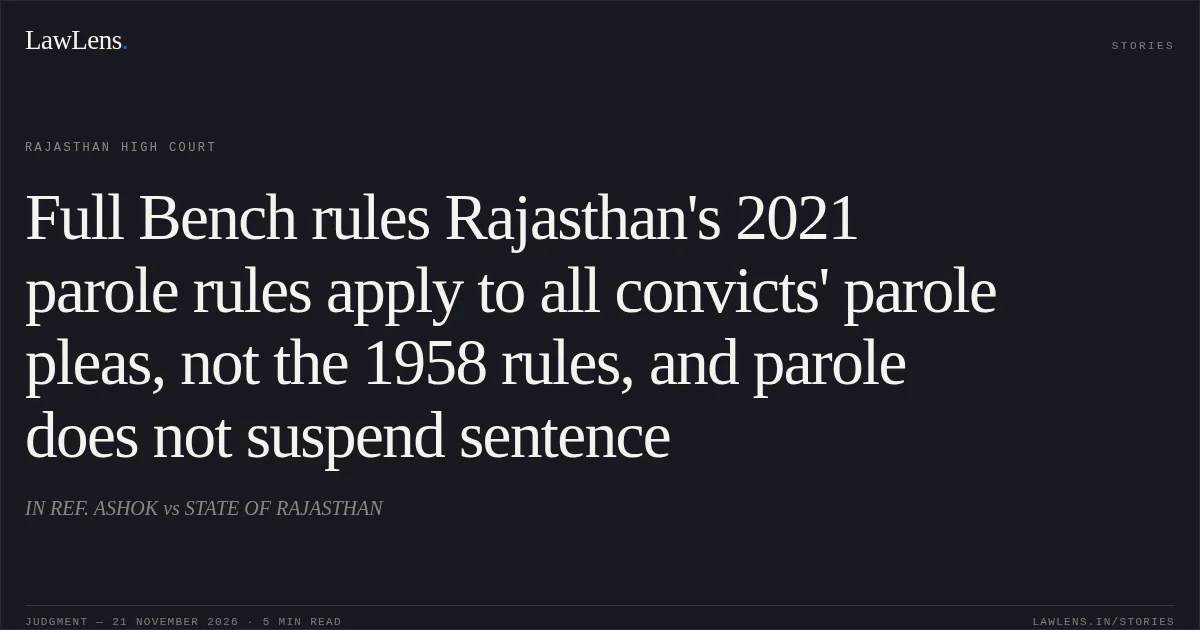
(a) The 2021 Rules, effective 30.06.2021 and expressly repealing the 1958 Rules, govern every parole or permanent parole application made after their commencement, irrespective of the date of conviction; the Jagdish/Hitesh principle applies only to remission and permanent release
¶ 35, 36(i)(b) Grant of parole does not amount to suspension, remission, or commutation of sentence; it is a conditional release that changes only the mode of undergoing the sentence, and parole time under Rule 10 of the 2021 Rules counts as imprisonment served
¶ 24–26, 36(ii)(c) The repeal of the CrPC, 1973 by the BNSS, 2023 neither revives nor affects the 1958 Rules or the 2021 Rules; Section 531(2)(b) BNSS saves only rules in force before 01.07.2024
¶ 34, 36(iii)The reference is disposed of, and the matter is to be placed before the roster bench to decide the writ petitions in accordance with these answers
¶ 37–38Original Court PDF
IN REF. ASHOKvsSTATE OF RAJASTHAN
Click to open original judgment
Original judgment, available to read, download and summarize on LawLens.in