01Facts
The plaintiffs instituted Title Suit No. 5 of 2009, heard analogously with Title Suit No. 6 of 2009, claiming right, title, interest and possession in respect of a common passage described in the plaint schedule.
¶ 1, 3A Survey Passed Commissioner was appointed under Order XXVI Rule 9 of the Code of Civil Procedure, 1908 (“CPC”), but the plaintiffs challenged the initial report as improperly prepared. In C.O. No. 2575 of 2014, the High Court directed a fresh measurement of the passage and preparation of a sketch map. As the Commissioner did not complete the exercise for several years, the plaintiffs sought appointment of a new Commissioner; that request was ultimately allowed pursuant to the High Court’s order dated 4 December 2024 in C.O. No. 3321 of 2023. The newly appointed Commissioner measured the passage, prepared a sketch map and submitted a report, which was accepted without objection by either party. At the stage of arguments, the plaintiffs filed an application under Order VI Rule 17 CPC seeking to incorporate the actual measurement of the common passage in the plaint without altering the nature or character of the suit. The Trial Court rejected the amendment application as belated and imposed costs of Rs. 1,000 on the defendants. The plaintiffs challenged that order in the present revision.
¶ 2, 4–902Issues
i.Whether the plaintiffs should be permitted to amend the plaint under Order VI Rule 17 CPC to incorporate the actual measurement of the common passage at the stage of arguments?
¶ 4, 9–13ii.Whether the proposed amendment was barred by the proviso to Order VI Rule 17 CPC because the plaintiffs failed to establish that, despite due diligence, the amendment could not have been sought before commencement of trial?
¶ 10–13iii.Whether the Trial Court’s rejection of the amendment application warranted interference in revisional jurisdiction?
¶ 1–2, 13–1403Law Applied
The Court applied Order VI Rule 17 CPC, under which amendments necessary for determining the real questions in controversy may generally be allowed at any stage, subject to the requirement that, after commencement of trial, the applicant must establish that despite due diligence the matter could not have been raised earlier.
¶ 10, 12The Court also considered the principle that amendments should ordinarily be allowed when necessary for effective adjudication and for deciding the real controversy between the parties, as discussed in Rajesh Kumar Aggarwal v. K.K. Modi, (2006) 4 SCC 385; Om Prakash Gupta v. Ranbir B. Goyal, (2002) 2 SCC 256; and LIC of India v. Sanjeev Builders (P) Ltd., (2022) 16 SCC 1. Conversely, relying on Basavaraj v. Indira, (2024) 3 SCC 705, the Court recognised that the post-trial amendment restriction prevents a party from introducing an amendment belatedly unless the statutory requirement of due diligence is satisfied.
¶ 10–1204Reasoning
The Court held that the proposed amendment was filed nearly seventeen years after institution of the suit and at the stage of arguments, but the plaintiffs gave no valid explanation for their failure to seek it before commencement of trial.
¶ 13Although the plaintiffs relied on the Commissioner’s proceedings to contend that the actual measurement had only recently become available, the Commissioner’s accepted report and sketch map already clearly recorded the measurements of the common passage. Further, the sale deeds annexed to the plaints also specified the measurements. Since the relevant material was already available and sufficient for adjudication, the amendment was not necessary for determining the real controversy. The plaintiffs accordingly failed to satisfy the due-diligence requirement under Order VI Rule 17 CPC, and the Trial Court’s refusal to permit the amendment was not erroneous.
¶ 8, 1305Holding
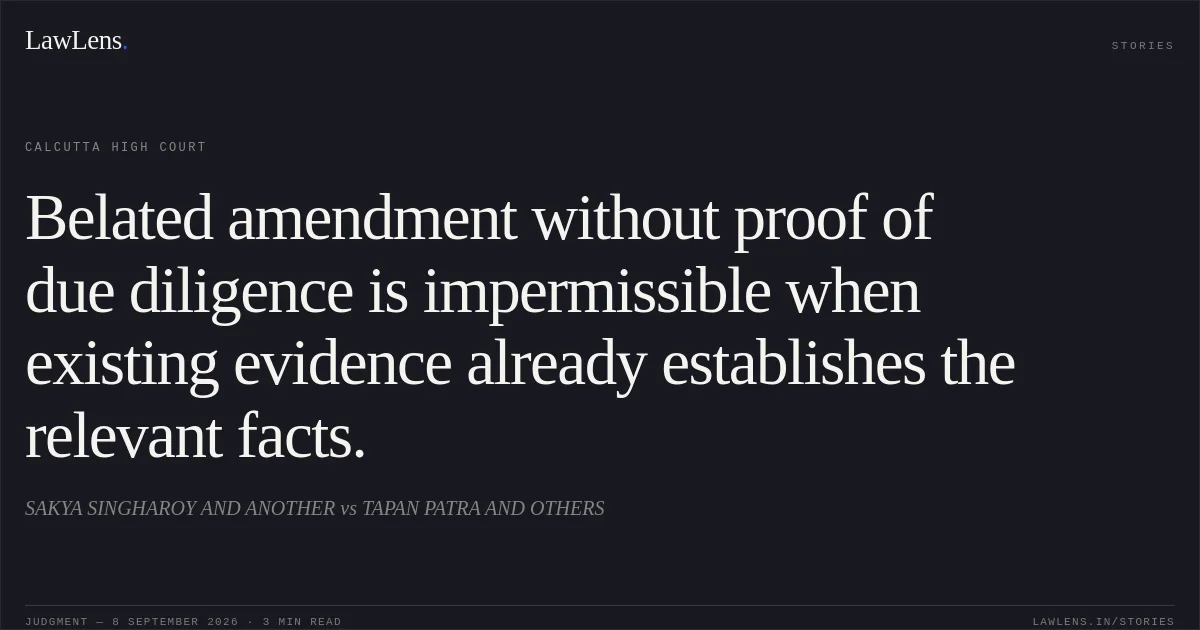
The High Court answered the issues against the plaintiffs. It held that the amendment application was excessively delayed, unsupported by any satisfactory explanation, and unnecessary because the Commissioner’s accepted report, sketch map and sale deeds already disclosed the measurements of the common passage.
¶ 13The revisional application, C.O. No. 2880 of 2026, was dismissed, and the Trial Court’s order rejecting the amendment application was affirmed. The connected application, if any, was disposed of, and any interim order was vacated.
¶ 14–16Original Court PDF
SAKYA SINGHAROY AND ANOTHERvsTAPAN PATRA AND OTHERS
Click to open original judgment
Original judgment, available to read, download and summarize on LawLens.in