01Facts
The respondent, M/s Workshaala Spaces, held a lease of Surya Building, Koramangala, under a lease deed dated 15.01.2019.
¶ 2.1It sub-leased the premises to the appellant under a sub-lease deed dated 16.01.2019 for 10 years from 06.05.2019, with a 29-month lock-in period.
¶ 2.2Disputes arose over rent defaults during COVID-19 and the induction of a third party into the premises. The appellant terminated the sub-lease on 10.03.2021.
¶ 2.3The respondent obtained interim protection under Section 9 of the Arbitration and Conciliation Act, 1996 (Com.AA No. 43/2021), which was upheld on appeal and continued by the Supreme Court in SLP Nos. 20475–76/2021.
¶ 2.4–2.5This Court appointed a sole arbitrator under Section 11(6) on 29.03.2022.
¶ 2.6The claim was filed in the name "M/s Workshaala Spaces," represented by its CEO and co-founder, Mr. Manoj Khandelwal, for Rs. 10,00,78,083 with interest.
¶ 2.6–2.7The appellant's objections raised locus standi and arbitrability but did not plead lack of jurisdiction. It also filed a counter-claim against the same claimant.
¶ 2.8, 8Issues were framed on 18.11.2022 without any locus issue.
¶ 2.9After evidence, the Tribunal framed two preliminary issues at the award stage, held that there was no arbitration agreement with the claimant, and rejected both the claim and counter-claim.
¶ 2.10–2.11The Commercial Court set aside the award under Section 34 for patent illegality, leaving the parties free to commence fresh arbitration.
¶ 2.12The appellant challenged that judgment in this appeal under Section 37.
¶ 1, 302Issues
i.1. Whether the appellant, having raised only a locus standi objection in its statement of objections without filing a Section 16 application, and having itself filed a counter-claim, can at the final stage challenge the claimant's standing and the Tribunal's jurisdiction.
¶ 6–11, 20ii.2. Whether the Commercial Court was justified in setting aside the arbitral award and whether the question under Section 19 of the Indian Partnership Act requires determination.
¶ 17–1803Law Applied
Section 16 of the Arbitration and Conciliation Act, 1996, under which a plea that the Tribunal lacks jurisdiction must be raised in the statement of defence, and which the Court treated as requiring a separate application where the objection concerns jurisdiction rather than merely locus standi.
¶ 20The principle that a party which has made a counter-claim against a claimant impliedly accepts that claimant's standing.
¶ 9The principle that a party which has paid rent to a claimant under a transaction cannot later deny that the claimant is the proper party.
¶ 19The principle that an objection raised late, without bona fides, and in a manner that delays adjudication is not to be entertained in arbitration, since parties choosing ADR must not take defences available in civil suits.
¶ 10–14The Tribunal's limited mandate under the order appointing it, which kept contentions open but did not permit a fresh jurisdictional objection.
¶ 11Section 19 of the Indian Partnership Act, 1932 (authority of partners to act for the firm), which the Court declined to decide.
¶ 3.8, 4.6, 17Sharada Bai v. Navratan Vyas, 2016 SCC OnLine Hyd 387, cited by the respondent for the rule that a jurisdictional plea must be raised no later than the statement of defence; the Court did not expressly discuss it.
¶ 4.8Provisions in the judgment · 8 · Linked ones open on LawLens
Commercial Courts Act, 2015 Section 13
Arbitration and Conciliation Act, 1996 Section 37Section 9Section 17Section 11Section 34Section 16
Indian Partnership Act, 1932 Section 19
04Reasoning
The Court held that the objection in paragraph 3(a) and paragraph 22 of the statement of objections concerned locus standi, not the Tribunal's jurisdiction.
¶ 6–7Since no Section 16 application was filed, the jurisdictional objection could not be raised for the first time at the final stage.
¶ 10, 20The appellant's counter-claim against the same claimant was treated as an implied admission of the claimant's standing.
¶ 9The Court relied on the appellant's concession that rent was paid to the respondent's account during occupation, and on the fact that the appellant did not raise the point at the Section 11 stage or in the Section 9 and Section 37 proceedings.
¶ 11–13, 19The Court described the objection as hyper-technical, noting that the authorisation (Ex. P-15) was signed by both partners, which was not brought to the Tribunal's notice.
¶ 9The Court treated the delay as an attempt to frustrate adjudication after five years.
¶ 14, 18Because the Commercial Court had left the parties free to recommence arbitration and that judgment was not challenged, the Court held that Section 19 questions need not be decided. Any defect in representation could be cured in fresh proceedings.
¶ 17–18The Court did not finally determine whether the Commercial Court's patent-illegality finding was correct under Section 34. Its reasoning rests on the appellant's conduct and the late, non-Section 16 objection.
¶ 19–2005Holding
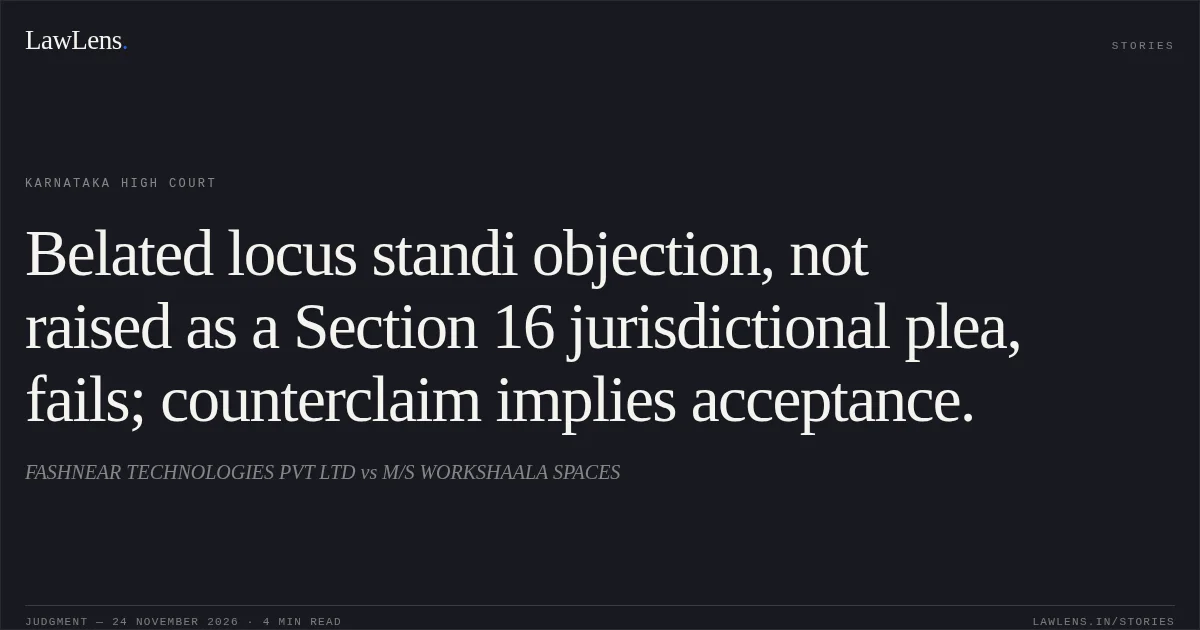
The appellant cannot, at the final stage and without a Section 16 application, dispute the claimant's locus standi or the Tribunal's jurisdiction, particularly after counter-claiming and receiving rent from the claimant.
¶ 9, 19–20The Court found no necessity to decide the Section 19 Partnership Act issue, since the Commercial Court had already permitted fresh arbitration in which the claimant could cure any representational defect.
¶ 17–18The appeal is dismissed as devoid of merit, and the Commercial Court's judgment dated 18.06.2024 in COM.AP No. 151/2023 stands. Parties remain free to commence fresh arbitration in accordance with law.
¶ 18, 21Original Court PDF
FASHNEAR TECHNOLOGIES PVT LTDvsM/S WORKSHAALA SPACES
Click to open original judgment
Original judgment, available to read, download and summarize on LawLens.in