Facts
The applicants (original accused) were convicted by the Judicial Magistrate First Class, Jetpur, in 2014 for an incident occurring on December 27, 2008.
Source reference: no citationThe prosecution alleged that while the victim 'X' and her cousin 'Y' were walking to a village Gaushala to fetch drinking water, the accused followed them on a motorcycle, whistled, made vulgar solicitations, and physically grabbed the victim’s arm.
Source reference: p. 16-17The Sessions Court, in a 2019 appeal, confirmed the conviction under Section 354 read with Section 114 of the IPC but reduced the sentence from two years' rigorous imprisonment to one year's simple imprisonment while increasing the fine.
Source reference: p. 1-2The applicants filed this revision challenging the conviction on grounds of delayed FIR, lack of a Test Identification Parade (TIP), and absence of independent witnesses.
Source reference: p. 3-4Issues
1. Whether the non-conduct of a Test Identification Parade and the absence of independent witnesses at the scene vitiated the conviction.
Source reference: p. 11 / para 5.22. Whether the seven-hour delay in lodging the FIR and the father’s role in narrating the complaint were fatal to the prosecution's case.
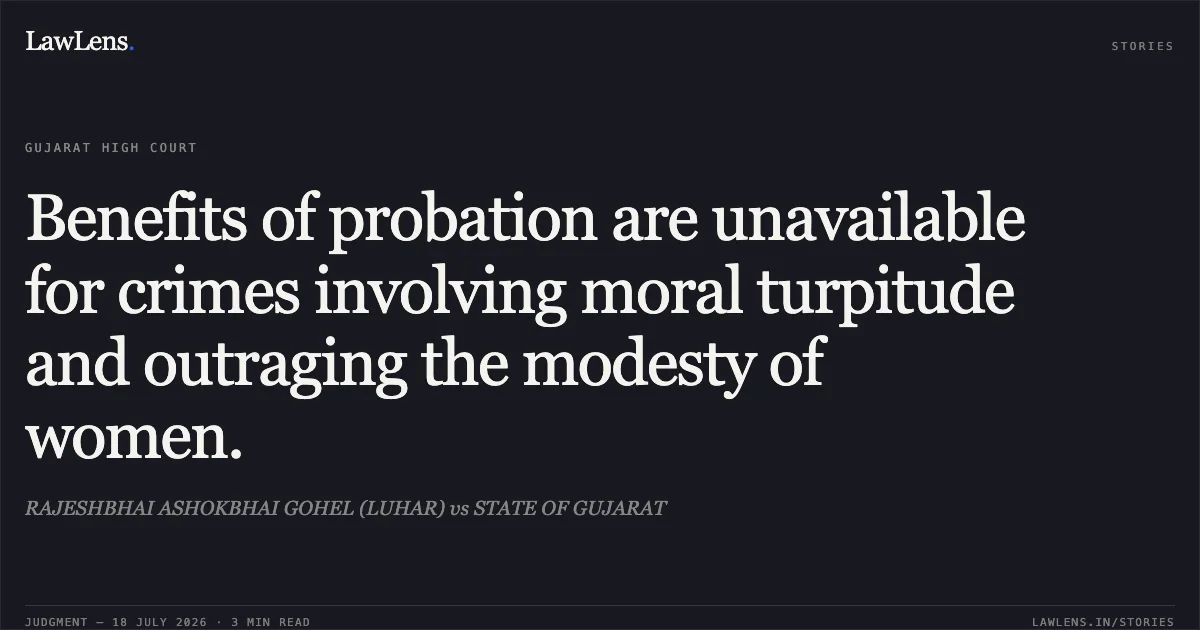
Source reference: p. 37 / para 233. Whether the benefit of probation under Section 4 of the Probation of Offenders Act, 1958, can be extended to an offense involving the outraging of a woman’s modesty.
Source reference: p. 42 / para 30Law Applied
The court primarily applied Section 354 of the IPC regarding assault or criminal force to a woman with intent to outrage her modesty, and Section 114 regarding abetment when the abettor is present.
Source reference: p. 2It relied on Vidyadharan v. State of Kerala, establishing that the offense is complete if the culprit knows his actions are likely to outrage modesty.
Source reference: p. 35Regarding witness credibility, it applied principles from Mukesh & others v. State of NCT of Delhi, holding that testimonies of relatives are reliable if intrinsically trustworthy.
Source reference: p. 38On the matter of sentencing, the court followed Ajahar Ali v. State of West Bengal and State of U.P. v. Shri Kishan, which dictate that probation is generally not available for crimes against women involving moral turpitude.
Source reference: p. 42-43Reasoning
The Court found the testimonies of the victim [Exh. 14] and the eyewitness cousin [Exh. 18] to be natural and consistent, noting that they identified the accused in the dock.
Source reference: p. 19-22The lack of independent witnesses was logically explained by the isolated location and dense winter mist at 8:00 AM.
Source reference: p. 34, 38The Court dismissed the challenge regarding the father’s role in the FIR, reasoning that in rural settings, it is natural for male heads to assist young girls in formalizing complaints against co-villagers.
Source reference: p. 37Furthermore, the presence of a domestic water tank did not discredit the victims' need to fetch potable water from the Gaushala, a fact supported by the defense’s own witness.
Source reference: p. 33The Court emphasized that for offenses under Section 354, the sole testimony of a trustworthy prosecutrix is sufficient for conviction.
Source reference: p. 34-35Holding
The Court upheld the conviction of the applicants under Section 354 read with Section 114 of the IPC, confirming the Sessions Court's modified sentence of one year's simple imprisonment.
The Court specifically denied the benefit of probation, holding that "roadside Romeos" committing crimes against the modesty of women—especially minors—do not qualify for such leniency regardless of the time elapsed since the incident.
Source reference: p. 42-44The revision application was dismissed, and the applicants were directed to surrender within eight weeks.
Source reference: p. 45-46Acts & Sections Cited
9 provisions across 3 statutes referred to in this judgment. Each provision opens on LawLens.
Code of Criminal Procedure, 19733
Indian Penal Code, 18605
Probation of Offenders Act, 19581
Original Court PDF
RAJESHBHAI ASHOKBHAI GOHEL (LUHAR)vsSTATE OF GUJARAT
Click to open original judgment
Original judgment, available to read, download and summarize on LawLens.in