Facts
Prior to 1992, the subject land in District Hardoi, U.P., was recorded as Category-6 (barren/non-agricultural/public utility land) under the U.P. Land Records Manual.
Source reference: para. 3In October 1992, the Sub-Divisional Officer (SDO) approved a recommendation to re-categorize the land to Category-5 (cultivable land), subsequently granting pattas (leases) to the appellant.
Source reference: para. 5During consolidation proceedings in 2016, a report revealed that the land was originally "public utility land" (specifically khalihan and pasture land) referable to Section 132 of the U.P. Zamindari Abolition and Land Reforms Act, 1950 ("Abolition Act"), making it ineligible for the conferment of bhumidhari rights.
Source reference: para. 8Consequently, the Consolidation Officer expunged the appellant’s name from the revenue records in 2019.
Source reference: para. 9The appellant challenged this, asserting that the SDO had the authority to change the land's category and that the proceedings were barred by res judicata due to a failed 1994 attempt to cancel the pattas.
Source reference: para. 11-12The High Court dismissed the writ petition, leading to this appeal.
Source reference: para. 10Issues
1. Whether the Sub-Divisional Officer possessed the statutory jurisdiction to re-categorize land from Category-6 to Category-5 to facilitate the grant of bhumidhari rights.
Source reference: para. 182. Whether the challenge to the pattas was barred by the principle of res judicata following the dismissal of cancellation proceedings in 1994.
Source reference: para. 33Law Applied
Section 132 of the Abolition Act mandates that bhumidhari rights shall not accrue in certain lands, including pasture lands, lands covered by water, or lands held for public purposes.
Source reference: para. 22Section 195 of the Abolition Act stipulates that admission to land by the Land Management Committee is subject to the prohibitions in Section 132.
Source reference: para. 20Legal maxim Quando aliquid prohibetur ex directo, prohibetur et per obliquum (what cannot be done directly cannot be done indirectly).
Source reference: para. 29Hinch Lal Tiwari v. Kamala Devi, emphasizing the protection of communal resources.
Source reference: para. 31Jagpal Singh v. State of Punjab, which prohibits the allotment of public utility land to private individuals through administrative manipulation.
Source reference: para. 32Reasoning
The Court observed that Category-6 land encompasses public utility areas like khalihan and pasture land, which fall strictly under the prohibitory ambit of Section 132 of the Abolition Act.
Source reference: para. 24It rejected the appellant's reliance on Paragraph Ka-155-Ka of the Land Records Manual, clarifying that the SDO's power to "transfer land from one class/category of khata to another" refers to the status of the tenure holder, not the physical character or classification of the land itself.
Source reference: para. 28The Court reasoned that only the State Government, under Section 117(6) of the Abolition Act and Section 77(2) of the U.P. Land Revenue Code, 2006, possesses the authority to change the class of public utility land, and only under stringent safeguards.
Source reference: para. 29Allowing subordinate officers to re-categorize land would render the statutory prohibitions of Section 132 nugatory.
Source reference: para. 29Regarding res judicata, the Court found that the 1994 dismissal was based on a threshold failure to prove the execution of the pattas, rather than an adjudication on the merits or legality of the lease; thus, the principle did not apply.
Source reference: paras. 35-36Holding
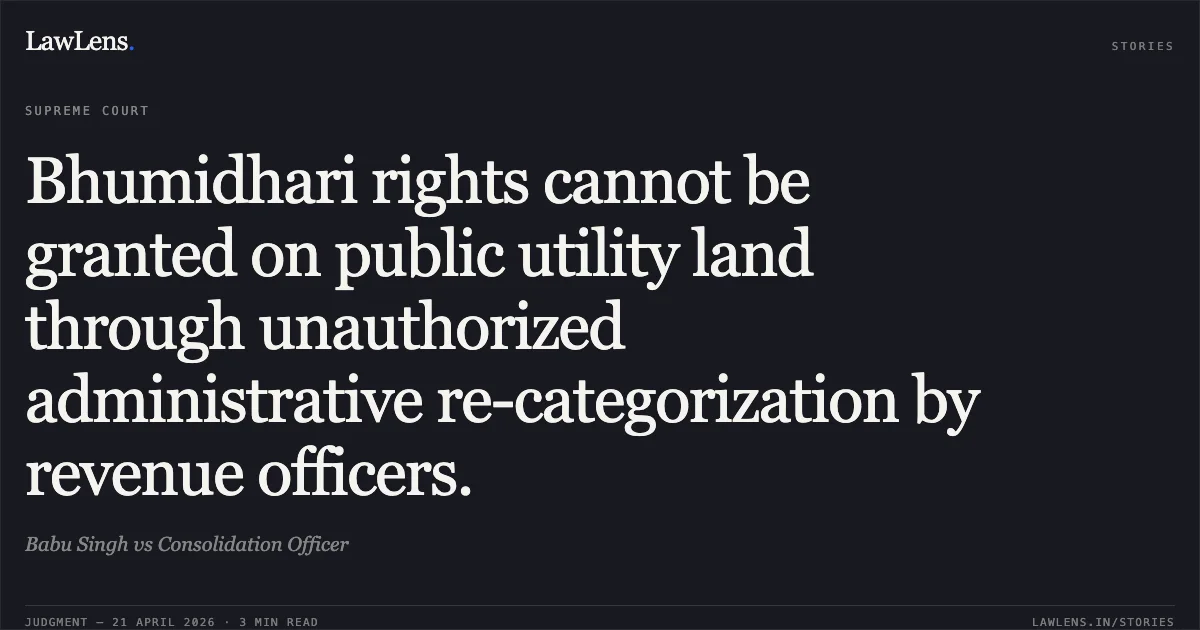
The Supreme Court dismissed the appeal, holding that the SDO lacked the jurisdiction to alter the land's category to circumvent Section 132 of the Abolition Act.
The Court held that the re-categorization was void, and consequently, the pattas granted to the appellant were void ab initio as bhumidhari rights cannot accrue on public utility land.
Source reference: para. 30The Court affirmed that consolidation authorities were justified in correcting the revenue records to reflect the land's original character.
Source reference: para. 10, 37No costs were ordered.
Source reference: para. 38Acts & Sections Cited
16 provisions across 6 statutes referred to in this judgment. Linked provisions open on LawLens.
U.P. Zamindari Abolition and Land Reforms Act, 19507
U.P. Land Revenue Act, 19013
U.P Consolidation of Holdings Act, 19533
U.P. Revenue Code, 20061
U.P. Primary Education Act, 19191
U.P. Municipalities Act, 19161
Original Court PDF
Babu SinghvsConsolidation Officer
Click to open original judgment
Original judgment, available to read, download and summarize on LawLens.in