01Facts
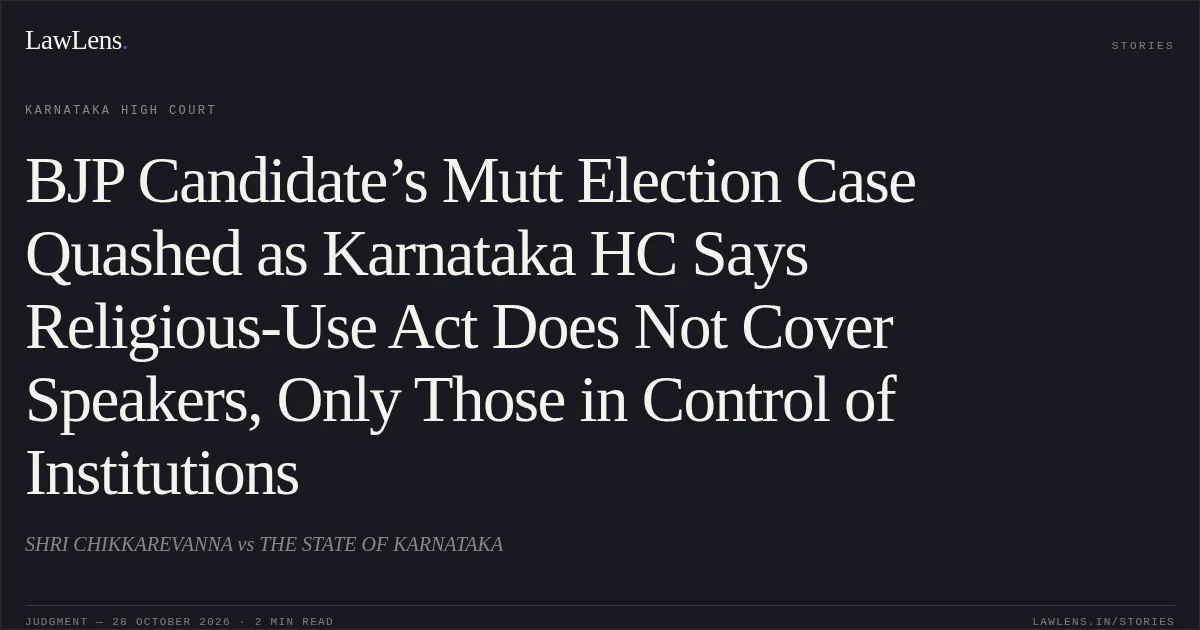
The petitioner, a BJP candidate in the 2023 Assembly election, attended and participated in a commemoration ceremony at a mutt while the Model Code of Conduct was in force.
pp. 2–5 · ¶ 2–5The complaint alleged that attendees raised slogans in his favour and that he promised to construct a building near a temple after the election.
pp. 2–5 · ¶ 2–5Following investigation, a charge sheet was filed in C.C. No. 784/2023 for offences including Sections 171E and 188 of the IPC and Sections 3, 6 and 7 of the Religious Institutions (Prevention of Misuse) Act, 1988.
pp. 2–5 · ¶ 2–5The petitioner sought quashing under Section 482 CrPC/Section 528 BNSS, contending, among other things, that he was neither the manager nor an official of the mutt
pp. 2–5 · ¶ 2–502Issues
i.1. Whether Sections 3 and 6 of the Religious Institutions (Prevention of Misuse) Act could be invoked against the petitioner, who was alleged to have used or spoken at a religious institution but was not its manager or person in control
pp. 5–7 · ¶ 5, 8–11ii.2. Whether the proceedings, including the allegation under Section 171E IPC, could continue against the petitioner on the facts alleged
pp. 7–13 · ¶ 12–1503Law Applied
Section 3 of the Religious Institutions (Prevention of Misuse) Act prohibits a religious institution or its manager from using, or permitting the use of, its premises for specified purposes, including political activity; the Court construed the provision as directed to the institution, its manager or the person in control, not the person using the premises or making a speech there
pp. 5–7 · ¶ 8–10Section 171E IPC punishes bribery, which is defined in Section 171B IPC and requires a gratification given or offered to induce or reward the exercise of an electoral right
pp. 9–11 · ¶ 14The Court also referred to a coordinate Bench decision in Crl.P. No. 1560/2024, which held that the ingredients of bribery require a person who gives or offers gratification and another person who is bribed or offered the gratification
pp. 8–13 · ¶ 14Provisions in the judgment · 14 · Linked ones open on LawLens
Code of Criminal Procedure, 1973 Section 482Section 155
Bharatiya Nagarik Suraksha Sanhita, 2023 Section 528
Indian Penal Code, 1860 Section 161Section 188
Religious Institutions (Prevention of Misuse) Act, 1988 Section 3Section 6Section 7
Representation of the People Act, 1951 Section 8Section 25Section 29Section 120Section 123Section 133
04Reasoning
The Court held that the allegations did not place the petitioner within the class of persons to whom Section 3 applies: responsibility for permitting the prohibited use lay with the mutt’s manager or the person in control, and any separate unlawful speech could be dealt with under other applicable provisions
pp. 6–7 · ¶ 9–11After excluding the Religious Institutions Act offences as against the petitioner, the Court noted that Section 171E IPC remained and was non-cognizable; it also recorded the petitioner’s reliance on the coordinate Bench’s decision concerning the ingredients of bribery
pp. 7–8 · ¶ 12–14In light of that decision and its own reasoning, the Court concluded that the proceedings against the petitioner should be quashed, without separately setting out a detailed application of Section 171E to each allegation in the complaint
p. 13 · ¶ 1505Holding
The petition was allowed, and the entire proceedings in C.C. No. 784/2023, arising from Crime No. 81/2023 of Ramdurg Police Station, were quashed insofar as the petitioner was concerned
pp. 13, order clauses (i)–(ii)Pending applications, if any, were disposed of
p. 14Original Court PDF
SHRI CHIKKAREVANNAvsTHE STATE OF KARNATAKA
Click to open original judgment
Original judgment, available to read, download and summarize on LawLens.in