01Facts
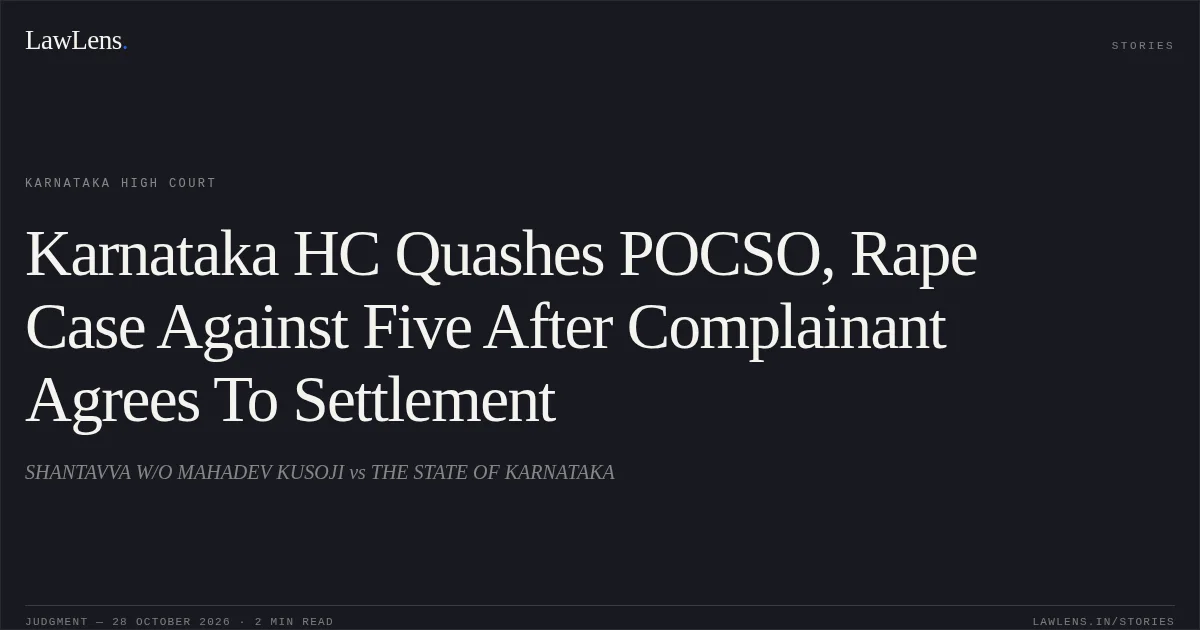
Respondent No. 2, the mother of the alleged victim, lodged a complaint against the five petitioners, leading to Crime No. 179/2025 and proceedings alleging offences under Sections 6 and 17 of the Protection of Children from Sexual Offences Act, 2012 (“POCSO Act”), Section 9 of the Child Marriage Restraint Act, and Sections 376, 376(3) and 498-A of the IPC.
pp. 3–8The petitioners sought to quash the proceedings under Section 528 of the BNSS/Section 482 of the CrPC.
pp. 3–8The complainant and accused No. 3 filed affidavits stating that the families had settled their dispute, that the complainant’s daughter and accused No. 3 were living together with a child, and that the complainant had no objection to quashing.
pp. 3–8The Court recorded that the case was pending investigation
pp. 3–802Issues
i.Whether the High Court could exercise its inherent jurisdiction to quash proceedings for non-compoundable offences on the basis of a settlement between the parties
pp. 9–10ii.Whether the settlement and circumstances placed before the Court justified quashing the proceedings against the petitioners
pp. 15–1703Law Applied
Section 528 of the BNSS and Section 482 of the CrPC preserve the High Court’s inherent power to quash criminal proceedings to secure the ends of justice or prevent abuse of process; that power is distinct from statutory compounding under Section 320 of the CrPC and may extend to non-compoundable offences.
pp. 9–13Relying on Narinder Singh v. State of Punjab, (2014) 6 SCC 466, the Court noted that the power must be exercised sparingly; serious and heinous offences, including rape, ordinarily should not be quashed merely because the parties have settled, while the nature of the dispute, the likelihood of conviction, the stage of proceedings, and the interests of justice are relevant considerations
pp. 9–13Provisions in the judgment · 11 · Linked ones open on LawLens
Bharatiya Nagarik Suraksha Sanhita, 2023 Section 528Section 359
Code of Criminal Procedure, 1973 Section 482Section 320
Protection of Children from Sexual Offences Act, 2012 Section 6Section 17
Indian Penal Code, 1860 Section 376Section 307Section 324Section 323Section 34
04Reasoning
The Court accepted the affidavits as establishing a voluntary settlement and noted that the complainant’s daughter and accused No. 3 were living together and had a child.
pp. 15–16It considered that the dispute had arisen between the families, that elders had intervened, and that continuation of the proceedings was unnecessary because the likelihood of conviction was remote.
pp. 15–16On that basis, it treated the settlement as sufficient to invoke its inherent jurisdiction, notwithstanding the non-compoundable nature of the alleged offences
pp. 15–1605Holding
The Court allowed the petition, accepted the compromise application, and quashed the proceedings in Crime No. 179/2025 and Special Case No. 91/2025 against all five petitioners for the offences specified in the order
p. 17Original Court PDF
SHANTAVVA W/O MAHADEV KUSOJIvsTHE STATE OF KARNATAKA
Click to open original judgment
Original judgment, available to read, download and summarize on LawLens.in