Facts
The Petitioner, a water and sewerage infrastructure company, was awarded a contract by the Respondent (DJB) in 2004
Source reference: p. 2Following a 2007 CBI FIR alleging corruption, the Respondent debarred the Petitioner from future tenders
Source reference: p. 2Though initial debarment circulars were quashed by the High Court for lack of due process, a formal blacklisting order was passed on March 28, 2008, stating the Petitioner would be barred until the CBI investigation concluded
Source reference: p. 3In 2013, the CBI Court convicted the Petitioner and its Managing Director under the IPC and Prevention of Corruption Act; appeals against this conviction remain pending
Source reference: p. 4, 8After several rounds of litigation, the Respondent issued a fresh impugned order on July 22, 2022, reiterating that the Petitioner remains debarred until the finalization of all court proceedings and appeals
Source reference: p. 4-5Issues
1. Whether an order of debarment/blacklisting can be for an indefinite or unlimited period of time
Source reference: p. 5 / para. 21(i)2. Whether the impugned order dated July 22, 2022, was passed mechanically and in violation of the Respondent's own enlistment rules and established legal precedents
Source reference: p. 5 / para. 21(iv)Law Applied
The Court primarily applied the principles regarding the proportionality and duration of debarment established by the Supreme Court of India in Kulja Industries Ltd. v. Chief General Manager (2014), which held that "debarment is never permanent" and must be commensurate with the seriousness of the case
Source reference: p. 10-11It further relied on Sabharwal Medicos Pvt. Ltd. v. Union of India (2013), which established that blacklisting during the pendency of criminal prosecution constitutes an impermissible indefinite period
Source reference: p. 13-14Additionally, the Court referred to the Rules for Enlistment of Contractors in Delhi Jal Board 2023, which prescribes a maximum debarment period of two years
Source reference: p. 8-9Reasoning
The Court observed that the impugned order failed to specify a time-bound duration, making it "open-ended" and dependent on the uncertain timeframe of judicial appeals
Source reference: p. 7The Court found that the Respondent's order was a mechanical reiteration of the 2008 order and failed to consider that the legal landscape regarding permanent blacklisting had evolved significantly since 2009
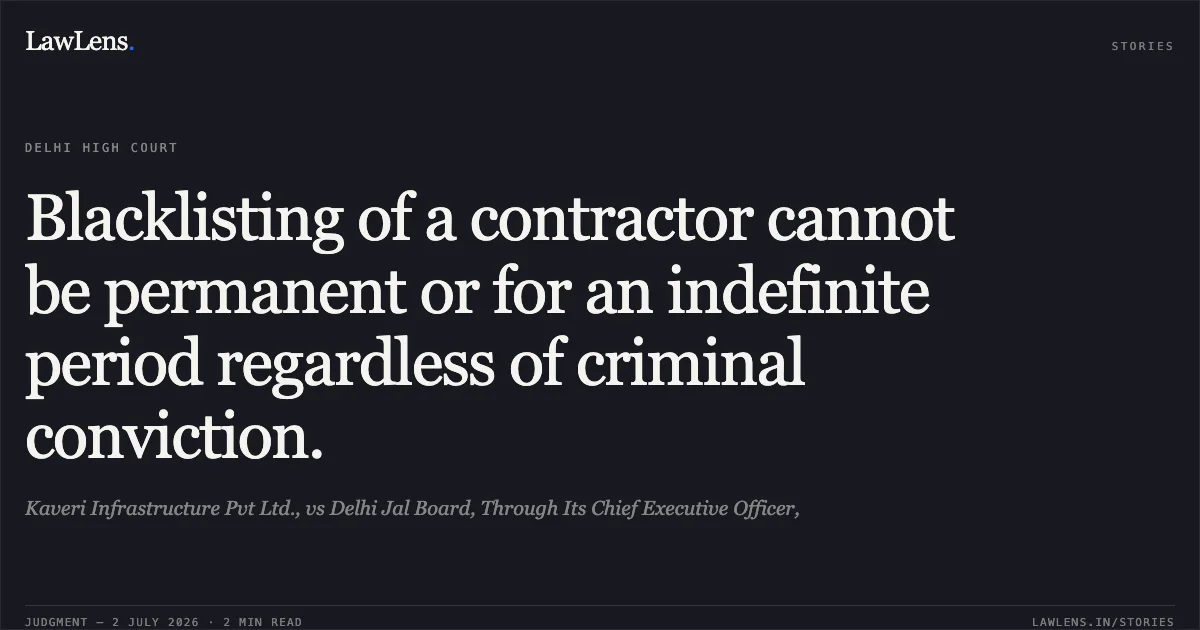
Source reference: p. 7, 15Applying Kulja Industries, the Court reasoned that even in cases involving fraud or corruption, the state cannot commercially eliminate a contractor indefinitely
Source reference: p. 11-12While the Petitioner’s conviction is a serious matter, it does not justify a permanent ban that exceeds the Respondent’s own internal guidelines (which limit debarment to two years) or the 18-year period the Petitioner has already served under debarment
Source reference: p. 8, 16The Court rejected the Respondent’s plea of limitation, holding that continued blacklisting constitutes a recurring cause of action
Source reference: p. 15Holding
The Court held that the impugned order dated July 22, 2022, was arbitrary, unlawful, and contrary to established law
The Court quashed the order and, noting that the Petitioner had already been blacklisted for 18 years (far exceeding the maximum prescribed period), declined to remand the matter for a fresh determination of the debarment period. The Court directed that the Petitioner is entitled to participate in all future tenders of the Delhi Jal Board, subject to fulfilling standard eligibility norms
Source reference: p. 16Acts & Sections Cited
1 provisions across 1 statute referred to in this judgment. Each provision opens on LawLens.
Prevention of Corruption Act, 19881
Original Court PDF
Kaveri Infrastructure Pvt Ltd.,vsDelhi Jal Board, Through Its Chief Executive Officer,
Click to open original judgment
Original judgment, available to read, download and summarize on LawLens.in