Facts
The appellant-contractor had been awarded several road-construction and resurfacing contracts by the Ahmedabad Municipal Corporation (“AMC”), valued at approximately ₹150.89 crores.
Source reference: paras. 2.1–2.3, 3; pp. 2–6During execution, AMC alleged deficiencies in the quality of work, including segregation in the concrete mix and failure to comply with prescribed standards.
Source reference: paras. 2.1–2.3, 3; pp. 2–6AMC thereafter passed Resolution No. 516 dated 10 August 2017 and issued a communication/order dated 15 September 2017 blacklisting the appellant for three years.
Source reference: para. 2.6; p. 5The appellant contended that it had not been issued a show-cause notice or given an opportunity of hearing before the blacklisting action.
Source reference: para. 2.8; p. 6It filed Civil Suit No. 1504 of 2018 seeking declarations that the resolution and order were illegal, arbitrary, contrary to natural justice, and void, along with a permanent injunction.
Source reference: para. 2.8; p. 6The Trial Court dismissed the suit principally on the ground that the appellant had not entered the witness box to prove its case.
Source reference: para. 4; p. 7During the proceedings, the three-year blacklisting period expired on 14 September 2020, but the appellant argued that the stigma continued to prejudice its business.
Source reference: paras. 8–9; pp. 10–11Issues
1. Whether AMC could blacklist the appellant without issuing a show-cause notice and affording an opportunity of hearing in accordance with the principles of natural justice
Source reference: para. 13(a); p. 122. Whether the appellant was required to enter the witness box to establish that the blacklisting order and resolution were passed without notice or hearing
Source reference: para. 13(b); p. 123. Whether the Trial Court erred in dismissing the suit on the ground that the appellant had not led oral evidence
Source reference: para. 13(c); p. 124. Whether expiry of the three-year blacklisting period rendered the appellant’s challenge infructuous
Source reference: paras. 8–9, 19; pp. 10–11, 24–25Law Applied
The Court exercised jurisdiction under Section 96 of the Code of Civil Procedure, 1908.
Source reference: para. 1; p. 1It considered Order XIV Rule 1 CPC, which requires issues to arise from material propositions of fact or law affirmed by one party and denied by the other, and Order XV Rule 1 CPC, which permits judgment where the parties are not at issue on any question of fact or law.
Source reference: paras. 16–18; pp. 23–24The Court applied the principles of natural justice, particularly a audi alteram partem, holding that blacklisting by the State or its instrumentalities must ordinarily be preceded by a meaningful show-cause notice and an opportunity to respond.
Source reference: paras. 14, 18; pp. 13–16Relying on *M/s. Erusian Equipment & Chemicals Ltd. v. State of West Bengal*, (1975) 1 SCC 70, and *Raghunath Thakur v. State of Bihar*, (1989) 1 SCC 229, the Court held that blacklisting has serious civil consequences and cannot be imposed without hearing.
Source reference: paras. 14, 18; pp. 13–16Relying on *Gorkha Security Services v. Government (NCT of Delhi)*, (2014) 9 SCC 105, and *Patel Engineering Ltd. v. Union of India*, (2012) 11 SCC 257, it further held that the notice must communicate both the alleged breaches and the specific proposed action of blacklisting, since blacklisting is a stigmatic and severe penalty.
Source reference: para. 14; pp. 16–22The Court also referred to Sections 101 and 102 of the Evidence Act, as relied upon by the appellant, concerning the burden of proof.
Source reference: paras. 7.2–7.3; pp. 8–10Reasoning
The Court found that AMC did not assert that any show-cause notice or opportunity of hearing had been provided before the resolution and order of blacklisting were passed.
Source reference: paras. 14–15, 18; pp. 13, 22–24Since AMC was an instrumentality falling within Article 12 of the Constitution, its power to exclude a contractor from future public contracts had to be exercised fairly, rationally, and consistently with Article 14.
Source reference: para. 14; pp. 13–22Blacklisting, described as having the effect of “civil death,” carried continuing commercial and reputational consequences and therefore required prior procedural fairness.
Source reference: para. 14; pp. 13–22The Court held that the central question was ascertainable from the undisputed documents and pleadings: the appellant alleged absence of notice, while AMC did not plead that notice and hearing had occurred.
Source reference: paras. 15–18; pp. 22–24Accordingly, the Trial Court adopted an erroneous and overly technical approach by insisting upon oral testimony from the appellant.
Source reference: paras. 15–18; pp. 22–24The expiry of the three-year period did not eliminate the controversy because the stigma of blacklisting could continue to affect the appellant’s ability to participate in future tenders.
Source reference: para. 19; p. 24The impugned action was therefore legally unsustainable for violation of natural justice, irrespective of the underlying allegations regarding defective work.
Source reference: no citationHolding
The High Court allowed the appeal and quashed and set aside the Trial Court’s judgment and decree dated 16 February 2026 in Civil Suit No. 1504 of 2018.
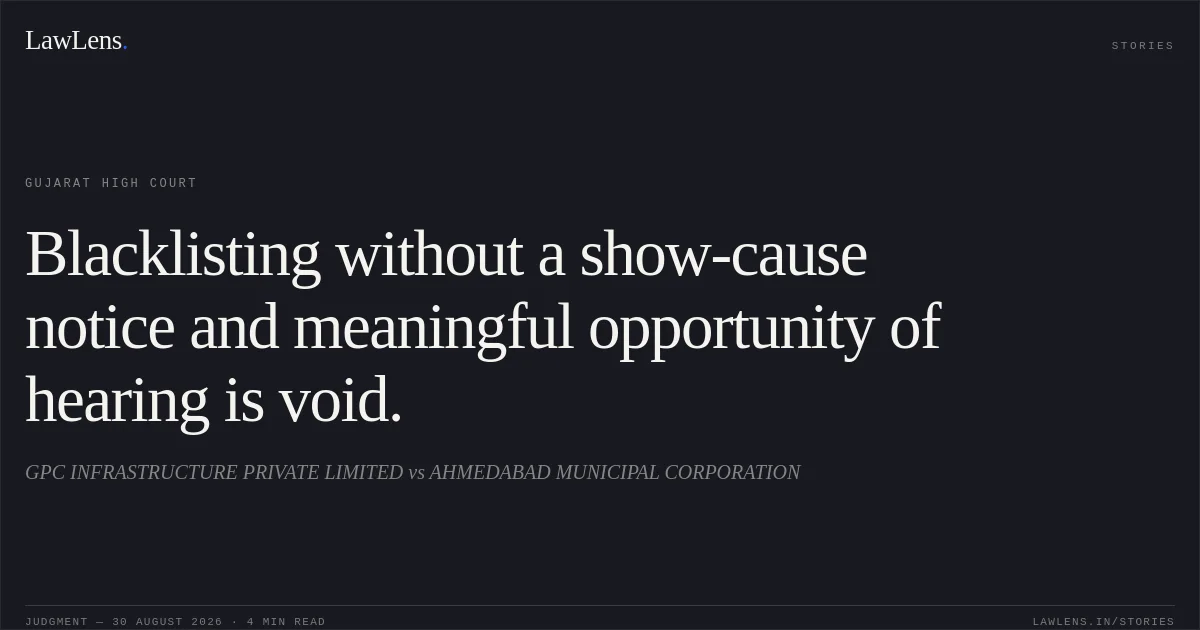
It further quashed and set aside AMC’s Resolution dated 10 August 2017 and order/communication dated 15 September 2017 blacklisting GPC Infrastructure Private Limited, holding that the action was void for having been taken without a prior show-cause notice and opportunity of hearing.
Source reference: para. 20; p. 25The decree was directed to be drawn, the record and proceedings were ordered to be returned to the Trial Court, and the connected civil application for stay was disposed of.
Source reference: para. 20; p. 25Acts & Sections Cited
1 provisions across 1 statute referred to in this judgment. Each provision opens on LawLens.
Code of Civil Procedure, 19081
Original Court PDF
GPC INFRASTRUCTURE PRIVATE LIMITEDvsAHMEDABAD MUNICIPAL CORPORATION
Click to open original judgment
Original judgment, available to read, download and summarize on LawLens.in
![A police constable cannot be removed for unauthorized absence without a Rule 359-compliant inquiry.. Mohammad Sidiq Khan vs D/o Home Ut Of Jammu & Kashmir. CAT - ['Srinagar']. LawLens](/stories/thumbnails/a-police-constable-cannot-be-removed-for-unauthorized-absence-without-a-rule-359-compliant-7b43fc316bd94f22a62676153bbc9d54.webp)
![A Review DPC lacks authority to determine or alter inter se seniority.. SAURABH KUMAR vs REVENUE. CAT - ['Patna']. LawLens](/stories/thumbnails/a-review-dpc-lacks-authority-to-determine-or-alter-inter-se-seniority-4b21640f20af46fcabdfc8273d2ce959.webp)