Facts
The plaintiffs claimed ownership of land bearing Survey No. 415, Block No. 303, admeasuring 0-65-76 hectare-sq. metre, at Mauje Bil, Vadodara, acquired under a registered Will and mutated in their names through Revenue Entry No. 2237.
Source reference: paras. 3.1, 8; pp. 2, 15–17They alleged that defendant No. 2, a broker, initially agreed to purchase the land and obtained their signatures on blank papers after paying an advance. Subsequently, allegedly in collusion with defendant No. 1, the defendants represented that the plaintiffs were signing a registered agreement to sell but procured execution and registration of a sale deed dated 7 July 2011 in favour of defendant No. 1.
Source reference: paras. 3.2–3.5; pp. 2–4The plaintiffs asserted that only Rs. 50 lakhs was paid, although the sale deed recorded consideration of approximately Rs. 85.34 lakhs, and that possession remained with them.
Source reference: paras. 3.5–3.7; pp. 3–4The Trial Court dismissed the suit in Special Civil Suit No. 181 of 2012 by judgment and decree dated 10 May 2024, leading to the present appeal under Section 96 CPC.
Source reference: paras. 1, 3.8–3.12; pp. 1, 5–6Issues
1. Whether the plaintiffs established that the sale deed was obtained under the guise of an agreement to sell by fraud or misrepresentation?
Source reference: para. 7(i); p. 142. Whether the plaintiffs established non-payment of the full sale consideration and, consequently, that title did not pass to defendant No. 1?
Source reference: para. 7(ii); p. 143. Whether the plaintiffs were entitled to challenge the transaction on the ground that it was prohibited by the Gujarat Prevention of Fragmentation and Consolidation of Holdings Act, 1947?
Source reference: para. 7(iii); p. 144. Whether the Trial Court committed an error in dismissing the plaintiffs’ suit?
Source reference: para. 7(iv); p. 14Law Applied
The Court applied Sections 5 and 54 of the Transfer of Property Act, 1882, under which a sale is a transfer of ownership for a price paid, promised, or partly paid and partly promised; non-payment of part of the consideration does not invalidate a registered sale unless the deed makes transfer of title conditional upon complete payment.
Source reference: paras. 18–20; pp. 21–23Relying on Dahiben v. Arvindbhai Kalyanji Bhanusali, the Court held that the vendor’s remedy for unpaid consideration is ordinarily recovery of money, not cancellation of the sale deed.
Source reference: para. 19; pp. 22–23Under Hemalatha (D) by LRs v. Tukaram (D) by LRs, a registered sale deed carries a strong presumption of valid execution and genuineness, which can be displaced only by specific pleadings and cogent evidence of fraud, coercion, mistake, incapacity, or fundamental illegality; vague allegations do not satisfy Order VI Rule 4 CPC.
Source reference: paras. 21–22; pp. 23–25The Court also considered the principle of non est factum recognised in Bismillah v. Janeshwar Prasad and Ramathal v. K. Rajamani, as well as the law concerning fragmentation under the Gujarat/Bombay Fragmentation Act discussed in Damodhar Narayan Sawale v. Shri Tezrao Bajirao Mhaske.
Source reference: paras. 5.3–5.6, 25–28; pp. 8–9, 26–29Reasoning
The Court found that the plaintiffs’ pleadings concerning the alleged fraud were general and lacked material particulars, including specific dates, events, or evidence showing how the defendants had prevented them from understanding the document.
Source reference: paras. 9–12, 22; pp. 18–19, 24–25The plaintiffs voluntarily attended the Sub-Registrar’s office, signed the sale deed on every page, and participated in a registration process lasting nearly one hour. The registered document also contained the plaintiffs’ acknowledgment of execution, and no supporting evidence established that they had been falsely told that they were signing only an agreement to sell.
Source reference: paras. 10–17; pp. 18–21On consideration, the sale deed expressly recorded payment of the full amount, cash-payment vouchers were produced, and the defendant produced bank records showing encashment of cheques and withdrawal of cash. The Court accordingly accepted the Trial Court’s finding that the consideration had been paid.
Source reference: paras. 17–20, 24; pp. 21–23, 26In any event, even assuming some balance remained unpaid, Sections 54 and the rule in Dahiben established that the registered sale would remain valid because the deed contained no clause making transfer of title conditional upon full payment.
Source reference: paras. 17–20, 24; pp. 21–23, 26The fragmentation plea also failed because the plaintiffs produced no evidence that any portion of the land had been acquired for a road or that the land sold was a prohibited fragment. The sale was of the property as a whole on an “as is where is” basis, and no competent revenue or statutory authority had declared the transaction void or voidable.
Source reference: paras. 25–28; pp. 26–29Holding
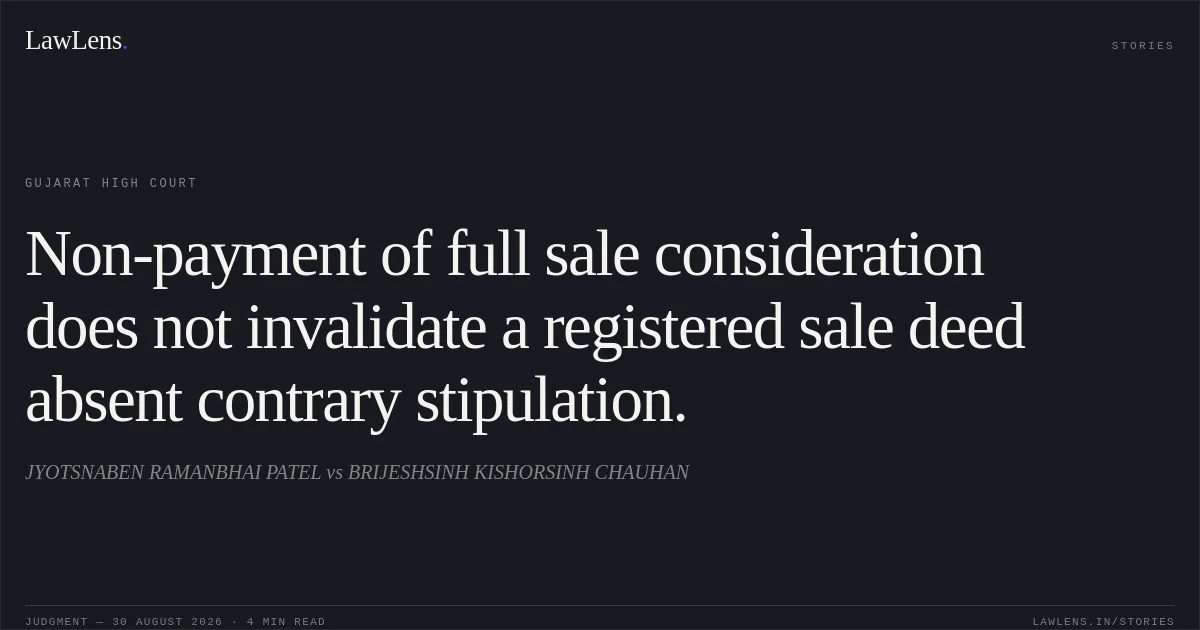
The High Court held that the plaintiffs failed to prove fraud, misrepresentation, non-payment of consideration, or violation of the Fragmentation Act. The registered sale deed was therefore valid, and title had passed to defendant No. 1 upon its execution and registration.
The First Appeal was dismissed, and the Trial Court’s judgment and decree dated 10 May 2024 in Special Civil Suit No. 181 of 2012 were confirmed.
Source reference: para. 31; p. 29Interim relief, if any, was vacated; the connected civil applications were disposed of as not surviving.
Source reference: Further Order; pp. 29–30The plaintiffs were permitted to withdraw the amount deposited before the Trial Court, with accrued interest, subject to verification of identity, but their request to suspend operation of the judgment for four weeks was refused.
Source reference: Further Order; pp. 29–30Acts & Sections Cited
5 provisions across 3 statutes referred to in this judgment. Each provision opens on LawLens.
Code of Civil Procedure, 19082
Transfer of Property Act, 18822
Indian Contract Act, 18721
Original Court PDF
JYOTSNABEN RAMANBHAI PATELvsBRIJESHSINH KISHORSINH CHAUHAN
Click to open original judgment
Original judgment, available to read, download and summarize on LawLens.in
![A police constable cannot be removed for unauthorized absence without a Rule 359-compliant inquiry.. Mohammad Sidiq Khan vs D/o Home Ut Of Jammu & Kashmir. CAT - ['Srinagar']. LawLens](/stories/thumbnails/a-police-constable-cannot-be-removed-for-unauthorized-absence-without-a-rule-359-compliant-7b43fc316bd94f22a62676153bbc9d54.webp)
![A Review DPC lacks authority to determine or alter inter se seniority.. SAURABH KUMAR vs REVENUE. CAT - ['Patna']. LawLens](/stories/thumbnails/a-review-dpc-lacks-authority-to-determine-or-alter-inter-se-seniority-4b21640f20af46fcabdfc8273d2ce959.webp)