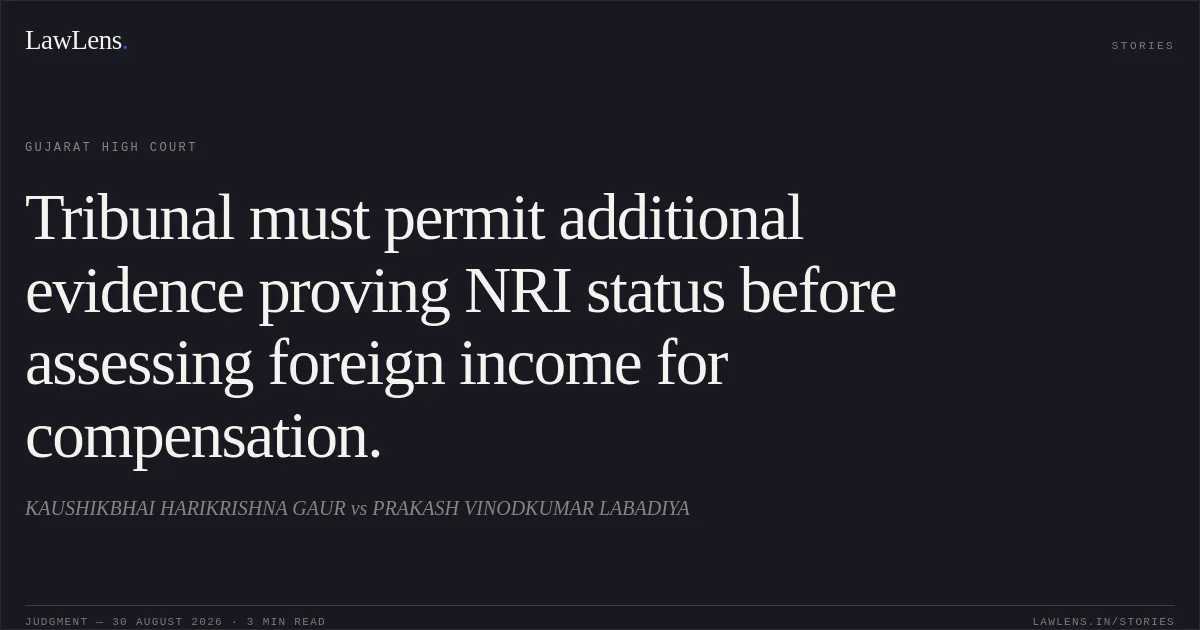
Facts
On 25 February 2013, the appellant-claimant was walking near Mukti Maidan, Ahmedabad, when respondent no. 1 allegedly drove car registration no. GJ-01-KA-1591 rashly and negligently, striking him from behind and causing grievous and fracture injuries.
Source reference: paras. 2; p. 2The claimant instituted MACP No. 480 of 2013 before the Motor Accident Claims Tribunal (Auxiliary), City Civil & Sessions Court, Ahmedabad. The Tribunal partly allowed the claim petition and awarded compensation of Rs. 2,32,000/- with interest at 9% per annum from the date of filing until realization.
Source reference: paras. 1, 4; pp. 1–2The claimant challenged the award only on the question of quantum, contending that he was an NRI working in the United Kingdom and that his income should have been assessed on the basis of documentary evidence or the applicable U.K. minimum wage.
Source reference: para. 5; p. 2; para. 7; p. 3The insurer disputed that the claimant’s NRI status had been proved, particularly because his passport had not been produced and proved in evidence.
Source reference: para. 8; p. 3Issues
1. Whether the Tribunal properly assessed the claimant’s income for determining compensation despite the claimant’s assertion that he was an NRI employed in the United Kingdom?
Source reference: paras. 7–10; pp. 3–42. Whether the claimant should be permitted to lead additional evidence to establish his NRI status and relevant income for reassessment of compensation?
Source reference: paras. 10–11; p. 43. Whether the Tribunal’s award should be set aside and the claim petition remanded for fresh adjudication?
Source reference: paras. 11–12; p. 4Law Applied
The Court applied the principles governing determination of just compensation in motor accident claims, including the requirement that the claimant’s established income and other relevant evidence must form the basis for assessing compensation.
Source reference: paras. 10–12; p. 4It further applied the procedural principle that where material evidence relevant to the quantum of compensation has not been properly proved, the appellate court may set aside the award and remit the matter to the Tribunal to permit the parties to lead evidence and secure a proper adjudication.
Source reference: paras. 10–12; p. 4Reasoning
The claimant relied on documents at Exhibits 36 to 39 and asserted that, as an NRI, his income should be assessed with reference to U.K. minimum wages, after deduction of applicable income tax.
Source reference: para. 7; p. 3However, the Court found that the essential foundational fact—his NRI status at the time of the accident—had not been established because the passport had not been proved in evidence.
Source reference: para. 10; p. 4Although the claimant relied on an affidavit attested by the U.K. Consulate, the Court considered that additional evidence was necessary to determine his status and, consequently, the appropriate income for calculating compensation.
Source reference: para. 9; p. 4Since the disputed evidence could materially affect the quantum, the Court held that the matter should be remanded rather than finally reassessed on the existing record.
Source reference: para. 11; p. 4Holding
The appeal was partly allowed.
The Gujarat High Court set aside the Tribunal’s judgment and award dated 23 July 2024 and remanded the claim petition for fresh adjudication.
Source reference: para. 12; p. 4The Tribunal was directed to permit both parties to lead evidence on the relevant issues, particularly the claimant’s NRI status and income, and to decide the matter expeditiously, preferably within six months from receipt of the High Court’s order.
Source reference: para. 12; p. 4Any amount deposited with the High Court Registry was directed to be transmitted to the Tribunal, and the record and proceedings were ordered to be returned.
Source reference: paras. 13–14; p. 5No order as to costs was made.
Source reference: para. 14; p. 5Original Court PDF
KAUSHIKBHAI HARIKRISHNA GAURvsPRAKASH VINODKUMAR LABADIYA
Click to open original judgment
Original judgment, available to read, download and summarize on LawLens.in
![A police constable cannot be removed for unauthorized absence without a Rule 359-compliant inquiry.. Mohammad Sidiq Khan vs D/o Home Ut Of Jammu & Kashmir. CAT - ['Srinagar']. LawLens](/stories/thumbnails/a-police-constable-cannot-be-removed-for-unauthorized-absence-without-a-rule-359-compliant-7b43fc316bd94f22a62676153bbc9d54.webp)
![A Review DPC lacks authority to determine or alter inter se seniority.. SAURABH KUMAR vs REVENUE. CAT - ['Patna']. LawLens](/stories/thumbnails/a-review-dpc-lacks-authority-to-determine-or-alter-inter-se-seniority-4b21640f20af46fcabdfc8273d2ce959.webp)