Facts
The petitioner, a contract worker, maintained Savings Bank Account No. 505118210004021 with Bank of India, Morigaon Branch.
Source reference: p.2, para. 2The account had allegedly been frozen since March 2026 pursuant to communication from cyber-crime authorities concerning a disputed transaction of ₹4,990 received through the National Cyber Crime Reporting Portal (NCCRP).
Source reference: p.2, para. 3; p.5, para. 12The petitioner claimed that the bank neither supplied the relevant details nor acted upon his representations, and that the blanket freeze prevented him from accessing the account’s credit balance of ₹40,790, affecting his business and livelihood.
Source reference: pp.2–3, paras. 3–5He therefore invoked the writ jurisdiction of the Gauhati High Court seeking relief against the freezing of the account.
Source reference: no citationIssues
1. Whether the petitioner’s entire bank account could remain frozen in connection with a cyber-fraud complaint involving a disputed amount of ₹4,990, without quantifying the amount or limiting the period of restraint.
Source reference: pp.4–5, paras. 8–102. Whether the interests of the cyber-fraud investigation could be balanced with the petitioner’s right to operate his bank account by retaining only the disputed amount under lien.
Source reference: p.5, paras. 14–15Law Applied
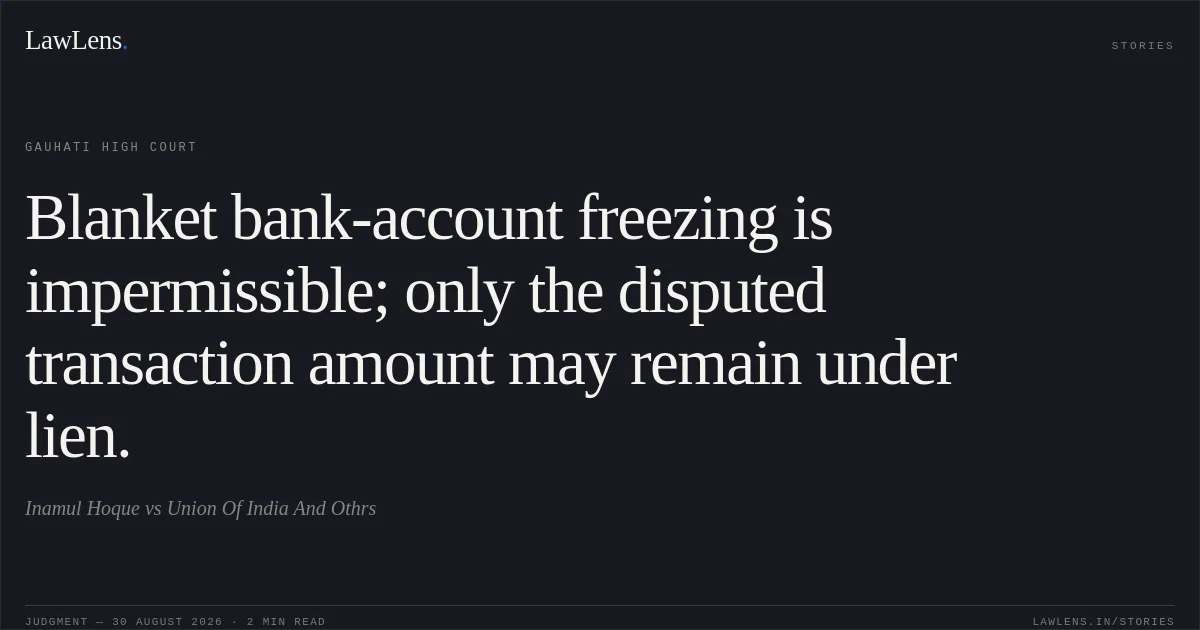
The Court applied the principle that a blanket freezing of an entire bank account, under the guise of investigation, should not be disproportionate where the disputed amount can be identified and secured; the restraint should be suitably limited to protect both the investigation and the rights of an innocent account holder.
Source reference: p.4, paras. 8–9It relied upon Mohammed Saifullah v. Reserve Bank of India & Ors., where the Madras High Court held that freezing an entire account without quantifying the amount or specifying the period may violate fundamental rights.
Source reference: p.4, para. 8Neelkanth Pharma Logistics Pvt. Ltd. v. Union of India & Anr., concerning the need to balance the complainant’s interests against the hardship caused to an account holder by blanket freezing.
Source reference: pp.4–5, para. 9Mr. Kartik Yogeshwar Chatur v. Union of India & Ors., which considered attachment/freezing of bank accounts in the context of Section 106 of the Bharatiya Nagarik Suraksha Sanhita.
Source reference: p.5, para. 10The Court further applied the equitable principle that the interests of cyber-fraud investigations must be balanced against the rights of a bona fide account holder.
Source reference: p.5, para. 14Reasoning
The Court accepted that the account had been frozen pursuant to cyber-crime complaints and recognised the seriousness of cyber fraud.
Source reference: p.5, paras. 12–14However, it found that justice required a balance between preserving the disputed amount for the investigation and avoiding unnecessary hardship to the petitioner by disabling the entire account.
Source reference: p.5, para. 14Since the alleged disputed transaction was ₹4,990, the Court considered it sufficient to secure that amount by imposing a lien, while permitting the petitioner to operate the remainder of the account.
Source reference: p.6, paras. 15–16This approach preserved the investigative authorities’ claim over the disputed funds without endorsing a disproportionate blanket freeze.
Source reference: no citationHolding
The Court disposed of the writ petition and directed Bank of India, Morigaon Branch, to defreeze Savings Bank Account No. 505118210004021 forthwith.
The bank was directed to retain a lien over ₹4,990 until further directions were issued by the authorities that had instructed the freeze.
Source reference: p.6, para. 16(b)No order as to costs was made.
Source reference: p.6, para. 16(c)Acts & Sections Cited
1 provisions across 1 statute referred to in this judgment. Each provision opens on LawLens.
Bharatiya Nagarik Suraksha Sanhita, 20231
Original Court PDF
Inamul HoquevsUnion Of India And Othrs
Click to open original judgment
Original judgment, available to read, download and summarize on LawLens.in
![A police constable cannot be removed for unauthorized absence without a Rule 359-compliant inquiry.. Mohammad Sidiq Khan vs D/o Home Ut Of Jammu & Kashmir. CAT - ['Srinagar']. LawLens](/stories/thumbnails/a-police-constable-cannot-be-removed-for-unauthorized-absence-without-a-rule-359-compliant-7b43fc316bd94f22a62676153bbc9d54.webp)
![A Review DPC lacks authority to determine or alter inter se seniority.. SAURABH KUMAR vs REVENUE. CAT - ['Patna']. LawLens](/stories/thumbnails/a-review-dpc-lacks-authority-to-determine-or-alter-inter-se-seniority-4b21640f20af46fcabdfc8273d2ce959.webp)