Facts
The Brihanmumbai Municipal Corporation (BMC), the planning authority for Mumbai, proposed to construct a 2,064-metre, four-lane cable-stayed bridge connecting Versova and Madh Island across Malad Creek.
Source reference: paras. 6.1–6.3, 7.1–7.3A portion of the project fell within CRZ-IA mangrove areas, the 50-metre mangrove buffer, CRZ-IB, CRZ-II, CRZ-III and CRZ-IV zones.
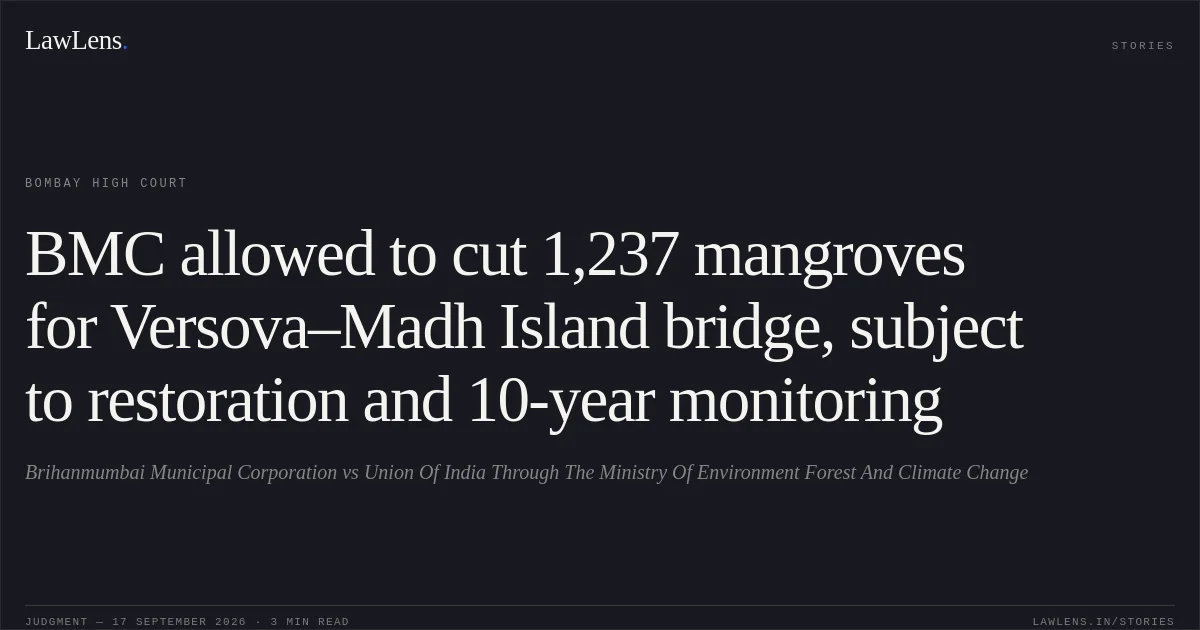
Source reference: para. 6.2The revised proposal recorded that approximately 2.7515 hectares of mangrove area and 1,237 mangroves would be affected, with approximately 2.5 hectares proposed for in-situ restoration and about 0.20 hectares permanently lost due to the bridge piers and pylons.
Source reference: paras. 6.4–6.7, 9.7–9.9The BMC proposed compensatory plantation of approximately 39,000 mangroves over nine hectares of degraded mangrove forest land and deposited ₹1,42,02,808 towards plantation, protection, operation and maintenance for ten years.
Source reference: paras. 7.15, 9.9Issues
Whether the High Court should permit the cutting of 1,237 mangroves over approximately 2.7515 hectares for construction of the proposed Versova–Madh Island bridge, notwithstanding the protection accorded to mangroves under earlier High Court orders?
Source reference: para. 9Whether the proposed project satisfied the requirements of larger public interest and sustainable development through statutory scrutiny, environmental safeguards, restoration and compensatory plantation measures?
Source reference: paras. 9.1–9.12Whether permission should be made conditional upon strict compliance with the undertaking, restoration plan, statutory permissions and periodic monitoring for ten years?
Source reference: paras. 9.12, 9.15–9.16Law Applied
The Court exercised its jurisdiction under Article 226 of the Constitution and applied the public trust doctrine recognised in Bombay Environmental Action Group v. State of Maharashtra, under which mangroves cannot be destroyed for private, commercial or other purposes unless the intervention is demonstrably required in public interest, while recognising the exception for projects necessary for public good under paragraph 83(viii) of that judgment.
Source reference: paras. 9.1, 9.16It applied the principle of sustainable development, requiring a balance between environmental protection and legitimate developmental activity, as explained in N.D. Jayal v. Union of India, Vellore Citizens’ Welfare Forum v. Union of India, and M.C. Mehta v. Union of India.
Source reference: paras. 9.6, 9.14The project was assessed under the Coastal Regulation Zone Notification, 2019, including clauses 5.1.1, 5.1.2, 5.2 and 10.3, and was subject to the recommendations and conditions of MCZMA and other competent authorities.
Source reference: paras. 6.3, 7.14, 9.10The Court also relied on the principle that courts ordinarily do not substitute their assessment for that of expert statutory authorities in policy and infrastructure matters where environmental safeguards have been considered.
Source reference: para. 9.2Reasoning
The Court held that the bridge was a public infrastructure project intended to provide direct connectivity between Versova and Madh Island, reduce the existing travel distance from approximately 22 kilometres to 1.5 kilometres, divert traffic from congested roads and significantly reduce projected carbon dioxide emissions.
Source reference: paras. 9.3–9.5Although public purpose alone could not justify environmental destruction, the project had undergone environmental assessment and statutory scrutiny, and its alignment had been adjusted to avoid obstructing local fishermen’s boats.
Source reference: paras. 9.6–9.7The Court gave weight to the proposed in-situ restoration of approximately 2.5 hectares, the limited permanent loss of approximately 0.20 hectares, plantation of approximately 39,000 mangroves over nine hectares, the deposited restoration costs and ten-year maintenance obligations.
Source reference: paras. 9.8–9.9Since the alignment did not pass through a protected area or eco-sensitive zone and MCZMA had confirmed that the project was permissible under the CRZ Notification, 2019, the Court concluded that the project represented a permissible reconciliation of environmental protection and substantial public interest.
Source reference: para. 9.10–9.11The Court nevertheless made permission conditional on strict compliance with all statutory conditions, the restoration plan and the BMC’s undertaking, warning that breach could attract both civil and criminal consequences.
Source reference: paras. 9.12, 9.15Holding
The Court answered the issues in favour of the BMC.
It held that the proposed bridge was justified by larger public interest and fell within the exception permitting limited intervention affecting mangroves under Bombay Environmental Action Group.
Source reference: para. 9.16The writ petition was allowed in terms of prayer clause (a), and the BMC was permitted to cut 1,237 mangroves over 2.7515 hectares for construction of the Versova–Madh Island bridge, subject to all conditions imposed by the competent authorities, the proposed in-situ restoration and compensatory plantation measures, the undertaking furnished by the BMC, and periodic monitoring for ten years.
Source reference: paras. 9.15–9.18Rule was made absolute.
Source reference: no citationOriginal Court PDF
Brihanmumbai Municipal CorporationvsUnion Of India Through The Ministry Of Environment Forest And Climate Change
Click to open original judgment
Original judgment, available to read, download and summarize on LawLens.in