01Facts
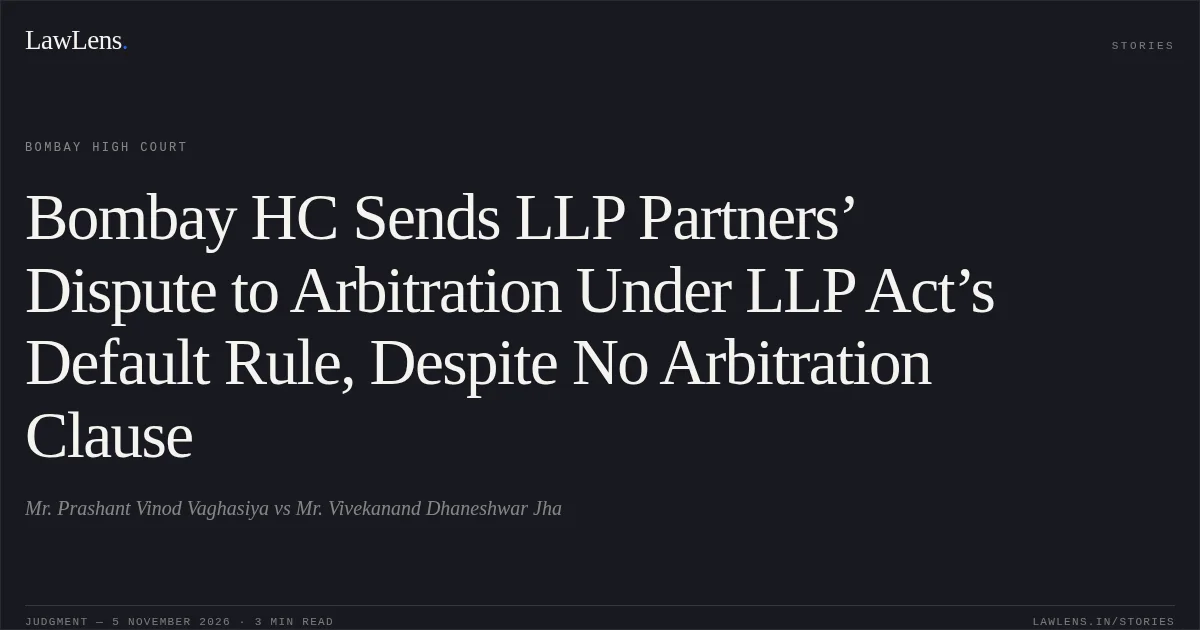
The petitioners sought appointment of an arbitrator under Section 11(6) of the Arbitration and Conciliation Act, 1996, in disputes concerning Avighnaa Infra Buildcon LLP.
p. 1The parties had entered into multiple LLP and supplementary agreements over time, but none contained an express arbitration clause.
pp. 1, 3–5The petitioners relied on Section 23(4) and Entry 14 of the First Schedule to the Limited Liability Partnership Act, 2008, which provide for arbitration of certain disputes between partners.
pp. 5–6, 8–9Respondent No. 1 opposed the petition, including on the grounds that a settlement agreement dated 7 December 2025 had resolved the disputes, that the Section 21 notice had been issued only by Petitioner No. 1, and that the agreement’s Mumbai-courts jurisdiction clause precluded arbitration.
pp. 1–2, 12–13Other respondents and a proposed intervenor sought participation in the arbitration.
pp. 2, 15–1702Issues
i.Whether, despite the absence of an express arbitration clause, the parties’ disputes could be referred to arbitration under Section 23(4) and Entry 14 of the First Schedule to the LLP Act.
pp. 5–6, 9–10ii.Whether the Mumbai-courts jurisdiction clause, the disputed settlement agreement, or the absence of a Section 21 notice from Petitioner No. 2 barred appointment of an arbitrator.
pp. 10–13, 15iii.Whether non-signatories or other proposed participants could be joined in the arbitration at the referral stage.
pp. 15–1703Law Applied
Section 23(4) of the Limited Liability Partnership Act, 2008 provides that, where the LLP agreement makes no provision on a matter, the partners’ mutual rights and duties are determined by the First Schedule; Entry 14 directs that disputes between partners arising out of the LLP agreement, and not resolvable under that agreement, be referred to arbitration under the Arbitration and Conciliation Act, 1996.
pp. 8–10The Court applied Indus Mobile Distribution Private Limited v. Datawind Innovations Private Limited to interpret the Mumbai jurisdiction clause as identifying the courts with jurisdiction in arbitration-related proceedings, rather than as excluding arbitration.
pp. 10–12It relied on SBI General Insurance Company Limited v. Krish Spinning in rejecting the settlement/accord-and-satisfaction objection at the referral stage.
p. 13It relied on ASF Buildtech Private Limited v. Shampoorji Pallonji and Company Private Limited for the arbitral tribunal’s authority to determine whether non-signatories are bound and should be impleaded.
pp. 15–17The Court also referred to Maverick Motors LLP v. Rohith Murthy in support of referring a dispute to arbitration under Entry 14 where the LLP agreement contains no express arbitration clause.
p. 12Provisions in the judgment · 15 · Linked ones open on LawLens
Arbitration and Conciliation Act, 1996 Section 2Section 7Section 8Section 11Section 12Section 21
Limited Liability Partnership Act, 2008 9 provisions
Section 2Section 3Section 6Section 7Section 11Section 12Section 23Section 27Section 2804Reasoning
The Court found that the petitioners and Respondent No. 1 had been partners of the LLP at relevant times and that their disputes arose from their LLP relationship and the related agreements.
pp. 13–15As the agreements contained no dispute-resolution provision, Entry 14 supplied the basis for statutory arbitration.
pp. 8–10, 12–15The Mumbai jurisdiction clause was not inconsistent with arbitration; the Court construed it as conferring jurisdiction on Mumbai courts for arbitration-related remedies and accordingly fixed Mumbai as the place of sitting.
pp. 10–12, 17The disputed settlement agreement did not defeat the referral, particularly because the petitioners challenged it; likewise, the Court held that the notice’s purpose was to calculate limitation and that the failure to issue it on behalf of Petitioner No. 2 was not a bar.
p. 13, 15Questions concerning the participation of non-signatories were left for the arbitrator to determine on application.
pp. 15–1705Holding
The Court allowed the petition and appointed retired Justice R. D. Dhanuka as sole arbitrator to adjudicate the disputes between the petitioners and Respondent No. 1.
p. 18The place of sitting was fixed at Mumbai, and the parties were permitted to raise their respective areas of dispute and contentions before the arbitrator.
pp. 18–19Respondent Nos. 2–4 and the proposed intervenor were granted liberty to seek impleadment before the arbitrator, who would decide the applications.
p. 17The petition and pending interim application were disposed of.
p. 20Original Court PDF
Mr. Prashant Vinod VaghasiyavsMr. Vivekanand Dhaneshwar Jha
Click to open original judgment
Original judgment, available to read, download and summarize on LawLens.in