01Facts
Under a registered Leave and Licence Agreement dated 4 May 2017, the Applicant licensed premises to the Respondent for a term ending 30 April 2022.
¶ 2–7The Applicant claimed arrears and other dues, ultimately seeking ₹3,56,39,549 with interest; the Respondent disputed liability and raised objections including limitation and the calculation of the claim.
¶ 2–7Clause XXXVIII provided for each party to appoint one arbitrator and for the Licensor to appoint a third arbitrator in the event of a deadlock.
¶ 33After an earlier Section 11 application was withdrawn with liberty to refile following proper service, the Applicant served a notice seeking the Respondent’s consent to appoint a sole arbitrator. The Respondent refused.
¶ 4The Applicant then applied under Section 11 for appointment of a sole arbitrator; the Respondent objected that the Applicant had not followed the agreed appointment procedure.
¶ 8–902Issues
i.1. Whether the Applicant’s request for the Respondent’s consent to appoint a sole arbitrator, rather than a request to appoint an arbitrator under Clause XXXVIII, established failure of the agreed procedure sufficient to invoke Section 11(6).
¶ 34–41ii.2. Whether the Licensor’s contractual power to appoint the third arbitrator could be acted upon consistently with the requirement of equal treatment of parties.
¶ 42–47iii.3. Whether the Court should determine the Respondent’s objections concerning limitation, the amount claimed and the scope of the arbitration clause at the Section 11 stage.
¶ 11–17, 25–3203Law Applied
Section 11(6) of the Arbitration and Conciliation Act, 1996 permits court intervention when the appointment procedure agreed by the parties has failed; a party’s refusal to accept a different procedure proposed by the other party does not, by itself, establish such failure.
¶ 36–41Under Section 11(6-A), referral-court scrutiny is generally confined to the existence of the arbitration agreement and its formal validity, while disputed merits and evidentiary questions are ordinarily left to the tribunal.
¶ 12–17A Section 21 notice serves a procedural function, principally identifying commencement for limitation purposes, and need not contain the detailed particulars required in a statement of claim under Section 23.
¶ 18–24Section 18 requires equal treatment in the arbitral process, including appointment; a one-sided appointment power that gives one party control over two of three arbitrators cannot be applied inconsistently with that requirement.
¶ 43–45The Court relied on Indian Oil Corporation Ltd. v. Raja Transport Pvt. Ltd., (2009) 8 SCC 520, on the need to invoke the agreed appointment procedure; Central Organisation for Railway Electrification v. ECI SPIC SMO MCML (JV), 2024 INSC 857, on equality in appointments; and Narayan Prasad Lohiya v. Nikunj Kumar Lohiya, (2002) 3 SCC 572, on the two party-appointed arbitrators appointing a presiding arbitrator.
¶ 36–40, 43–46It further applied SBI General Insurance Co. Ltd. v. Krish Spinning, (2024) 12 SCC 1, in leaving detailed limitation disputes for the tribunal.
¶ 27–29Provisions in the judgment · 8 · Linked ones open on LawLens
Arbitration and Conciliation Act, 1996 Section 7Section 11Section 16Section 18Section 21Section 23
Insolvency and Bankruptcy Code, 2016. Section 9
Limitation Act, 1963 Section 14
04Reasoning
The Court held that the Section 11 inquiry did not require it to decide the merits of the monetary claim or the Respondent’s detailed limitation and accounting objections.
¶ 23, 27–32The notice was not invalid merely because it lacked a month-wise calculation, and the substantive objections were left open for the tribunal.
¶ 23, 27–32However, the Applicant’s notice sought consent to a sole arbitrator, whereas Clause XXXVIII contemplated separate party appointments.
¶ 34–41The Respondent’s refusal to accept that proposed alternative therefore did not amount to failure to comply with the agreed procedure.
¶ 34–41Although the Licensor’s power to appoint the third arbitrator could not be exercised in a way that gave the Applicant control over two of three appointments, that concern did not establish a present basis to appoint a sole arbitrator: neither party had yet appointed its own arbitrator, and the Applicant had not called upon the Respondent to do so.
¶ 44–5105Holding
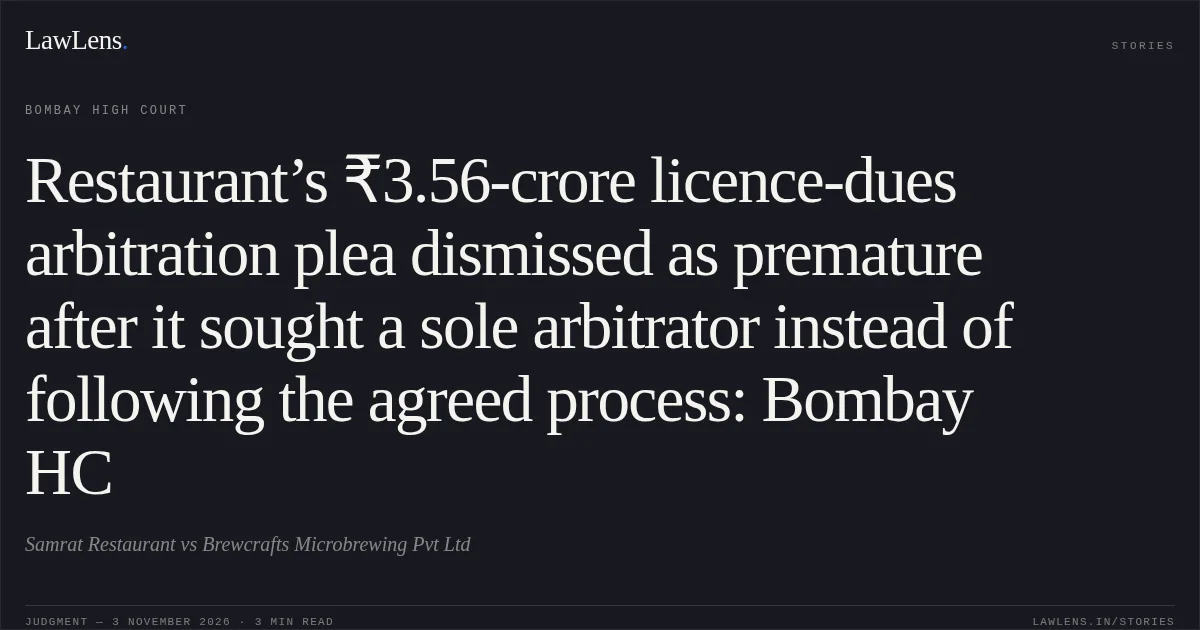
The Court dismissed the application as premature because the Applicant had not shown that the appointment procedure agreed in Clause XXXVIII had failed.
¶ 51–55It clarified that the Applicant could invoke arbitration afresh by appointing its arbitrator and calling upon the Respondent to appoint its arbitrator; any appointment of a third arbitrator must comply with equality and independence requirements.
¶ 53The objections concerning limitation, the calculation and components of the claim, payments, security-deposit adjustment, interest, post-expiry claims and the effect of earlier proceedings were left open.
¶ 54No order as to costs was made.
¶ 55Original Court PDF
Samrat RestaurantvsBrewcrafts Microbrewing Pvt Ltd
Click to open original judgment
Original judgment, available to read, download and summarize on LawLens.in