01Facts
The references concerned acquisition of Final Plot No. 901, T.P.S. IV, Mahim Division, Mumbai, measuring 642.98 sq. m., including a garage structure.
¶ 2The Section 11 award dated 16 February 2004 fixed total compensation at ₹2,01,37,662 and apportioned it among the claimants.
¶ 2–3The owners sought enhancement; M/s. Sadanand Garage claimed tenancy and occupation rights over the plot; Century Developers and proposed flat purchasers asserted claims arising from agreements relating to the property.
¶ 4–17The Court heard the references together and considered both the market value of the acquired property and the competing claims to its compensation.
¶ 202Issues
i.1. Whether the market value of the acquired land was correctly determined by the Land Acquisition Officer, and what was its market value on the relevant date.
¶ 23–28, 61–71ii.2. Whether, and in what proportion, the land compensation should be apportioned between the owners and Sadanand Garage.
¶ 72–83, 85–111iii.3. Whether Century Developers or the proposed flat purchasers established an entitlement to share in the statutory acquisition compensation.
¶ 112–11803Law Applied
Section 23(1) of the Land Acquisition Act, 1894 requires market value to be assessed as at publication of the Section 4(1) notification, ordinarily by reference to the price in genuine, proximate and comparable transactions, with justified adjustments for differences in the properties.
¶ 25–28A Ready Reckoner or Basic Valuation Register cannot, by itself, determine market value [Jawajee Nagnatham v. Revenue Divisional Officer, discussed at paras. 31–32].
¶ 31–32The value of different interests in acquired property must be apportioned according to the interests actually lost; a lessee or tenant does not automatically receive a fixed proportion of the compensation [Dossibai Nanabhoy Jeejeebhoy v. P.M. Bharucha, paras. 76–77; Kiran Tandon v. Allahabad Development Authority, paras. 74–75; Harkishan v. Delhi Simla Catholic Archdiocese, paras. 79–84].
¶ 74–84Occupation may constitute an encumbrance affecting value, but its extent must be established [M.B. Gopala Krishna v. Special Deputy Collector, paras. 55–57].
¶ 55–57A person claiming an interest in compensation need not be the owner, but must prove the nature and extent of that interest [Kachrulal Hiralal Dhoot v. The Gurudwara Board, paras. 58–60].
¶ 58–60Statutory additions and interest are governed by the applicable provisions of the Act and follow the apportionment of principal compensation, subject to law.
¶ 70, 110, 119(vii)Provisions in the judgment · 1 · Linked ones open on LawLens
Transfer of Property Act, 1882 Section 55
04Reasoning
The Court selected 19 September 2002 as the relevant valuation date, treating it as the last date of the Section 4 notification publications established by the record.
¶ 24It rejected the Ready Reckoner as conclusive and relied principally on a registered transaction involving a nearby plot of similar area, with a second adjusted transaction serving as corroboration.
¶ 38–44, 45–54Despite shortcomings in the valuer’s adjustments, the Court found the two resulting rates broadly consistent and fixed market value at ₹1,70,200 per sq. m.
¶ 61–70On apportionment, the evidence established the Garage’s substantial and longstanding occupation, but not exclusive tenancy of the entire plot; nor could the Garage establish ownership or a perpetual lease.
¶ 85–108As the evidence did not permit precise separate valuation of the owners’ and Garage’s interests, the Court adopted an equal division as a fact-specific estimate, rather than a general rule.
¶ 85–108Century Developers failed to establish a surviving right to compensation after termination of its agreement and dismissal of its specific-performance suit; the flat purchasers likewise failed to prove an enforceable interest in the acquired land entitling them to statutory compensation.
¶ 112–11805Holding
The references were partly allowed.
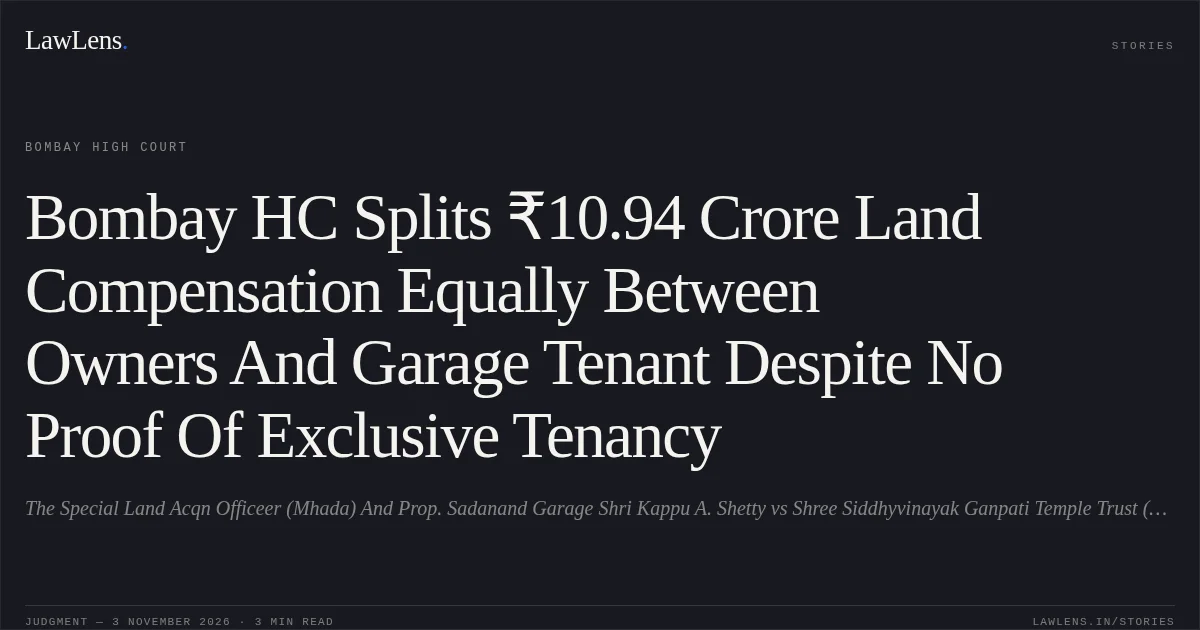
¶ 119The Court fixed the land value at ₹1,70,200 per sq. m., totalling ₹10,94,35,196, and assessed the structure and trees at ₹3,85,300.
¶ 68–71The land compensation was apportioned equally between the owners and Sadanand Garage, each receiving ₹5,47,17,598; the structure-and-tree amount was payable to the owners according to their title shares.
¶ 109–111, 119(ii)–(iii)Century Developers’ claim for ₹20,00,000 and the flat purchasers’ claims to apportionment were rejected, without deciding any separate contractual remedies.
¶ 115, 118–119(iv)–(vi)Statutory benefits were to follow the principal apportionment, subject to law, with prior payments adjusted; the authority was directed to calculate and release the amounts within eight weeks, and there was no order as to costs.
¶ 119(vii)–(x)Original Court PDF
The Special Land Acqn Officeer (Mhada) And Prop. Sadanand Garage Shri Kappu A. ShettyvsShree Siddhyvinayak Ganpati Temple Trust (Acquiring Body)
Click to open original judgment
Original judgment, available to read, download and summarize on LawLens.in