01Facts
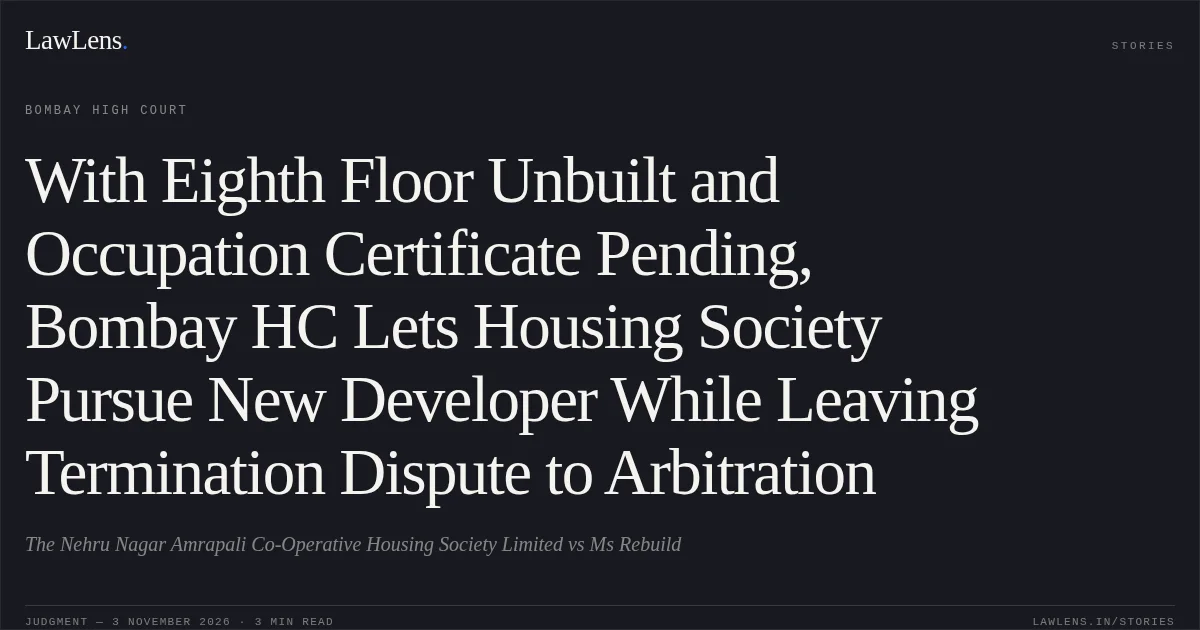
The Society entered into a Development Agreement in 2007 and a Supplemental Development Agreement in 2012 with Respondent No. 1 for redevelopment of Building No. 133.
¶ 3–5, 9–17In 2015, Respondent No. 2 took an assignment of the remaining development work and related liabilities.
¶ 3–5, 9–17The rehabilitation portion, comprising the ground and seven upper floors, was constructed and occupied, but the eighth floor remained unbuilt and no Occupation Certificate had been obtained.
¶ 3–5, 9–17The Society issued a termination notice in 2017, while Respondent No. 2 later issued its own termination communication in 2019 and informed MahaRERA in 2020 that restarting the project was not possible.
¶ 18–28The Society sought, under Section 9 of the Arbitration and Conciliation Act, 1996, delivery of original redevelopment documents and permission to proceed with redevelopment through another developer or by self-redevelopment.
¶ 1–2, 40–5502Issues
i.Whether interim relief under Section 9 should permit the Society to advance redevelopment through a new developer or by self-redevelopment, notwithstanding the unresolved dispute over termination and restoration of Respondent No. 2’s rights.
¶ 2, 61, 74–81ii.Whether Respondent No. 2’s subsequent correspondence and the parties’ cooperation after the 2022 court order established that the development arrangement had been restored.
¶ 29–39iii.Whether the Society’s alleged failure to provide a Power of Attorney or other cooperation justified preventing it from proceeding with redevelopment.
¶ 40–48iv.Whether the Society’s redevelopment steps could proceed while safeguarding Respondent No. 2’s monetary claims and the rights of existing flat purchasers.
¶ 54–58, 78–8203Law Applied
Section 9 of the Arbitration and Conciliation Act, 1996 empowers the Court to grant interim protection where warranted, without conducting a trial or finally deciding disputed contractual rights; the Court considers the prima facie case, balance of convenience and need to preserve the subject matter of arbitration.
¶ 2The Court relied on Kannamwar Nagar Aditya Cooperative Housing Society Limited v. Shraddha Platinum Builders and Developers and Om Vithal Cooperative Housing Society Limited v. Trilogy Infra Private Limited for the principles that redevelopment need not remain suspended until arbitration concludes, while the developer’s claims and third-party rights must be protected.
¶ 2, 62, 72–73It also referred to Pioneer Constructions v. Sahakarnagar Co-operative Housing Society Limited and Swashray Co-operative Housing Society Limited v. Shanti Enterprises on the Society’s interest in reconstruction and the principle that it should not be left indefinitely at the developer’s mercy.
¶ 63, 66–70The Society’s redevelopment process remained subject to applicable requirements, including Section 79A of the Maharashtra Co-operative Societies Act, 1960, RERA, and approvals from the relevant authorities.
¶ 82(ii)Provisions in the judgment · 1 · Linked ones open on LawLens
Arbitration and Conciliation Act, 1996 Section 9
04Reasoning
The Court did not finally determine the validity or effect of either party’s termination.
¶ 20–28, 34–39It found, provisionally, that Respondent No. 2’s 2019 and 2020 communications treated the arrangement as terminated, while the later correspondence and 2022 order did not clearly establish an unconditional restoration of all development rights.
¶ 20–28, 34–39The Court left the alleged non-cooperation and Power of Attorney issues for arbitration, noting that the material did not establish that the Society caused the entire delay or that Respondent No. 2 had a definite, reliable programme and financial arrangements to complete the work.
¶ 45–48, 77Given the prolonged incompletion, absence of an Occupation Certificate and continuing dispute, it concluded that the Society should not have to wait indefinitely.
¶ 55–58, 78–81It balanced that relief by keeping Respondent No. 2’s monetary claims open, requiring preservation of records, and protecting existing purchasers’ rights and Respondent No. 2’s statutory responsibilities.
¶ 55–58, 78–8105Holding
The Petition was partly allowed.
¶ 82(ii)–(vii)The Society may proceed, subject to applicable law and approvals, to appoint a new developer or undertake self-redevelopment; Respondents may not represent that they have continuing independent redevelopment authority or obstruct the Society’s lawful steps.
¶ 82(ii)–(vii)They must hand over the original project documents within two weeks, subject to keeping copies, and Respondent No. 2 must file an affidavit detailing purchasers, project finances, permissions, liabilities and construction status within three weeks.
¶ 82(ii)–(vii)The Respondents are restrained from creating fresh third-party rights or encumbrances on the Society’s property, without affecting existing purchasers’ rights or statutory responsibilities; Respondent No. 2’s money claims remain for arbitration, and no charge or lien is recognised on the basis of its claim alone.
¶ 82(viii)–(xi)The Society must preserve records and protect purchaser rights, and, if arbitration has not commenced, take steps to commence it within 90 days.
¶ 82(x), (xvi), (xviii)All findings are prima facie and leave the parties’ substantive rights and liabilities for arbitration.
¶ 82(xix)Original Court PDF
The Nehru Nagar Amrapali Co-Operative Housing Society LimitedvsMs Rebuild
Click to open original judgment
Original judgment, available to read, download and summarize on LawLens.in