01Facts
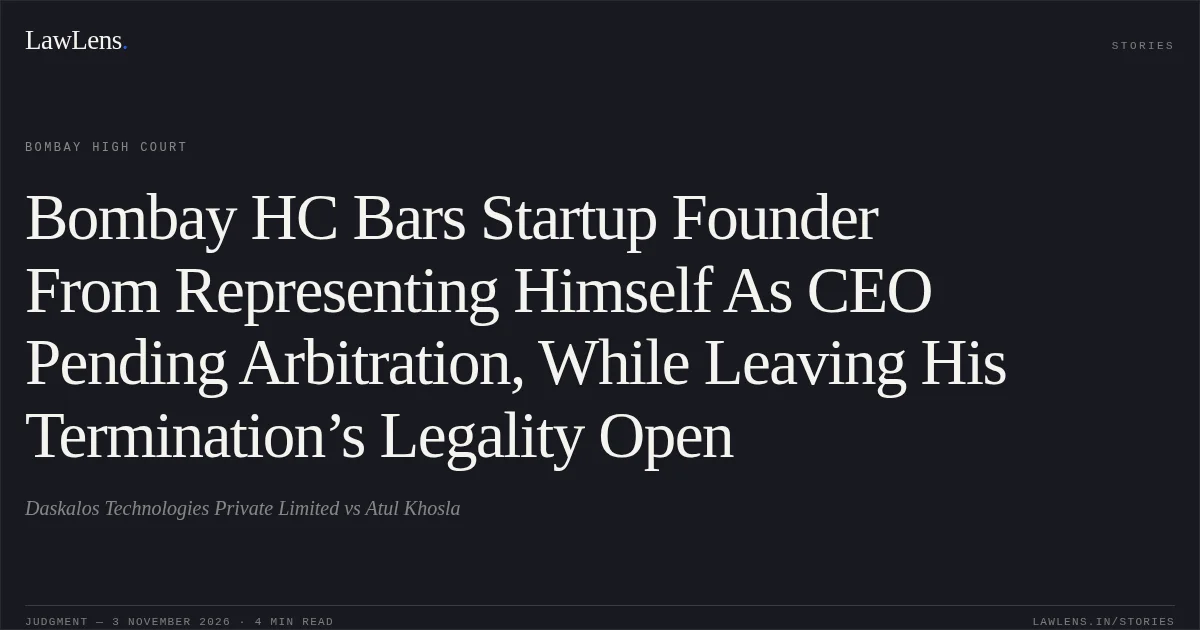
The Petitioner company appointed the Respondent as its CEO under an Employment Agreement dated 1 July 2025, while he continued as Vice-Chancellor of Shoolini University.
¶ 1After receiving a UGC communication stating that a Vice-Chancellor required to be a whole-time salaried officer could not be employed by a private company, the Petitioner issued a letter on 29 September 2026 asserting that the Agreement was void or rescinded, and alternatively terminating it for alleged contractual breaches.
¶ 1–3The Respondent disputed the termination and maintained that he continued as CEO. The Board subsequently ratified the letter at a meeting on 19 October 2026.
¶ 143–45The Petitioner sought interim relief under Section 9 of the Arbitration and Conciliation Act, 1996, including restraints on the Respondent holding himself out as CEO, interfering with management, pursuing parallel proceedings, and using company information.
¶ 183–9002Issues
i.Whether the Court could entertain a Section 9 application despite the Singapore seat of arbitration and the Respondent’s territorial-jurisdiction objection.
¶ 92–94ii.Whether the contractual dispute concerning the Respondent’s CEO appointment and termination was arbitrable.
¶ 95–96iii.Whether the Board’s resolution dated 19 October 2026 validly ratified the termination letter issued on 29 September 2026.
¶ 143–45, 163–73iv.Whether interim relief should restrain the Respondent from holding himself out as CEO, interfering with the Company, pursuing proceedings elsewhere, or making allegedly disparaging statements.
¶ 183–20603Law Applied
Section 9 of the Arbitration and Conciliation Act permits interim measures in support of arbitration; under PASL Wind Solutions Pvt. Ltd. v. GE Power Conversion India Pvt. Ltd., an Indian court may entertain a Section 9 application where the arbitration is seated outside India.
¶ 93Under Vidya Drolia v. Durga Trading Corporation, disputes concerning rights in personam are generally arbitrable, subject to the recognised limits on arbitration.
¶ 96A contract of personal service is ordinarily not specifically enforceable, subject to the exceptions stated in Executive Committee of Vaish Degree College v. Lakshmi Narain; Sections 14 and 41(e) of the Specific Relief Act, 1963 restrict specific performance and injunctions concerning such contracts.
¶ 97–99Rule 8(2) of the Companies (Meetings of Board and its Powers) Rules, 2014 requires appointment or removal of key managerial personnel to be exercised by Board resolution.
The doctrine of ratification, as explained in Maharashtra State Mining Corpn. v. Sunil and Sri Parmeshwari Prasad Gupta v. Union of India, permits a competent authority to validate retrospectively an act done on its behalf without prior authority, where the authority had power to perform that act.
¶ 147–52Anti-suit injunctions are governed by the principles in Modi Entertainment Network v. W.S.G. Cricket Pte. Ltd. and are subject to Sections 41(a) and 41(b) of the Specific Relief Act.
¶ 197–202Provisions in the judgment · 21 · Linked ones open on LawLens
Arbitration and Conciliation Act, 1996 Section 2Section 8Section 9Section 45
Indian Contract Act, 1872 Section 18Section 19Section 23Section 200
Specific Relief Act, 1963 Section 14Section 41
Companies Act, 2013 Section 2Section 166Section 173Section 179Section 203Section 241Section 242
Code of Civil Procedure, 1908 Section 20
University Grants Commission Act, 1956 Section 11Section 12Section 26
04Reasoning
The Court held that the Singapore seat did not, by itself, bar Section 9 relief and found that part of the cause of action arose in Mumbai; the contractual dispute was between the parties and concerned rights in personam, although the arbitral tribunal could not determine the independent rights of the UGC or the University.
¶ 93–96The Court treated the employment relationship as a private contract of personal service, so the Respondent could not obtain reinstatement merely by disputing termination.
¶ 98–99It nevertheless found that the two directors had issued the termination letter on behalf of the Company, that the Board had authority to remove the CEO, and that its formal resolution of 19 October 2026 validly ratified the earlier act with retrospective effect.
¶ 146–56That ratification established corporate authority but did not prove the alleged breaches or establish that the Agreement was void or rescinded.
¶ 180–82Because the Respondent continued to assert that he held office as CEO, a limited restraint against representing himself as authorised to bind the Company was warranted to prevent confusion.
¶ 184–90The Court declined broader management, anti-suit, and non-disparagement reliefs, finding them insufficiently justified or overbroad; it continued protection for company property and confidential information.
¶ 193–205, 207–1005Holding
The Petition was partly allowed.
¶ 211The Respondent was restrained, pending commencement and conclusion of arbitration, from representing himself as the Company’s present CEO, authorised signatory, or representative, or from acting to bind the Company in that capacity.
¶ 211He remained free to dispute the termination and pursue lawful remedies, and his rights as director and shareholder were preserved.
¶ 212The broader management-interference, anti-suit, and non-disparagement prayers were rejected.
¶ 212The Respondent was directed not to use or disclose the Company’s confidential or proprietary information, to return company property within seven days, and to file an affidavit detailing company property and credentials in his possession or control.
¶ 213The Petitioner was directed to commence arbitration within 90 days if it had not already commenced; the merits of termination and related disputes were left open.
¶ 214Original Court PDF
Daskalos Technologies Private LimitedvsAtul Khosla
Click to open original judgment
Original judgment, available to read, download and summarize on LawLens.in