01Facts
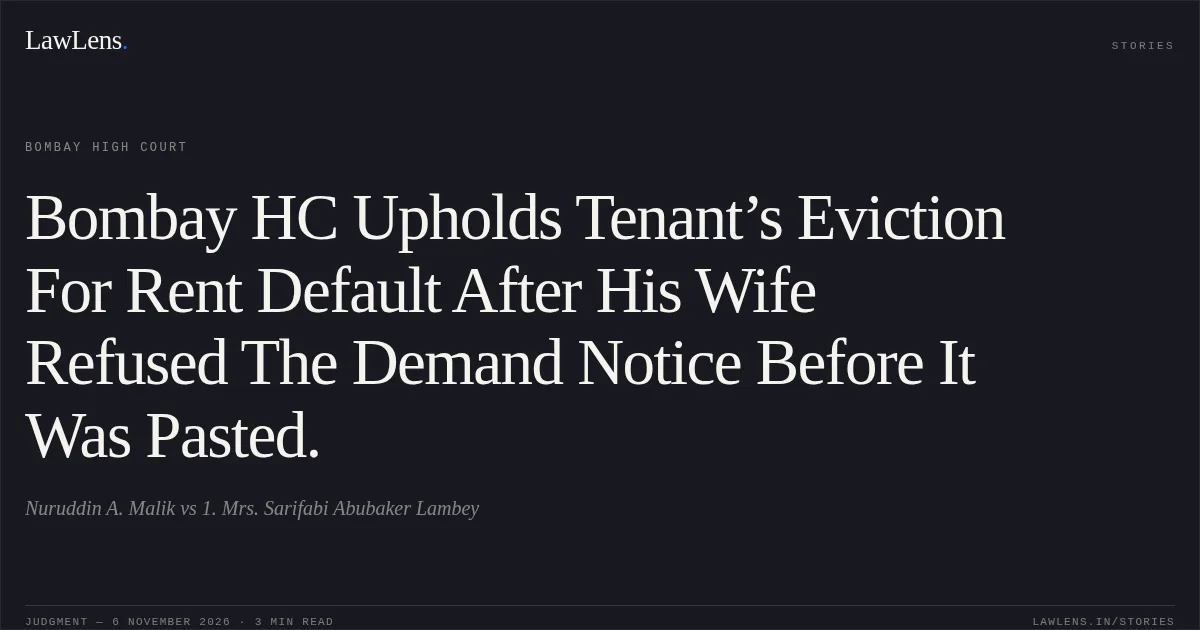
The landlord issued a demand notice dated 23 August 1984 seeking rent from 1 April 1983 and later filed a suit for eviction on the ground of default.
¶ 2The tenant denied receiving the notice and disputed Plaintiff No. 1’s ownership, contending that Plaintiff No. 2 had inducted him.
¶ 3The trial court decreed eviction for default and denial of title; the appellate court affirmed.
¶ 4In revision, the landlord relied on the returned registered-post packet, a certificate-of-posting receipt, and evidence that Plaintiff No. 2 pasted the notice after the tenant’s wife refused to accept it.
¶ 11–12, 20–22The tenant was abroad, while his wife resided at the premises.
¶ 11–12, 20–2202Issues
i.Whether the evidence established valid service of the demand notice required for eviction on the ground of default.
¶ 20–24ii.Whether the tenant’s challenge to the plaintiffs’ title justified disturbing the decree for eviction on the ground of denial of title.
¶ 3003Law Applied
Under the pre-amendment Section 12(2) of the Bombay Rent, Hotel and Lodging House Rates Control Act, 1947, a suit for possession on the ground of non-payment could not be instituted until one month after service of a written demand notice in the manner provided by Section 106 of the Transfer of Property Act, 1882.
¶ 19, 23–24The applicable Section 106 permitted service by post, personal tender or delivery to a family member or servant at the tenant’s residence, or—if tender or delivery was impracticable—affixation to a conspicuous part of the property.
¶ 17, 24The Court applied the presumptions concerning service under Section 114 of the Evidence Act and Section 28 of the Bombay General Clauses Act, relying on Madan and Co. v. Wazir Jaivir Chand, (1989) 1 SCC 264; David K.N. v. Chaubey, 2003 SCC OnLine Bom 237; and Narayan Ganpat Bhoite v. Smt. Rampyari Suchitram Gupta, 2000 SCC OnLine Bom 566.
¶ 26–28It also relied on Harbanslal Jagmohandas v. Prabhudas Shivlal, (1977) 1 SCC 575, and Jaywant S. Kulkarni v. Minochar Dosabhai Shroff, (1988) 4 SCC 108, concerning the consequences of a tenant’s failure to comply with the statutory payment requirements.
¶ 18, 29Provisions in the judgment · 3 · Linked ones open on LawLens
Transfer of Property Act, 1882 Section 106
Code of Civil Procedure, 1908 Section 115
General Clauses Act, 1897 Section 27
04Reasoning
The Court found that the notice was sent to the correct address; the tenant’s wife lived at the premises and, as shown by the cross-examination, was present when the notice was pasted and had refused to accept it.
¶ 21–24, 28The registered packet’s return and the unreturned certificate-of-posting item, considered with the oral and documentary evidence, supported the finding of service; the tenant produced no rebuttal evidence.
¶ 21–24, 28Since the tenant neither disputed the rent amount nor paid or tendered the amount as required by Section 12, the concurrent default finding disclosed no ground for revision.
¶ 23, 25, 29As to title, the Court considered the tenant’s assertion that Plaintiff No. 1 was not the owner and that Plaintiff No. 2 had inducted him, together with the evidence and pleadings, and upheld the finding that the challenge was not a bona fide denial of title.
¶ 3005Holding
The High Court held that service of the demand notice was sufficiently proved and that the tenant’s title challenge did not warrant interference with the concurrent eviction decrees.
¶ 31–32Finding no jurisdictional or manifest error, it dismissed the civil revision application.
¶ 31–32The stay was continued for four weeks from uploading of the order, subject to the occupants filing an affidavit-cum-undertaking within two weeks to surrender possession if no favourable order was obtained from the Supreme Court, continue monthly compensation payments, and create no third-party rights; Respondent No. 2 was permitted to withdraw the deposited amounts.
¶ 34–35Original Court PDF
Nuruddin A. Malikvs1. Mrs. Sarifabi Abubaker Lambey
Click to open original judgment
Original judgment, available to read, download and summarize on LawLens.in