Facts
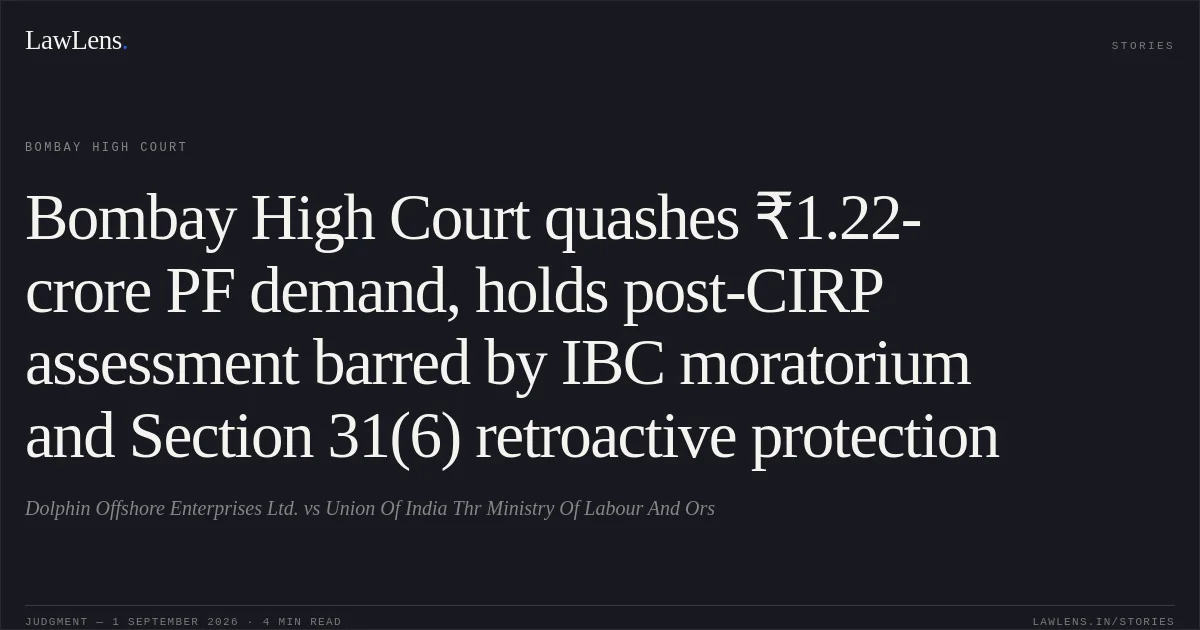
A petition under Section 9 of the Insolvency and Bankruptcy Code, 2016 (“IBC”) against the Petitioner was admitted, and the Corporate Insolvency Resolution Process (“CIRP”) commenced on 16 July 2020.
Source reference: paras. 3–4The Employees’ Provident Fund Organisation (“EPFO”) had already initiated proceedings under Section 7A of the Employees’ Provident Funds and Miscellaneous Provisions Act, 1952 (“EPF Act”) concerning provident-fund remittances for April 2018 to September 2019.
Source reference: paras. 3–4During the CIRP, EPFO submitted a claim of Rs.2,24,98,772, which was verified and admitted by the Resolution Professional.
Source reference: para. 3The Committee of Creditors approved the resolution plan of Deep Industries Ltd., which was sanctioned by the NCLT on 29 September 2022. Under the approved plan, EPFO’s claim was settled for Rs.2,250, which was paid to it.
Source reference: paras. 3–4Despite being informed of the CIRP, the moratorium, and the approved resolution plan, EPFO continued the Section 7A inquiry and, on 24 February 2023, assessed provident-fund dues at Rs.1,22,48,716, directing payment and threatening recovery, damages, interest and prosecution.
Source reference: paras. 11–12, 17The Petitioner challenged that order under Article 227 of the Constitution.
Source reference: para. 2Issues
1. Whether EPFO could continue the inquiry and assessment under Section 7A of the EPF Act after commencement of the CIRP and imposition of moratorium under Section 14 of the IBC?
Source reference: paras. 9–182. Whether the Section 7A proceedings and the demand raised after approval of the resolution plan were barred or extinguished under Section 31(6) of the IBC?
Source reference: paras. 18–203. Whether EPFO could recover pre-CIRP provident-fund dues from the Corporate Debtor and its assets after the resolution plan had been approved and implemented, particularly where EPFO’s claim had been admitted and settled under the plan?
Source reference: paras. 19–26Law Applied
The Court applied Section 14 of the IBC, which imposes a moratorium and prohibits continuation of proceedings against the Corporate Debtor that create or enforce liabilities during the CIRP.
Source reference: paras. 10, 18It relied on Rajendra K. Bhutta v. Maharashtra Housing and Area Development Authority, holding that the moratorium operates as a statutory freeze against proceedings affecting the Corporate Debtor’s assets or liabilities.
Source reference: para. 10Section 31(6) of the IBC, introduced by the Insolvency and Bankruptcy Code (Amendment) Act, 2026, provides that, unless otherwise provided in the resolution plan, pre-approval claims against the Corporate Debtor and its assets are extinguished and no proceedings, including assessment proceedings, may be continued or instituted on their basis; Explanation III gives the provision retrospective operation, subject to matters attaining finality.
Source reference: para. 18The Court also applied Section 32A of the IBC, which protects the Corporate Debtor and its assets from liability and prosecution for offences committed before the CIRP where the approved resolution plan results in a change of management or control.
Source reference: para. 25It relied on Ghanashyam Mishra & Sons Pvt. Ltd. v. Edelweiss Asset Reconstruction Co. Ltd. for the “clean slate” principle, and on Employees’ Provident Fund Organisation v. Jaykumar Pesumal Arlani and Employees’ Provident Fund Organisation v. Subhlaxmi Investment Advisory Pvt. Ltd. for the proposition that EPFO assessment proceedings cannot continue during the moratorium.
Source reference: paras. 5–6, 13The Court further followed Sundresh Bhatt, Liquidator of ABG Shipyard v. Central Board of Indirect Taxes and Customs, which limits statutory authorities during the moratorium to assessment or determination of dues in accordance with the IBC and prohibits recovery against the Corporate Debtor.
Source reference: paras. 14–16Reasoning
The Court held that EPFO had actual notice of the CIRP and moratorium but nevertheless continued the Section 7A inquiry by calling for documents and recording evidence during the moratorium.
Source reference: paras. 11–12Although assessment proceedings may, in an appropriate case, be distinguished from recovery proceedings, the impugned order did more than quantify dues: it demanded payment within 15 days and threatened recovery under Sections 8B–8G of the EPF Act, damages, interest and prosecution.
Source reference: paras. 17–18It was therefore, in substance, a recovery proceeding impermissible during the moratorium.
Source reference: paras. 17–18The subsequent approval of the resolution plan did not cure the defect.
Source reference: paras. 18–20By virtue of Section 31(6), retrospectively applied, the pre-approval claim stood extinguished except to the extent provided in the approved plan, and further proceedings for assessment were expressly prohibited.
Source reference: paras. 18–20The Court also noted that EPFO had submitted its claim, received Rs.2,250 under the plan, and did not challenge the plan before the NCLAT despite having an opportunity to do so.
Source reference: para. 21The Court distinguished Dalmia Cement, since that case involved non-filing of an EPFO claim and did not decide the legality of continuing a Section 7A inquiry during the moratorium.
Source reference: paras. 22–24Recovery against the Corporate Debtor’s assets was additionally inconsistent with the protection under Section 32A.
Source reference: para. 25Holding
The Court answered the issues against EPFO.
It held that continuation of the Section 7A inquiry during the moratorium violated Section 14 of the IBC; the resulting post-resolution assessment and demand were extinguished and barred under Section 31(6); and recovery could not be pursued against the Corporate Debtor or its assets after approval and implementation of the resolution plan.
Source reference: para. 26The order dated 24 February 2023 assessing dues of Rs.1,22,48,716 and directing payment was quashed and set aside.
Source reference: para. 27The writ petition was allowed, and the rule was made absolute.
Source reference: para. 27Acts & Sections Cited
9 provisions across 2 statutes referred to in this judgment. Each provision opens on LawLens.
Insolvency and Bankruptcy Code, 2016.8
Customs Act,19621
Original Court PDF
Dolphin Offshore Enterprises Ltd.vsUnion Of India Thr Ministry Of Labour And Ors
Click to open original judgment
Original judgment, available to read, download and summarize on LawLens.in