Facts
The petitioner engaged the respondent, a sole proprietorship concern, under a Letter of Engagement dated 1 April 2021 for marketing, branding and promotional services.
Source reference: paras. 2–3The agreement contained an indemnification clause and an arbitration clause providing for arbitration of disputes arising under the Letter of Engagement, with New Delhi as the exclusive jurisdictional venue.
Source reference: paras. 2–3, 21Between April 2022 and February 2024, the respondent raised invoices aggregating to a taxable value of ₹18,53,31,120, along with GST of ₹3,33,59,601.59, which the petitioner paid between April 2022 and June 2024.
Source reference: para. 4The petitioner claimed input tax credit on the GST component.
Source reference: para. 5Subsequently, the GST authorities issued a notice under Rule 86A of the Central Goods and Services Tax Rules, 2017, alleging that the petitioner had claimed faulty input tax credit from non-existent firms, including the respondent.
Source reference: para. 5The respondent’s GST registration was cancelled suo motu with retrospective effect from 30 September 2021, and that cancellation was challenged before the Rajasthan High Court.
Source reference: para. 6The petitioner issued a demand notice and invoked arbitration on 23 April 2025, seeking indemnification of ₹3,33,59,601.59, with interest, on the ground that it had paid the GST component to the respondent but was subsequently required to reverse the credit and discharge the tax liability.
Source reference: para. 7The respondent denied liability, asserted that the tax had been deposited, disputed the applicability of the indemnity clause, and did not consent to the appointment of an arbitrator.
Source reference: para. 8The petitioner thereafter paid ₹4,46,16,401 to the GST authorities, comprising tax, interest and penalty, and filed the present petition under Section 11(6) of the Arbitration and Conciliation Act, 1996, seeking appointment of a sole arbitrator.
Source reference: para. 9Issues
Whether the existence of an arbitration agreement between the parties justified reference of the petitioner’s claim to arbitration under Section 11(6) of the Arbitration and Conciliation Act, 1996.
Source reference: paras. 19–22, 31Whether the petitioner’s claim for recovery or indemnification of the GST amount was a non-arbitrable tax dispute falling exclusively within the jurisdiction of GST authorities.
Source reference: paras. 11–15, 18, 23–26Whether questions concerning the respondent’s alleged non-deposit of GST, reversal of input tax credit and the petitioner’s payment to the tax authorities rendered the dispute manifestly non-arbitrable at the Section 11 stage.
Source reference: paras. 19–20, 30Law Applied
The Court applied Section 11(6) of the Arbitration and Conciliation Act, 1996, holding that, at the stage of appointing an arbitrator, the referral court’s enquiry is confined to examining the prima facie existence of an arbitration agreement and not other issues.
Source reference: paras. 19–20This principle was derived from SBI General Insurance Co. Ltd. v. Krish Spinning, (2024) 12 SCC 1, and reaffirmed in Office for Alternative Architecture v. Ircon Infrastructure and Services Ltd., 2025 SCC OnLine SC 1098.
Source reference: paras. 19–20Issues of jurisdiction and arbitrability are ordinarily to be determined by the arbitral tribunal under Section 16 of the Act.
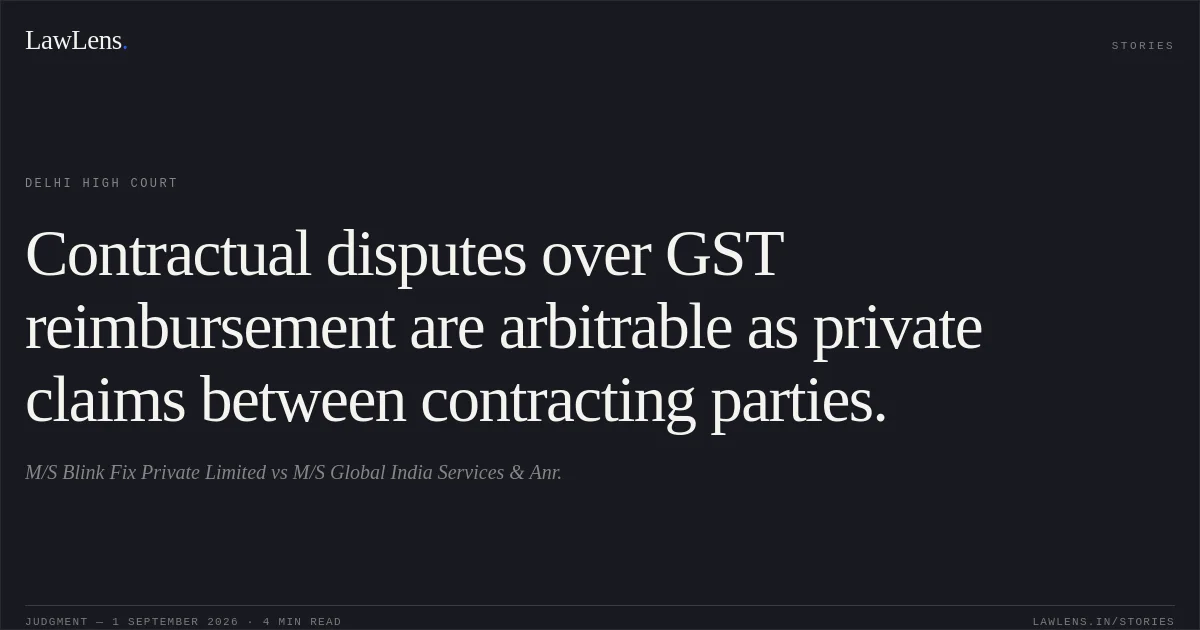
Source reference: para. 30The Court distinguished sovereign tax matters—such as taxability, assessment, collection, validity of input tax credit denial and cancellation of GST registration—from private contractual disputes concerning which contracting party must bear an indirect tax burden or reimburse money paid under a contract.
Source reference: paras. 24–25It also relied on Spectrum Power Generation Ltd. v. GAIL (India) Ltd., 2022 SCC OnLine Del 4262, which held that a dispute regarding the contractual passing-on or reimbursement of GST is an inter se contractual dispute and does not challenge the State’s taxing power.
Source reference: para. 27Reasoning
The Court found that the petitioner’s claim was, prima facie, a pure monetary claim arising from the parties’ contractual dealings.
Source reference: no citationAlthough the factual background involved GST proceedings, the petitioner was not asking the arbitral tribunal to determine the validity of the GST levy, the correctness of the tax authorities’ assessment, the legality of the reversal of input tax credit, or the validity of the respondent’s retrospective cancellation of registration.
Source reference: paras. 24–26Rather, it sought recovery from the respondent of the amount represented as GST in the respondent’s invoices and paid by the petitioner under the contractual arrangement.
Source reference: no citationDetermining whether the respondent was contractually obliged to indemnify or reimburse the petitioner would affect only the rights and liabilities of the parties inter se and would neither bind the revenue nor encroach upon the State’s sovereign taxing functions.
Source reference: paras. 25–29Since the arbitration agreement was admitted and the agreement designated New Delhi as the juridical seat, objections concerning the respondent’s alleged non-deposit of tax, the petitioner’s entitlement to reimbursement and the arbitrability of particular claims were left to the arbitral tribunal under Section 16.
Source reference: paras. 21–22, 30–31Holding
The Court held that the dispute was not manifestly non-arbitrable at the Section 11 stage and that the arbitration agreement prima facie covered the petitioner’s contractual monetary claim.
Mr. Justice (Retd.) J.R. Midha, former Judge of the Delhi High Court, was appointed as the sole arbitrator to adjudicate the disputes.
Source reference: para. 32The respondent was expressly permitted to raise objections concerning jurisdiction and arbitrability before the arbitrator, who was directed to decide them on their merits.
Source reference: para. 33The arbitrator was required to furnish the disclosures under Section 12, and the parties were directed to share the arbitrator’s fee and arbitral costs equally.
Source reference: paras. 34–36All claims, counterclaims and contentions were kept open, with no opinion expressed on the merits.
Source reference: paras. 37–38Since the arbitral tribunal had been constituted, O.M.P.(I) (COMM.) 332/2025 was directed to be treated as an application under Section 17 of the Act and dealt with by the sole arbitrator.
Source reference: paras. 40–41Acts & Sections Cited
7 provisions across 2 statutes referred to in this judgment. Each provision opens on LawLens.
Arbitration and Conciliation Act, 19965
Central Goods and Services Tax Act, 20172
Original Court PDF
M/S Blink Fix Private LimitedvsM/S Global India Services & Anr.
Click to open original judgment
Original judgment, available to read, download and summarize on LawLens.in