Facts
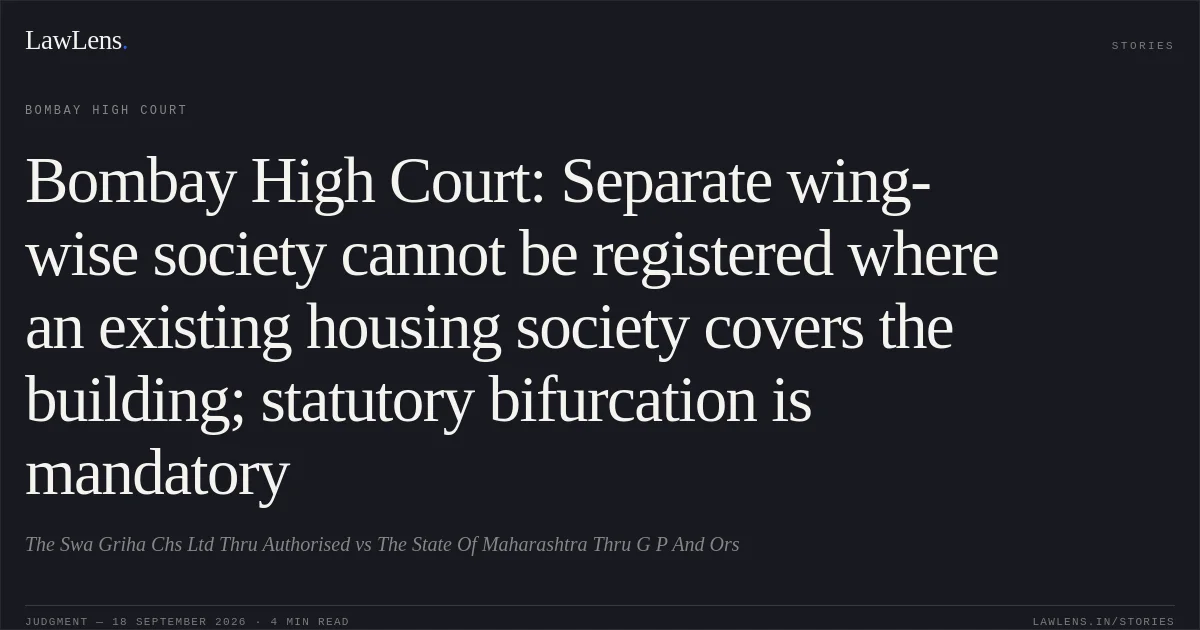
The Petitioner, The Swa-Griha Co-operative Housing Society Ltd., was registered in 1968 in respect of the original building on land owned by MHADA.
Source reference: paras. 3–5The Society later undertook redevelopment of its land together with adjoining MHADA lands, resulting in a building comprising Wings A, B, C and D.
Source reference: paras. 3–5Although the Petitioner-Society already existed for the building, the purchasers of Wings A and B, through Respondent No. 5, applied for registration of a separate society.
Source reference: paras. 6–7The Deputy Registrar registered Atharva Co-operative Housing Society Ltd. on 20 February 2025. The Petitioner’s appeal before the Joint Registrar and revision before the Minister for Cooperation were dismissed.
Source reference: paras. 6–7The Petitioner challenged all three orders, contending that a separate society could not be registered under Section 9 of the Maharashtra Co-operative Societies Act, 1960 (“MCS Act”) when an existing society already covered the building.
Source reference: paras. 8–11Issues
Whether a separate co-operative housing society could be registered under Section 9 of the MCS Act in respect of part of a building already covered by an existing housing society, without following the bifurcation procedure under Sections 17 or 18 of the MCS Act?
Source reference: paras. 22–30Whether the common structural features, utilities, amenities, parking arrangements and land-related rights made formation of separate societies for Wings A–B and Wings C–D legally and practically impermissible?
Source reference: paras. 34–39Whether the contractual stipulations requiring purchasers in Wings A and B to become members of the Petitioner-Society barred the formation and registration of a separate society?
Source reference: paras. 44–47Law Applied
The Court held that Section 9 of the MCS Act, read harmoniously with Sections 17 and 18 and the special provisions applicable to housing societies under Chapter XIII-B, permits registration of a new housing society only where no society already exists in respect of the concerned building.
Source reference: paras. 22–30Where separation from an existing society is sought, the statutory route is division or bifurcation under Section 17, through a two-thirds resolution and the Registrar’s approval, or under Section 18, through a reasoned order of the Registrar after consultation with the federal society, preparation of a draft scheme, and consideration of objections.
Source reference: paras. 22–28Registration under Section 9 cannot be used to indirectly fragment an existing society or create overlapping jurisdictions over the same property.
Source reference: para. 32The Court also relied on Cosmopolitan III Co-operative Housing Society Ltd. v. Hon’ble Minister, Cooperation regarding the comprehensive nature of bifurcation proceedings; Sarita Co-operative Housing Society Ltd. v. Minister for Cooperation on the impermissibility of indirect fragmentation; Sadguru Universal CHS Ltd. v. State of Maharashtra on the structural, access, utility, maintenance, parking, ownership and members’ convenience tests; and Kritika Jewels Co-operative Housing Society v. State of Maharashtra on the binding effect of contractual undertakings for formation of one common society.
Source reference: paras. 28, 32, 36–38, 46Mere disputes between residents or difficulties in management do not, by themselves, justify bifurcation or creation of a separate society.
Source reference: paras. 41–43Reasoning
The Court found that the Deputy Registrar acted without appreciating that the Petitioner-Society already existed in respect of the building and that 72 purchasers from Wings A and B had already become its members.
Source reference: paras. 18–21The Petitioner had also not been properly impleaded or heard, and its objections were disregarded, rendering the registration order jurisdictionally defective.
Source reference: paras. 18–21Since any separation would affect the ownership and management of land, the superstructure, common amenities, utilities, liabilities and financial obligations, the matter could only be addressed through the detailed bifurcation mechanisms under Sections 17 or 18, not through a direct Section 9 registration.
Source reference: paras. 25–28Independently, the building was found to be an integrated structure: the wings shared a common terrace, underground water tank, water and electricity systems, vehicular entrance, recreational ground and a common ten-floor parking structure.
Source reference: paras. 34–39These features made independent administration and division of rights impracticable.
Source reference: paras. 34–39Further, the development agreement and agreements for sale expressly required purchasers to become members of the Petitioner-Society and stated that the developer was not obliged to form a separate society.
Source reference: paras. 44–47Holding
The Court answered the issues against the Respondents.
It held that the Deputy Registrar had no jurisdiction to entertain a direct Section 9 application for registration of a new society in respect of a building already covered by the Petitioner-Society; the proper remedy was bifurcation under Sections 17 or 18 of the MCS Act.
Source reference: paras. 25, 29–33The Court further held that the integrated structure, common facilities and contractual obligations independently militated against creation of a separate society.
Source reference: paras. 34–39, 44–47Accordingly, the Court set aside the Deputy Registrar’s registration order dated 20 February 2025, the Joint Registrar’s appellate order dated 8 July 2025 and the Minister’s revisional order dated 18 February 2026, and cancelled the registration of Atharva Co-operative Housing Society Ltd.
Source reference: para. 49The writ petition was allowed, Rule was made absolute, and there was no order as to costs.
Source reference: para. 50Operation of the judgment was stayed for six weeks at the request of Respondent No. 4.
Source reference: para. 51Acts & Sections Cited
4 provisions across 2 statutes referred to in this judgment. Each provision opens on LawLens.
Maharashtra Co-operative Societies Act, 19603
Maharashtra Ownership Flats (Regulation of the promotion of construction, sale, management and transfer) Act, 19631
Original Court PDF
The Swa Griha Chs Ltd Thru AuthorisedvsThe State Of Maharashtra Thru G P And Ors
Click to open original judgment
Original judgment, available to read, download and summarize on LawLens.in