Facts
The Petitioners, primarily merchant exporters, entered into contracts with overseas buyers for the export of sugar and claimed to have received advance payments before 13 May 2026.
Source reference: paras. 7–11Earlier notifications dated 14 November 2025 and 13 February 2026 had allocated export quotas for the 2025–26 sugar season, with exports to be completed within specified timelines.
Source reference: paras. 7–11On 12 May 2026, the Department of Food and Public Distribution communicated the Committee of Ministers’ decision to prohibit sugar exports with immediate effect.
Source reference: paras. 12–15, 53Pursuant thereto, the Directorate General of Foreign Trade (“DGFT”) issued Notification dated 13 May 2026, changing sugar’s export status from “restricted” to “prohibited” until 30 September 2026 or until further orders.
Source reference: paras. 12–15, 53The Notification created limited exceptions, including exports under EU/USA quotas, the Advance Authorisation Scheme, Government-to-Government exports, and consignments satisfying specified physical-export conditions.
Source reference: para. 53The Petitioners challenged the Notification only to the extent that it prevented completion of pre-existing export contracts for which advance payments had allegedly been received.
Source reference: paras. 14–16, 48, 70During the proceedings, their representations seeking permission to complete such contracts were rejected by the DGFT on 3 June 2026; that rejection was not separately challenged.
Source reference: paras. 14–16, 48, 70Issues
1. Whether the DGFT Notification dated 13 May 2026 changing the export policy for sugar from “restricted” to “prohibited” was arbitrary, unreasonable, discriminatory, or otherwise invalid under Articles 14 and 19(1)(g) of the Constitution.
Source reference: paras. 51, 56–58, 83–852. Whether private export contracts executed before 13 May 2026, coupled with receipt of advance payments from overseas buyers, created vested rights, legitimate expectations, or rights enforceable against the subsequent export prohibition.
Source reference: paras. 59–62, 71–803. Whether the Petitioners could invoke the transitional arrangement under paragraph 1.05(b) of the Foreign Trade Policy, 2023 without holding and registering an Irrevocable Commercial Letter of Credit (“ICLC”) before the restriction was imposed.
Source reference: paras. 61–624. Whether the Petitioners’ consignments fell within the exception for consignments already in the physical export pipeline or were otherwise protected because export-related steps had commenced before 13 May 2026.
Source reference: paras. 68–72Law Applied
The Court applied Sections 3 and 5 of the Foreign Trade (Development and Regulation) Act, 1992, which empower the Central Government to formulate and amend import-export policy in public interest.
Source reference: paras. 53–56It treated the impugned Notification as a prospective policy measure, subject to judicial review only on grounds such as arbitrariness, irrationality, perversity, discrimination, or mala fides.
Source reference: paras. 75–76Paragraph 1.05(b) of the Foreign Trade Policy, 2023 provides that exportability is governed by the policy prevailing on the date of export; post-restriction exports may continue only where the exporter had an ICLC issued before the restriction and duly registered it within the prescribed period.
Source reference: para. 61The Court relied on Union of India v. Asian Food Industries, (2006) 13 SCC 542, holding that actual customs permission for clearance and loading is material in determining whether goods had entered the export process.
Source reference: paras. 47, 69It relied on Ugar Sugar Works Ltd. v. Delhi Administration, (2001) 3 SCC 635, PTR Exports (Madras) Pvt. Ltd. v. Union of India, 1996 SCC OnLine SC 268, and Go-Go International v. Union of India, 2004 (77) DRJ 145, for the rule that the Government may revise or withdraw an export policy in public interest and that quota allocation does not create a vested right.
Source reference: paras. 73–80The Court further held, relying on Ram Parvesh Singh v. State of Bihar, (2006) 8 SCC 381, that legitimate expectation is not an enforceable legal right.
Source reference: paras. 73–80Reasoning
The Court found that the export prohibition was a considered policy decision taken after assessment of declining domestic sugar production, anticipated shortfalls, domestic consumption requirements, price stability, and recommendations of governmental committees.
Source reference: paras. 38–42, 54–57It therefore held that the Notification was neither arbitrary nor irrational and that the restriction was a reasonable measure in the public interest under Article 19(1)(g).
Source reference: para. 83The Petitioners’ private contracts and advance payments did not override the statutory export policy or create vested rights against the State.
Source reference: paras. 60, 73–76The earlier quota notifications merely prescribed an export framework and modalities; they did not confer an unconditional right to export.
Source reference: paras. 60, 73–76The Court distinguished Shriram Food Industry Ltd. v. Union of India, 2024 (6) Mh.L.J. 136, because that case involved pre-existing ICLCs, whereas the present Petitioners admittedly lacked such ICLCs and had not registered them as required by paragraph 1.05(b).
Source reference: paras. 61–62Receipt of advance payment could not be treated as equivalent to an ICLC.
Source reference: paras. 61–62Further, the Petitioners failed to establish that their incomplete consignments satisfied the Notification’s physical-export exceptions or had obtained the requisite customs clearance/Let Export Order before the restriction.
Source reference: paras. 68–72Disputed factual claims concerning the stage of shipment could not ordinarily be resolved in writ jurisdiction.
Source reference: paras. 68–72The Court also rejected the reliance on a 2022 relaxation for advance-paid contracts, treating it as a one-time discretionary relaxation specific to that sugar season and not a binding precedent.
Source reference: paras. 63–67Holding
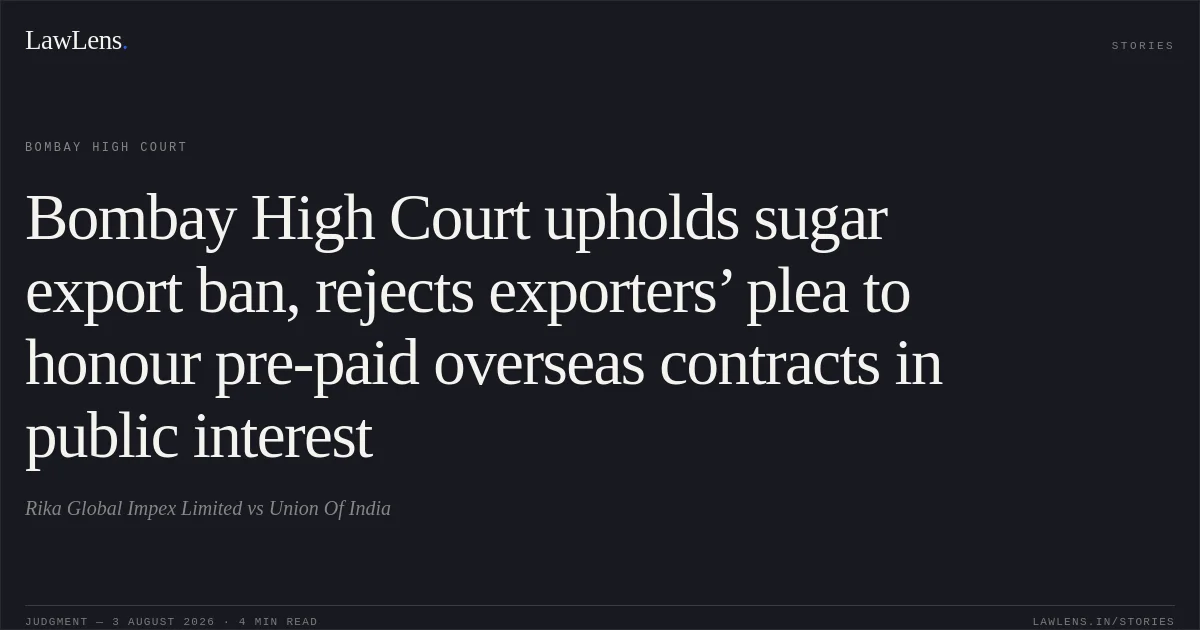
The Court held that the 13 May 2026 DGFT Notification was a valid, prospective policy decision made in the larger public and national interest.
Pre-existing private contracts and advance payments did not confer an enforceable right to export sugar after the prohibition, and the Petitioners could not invoke the transitional protection under paragraph 1.05(b) without pre-existing and registered ICLCs.
Source reference: paras. 61–62, 71–80Consignments supported by a Let Export Order issued before 13 May 2026 remained unaffected, subject to verification from customs records.
Source reference: paras. 61, 69, 71–72All four writ petitions were dismissed, the Rule was discharged, and the parties were directed to bear their own costs.
Source reference: para. 89As an equitable observation, the Petitioners were permitted to sell or dispose of retained sugar in the domestic market, subject to the governing law and Sugar Control Orders.
Source reference: para. 90Original Court PDF
Rika Global Impex LimitedvsUnion Of India
Click to open original judgment
Original judgment, available to read, download and summarize on LawLens.in