Facts
Comet Overseas Pvt. Ltd. purchased DFIA Licence No. 0210100847 dated 16 May 2007 from Gemini Overseas Ltd. for consideration of ₹14,51,795 paid through banking channels. The licence had been issued and endorsed transferable by the DGFT after Gemini’s certification of export-obligation fulfilment
Source reference: para. 2Relying on the licence, Comet imported Mulberry Raw Silk Yarn duty-free under Bill of Entry No. 437910 dated 22 October 2008; the duty foregone was ₹22,87,654.95
Source reference: para. 3Subsequently, the Directorate of Revenue Intelligence found that Gemini had allegedly exported fabric made from Noil Yarn mixed with cotton while declaring it to be Natural Silk Fabric predominantly made of Mulberry Raw Silk. Gemini admitted the incorrect description and expressed willingness to pay the duty foregone
Source reference: para. 4A show-cause notice was issued proposing recovery of duty and interest, confiscation under Section 111(o), and penalty under Section 112 of the Customs Act, 1962. The notice contained no specific allegation against Comet of collusion, wilful misstatement, or suppression of facts
Source reference: para. 5The adjudicating authority confirmed the duty demand, imposed redemption fine of ₹15,00,000 under Section 125, and penalty of ₹10,00,000 under Section 112. CESTAT set aside the penalty after finding that Comet had no knowledge of the irregularity, but upheld the duty, interest, and redemption fine
Source reference: para. 6The High Court admitted the appeal on the question whether an innocent transferee could be made liable when the licence had not been cancelled by the issuing authority
Source reference: para. 7Issues
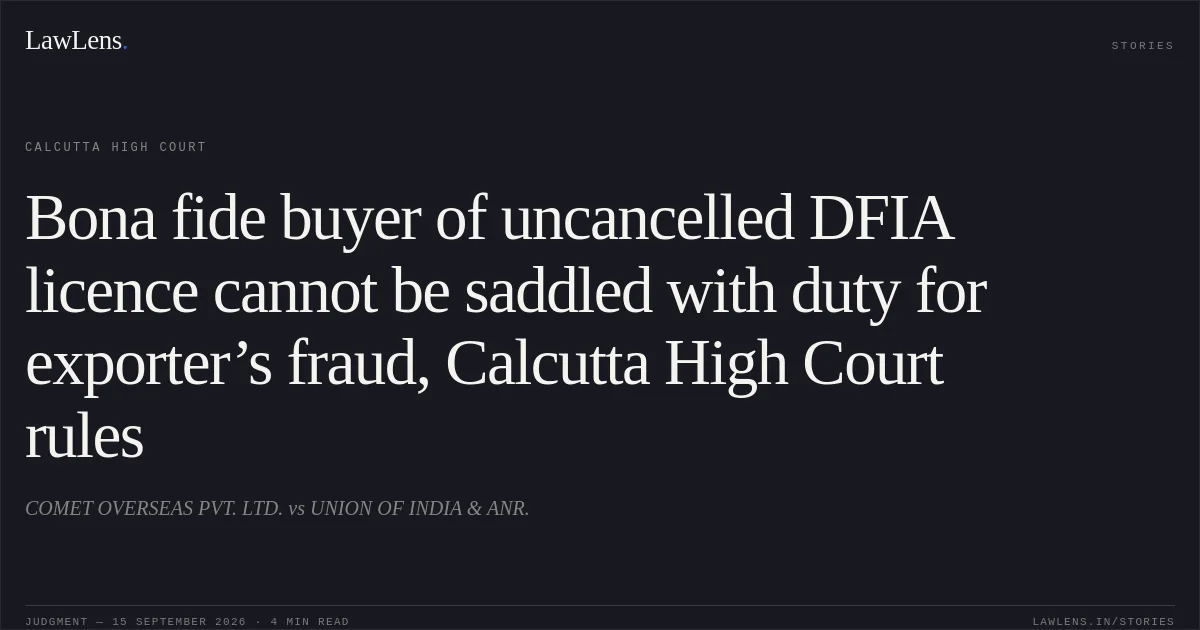
Whether a bona fide purchaser of a duty-free import licence for value, without notice of any irregularity by the original licence-holder, can be required to pay duty, interest, and redemption fine when the licence has not been cancelled by the issuing authority?
Source reference: para. 7Whether the appellant could raise limitation as an independent ground despite no limitation-related substantial question of law having been framed at the admission stage?
Source reference: paras. 13, 18, 21Law Applied
The Court applied the Customs Act, 1962, including the erstwhile proviso to Section 28(1) read with Section 28(4), concerning recovery of short-levied or non-levied duty in cases involving collusion, wilful misstatement, or suppression; Section 111(o), concerning confiscation for breach of exemption conditions; Section 112, concerning penalty for improper importation; Section 125, concerning redemption fine; and Section 130, governing appeals involving substantial questions of law
Source reference: paras. 5, 7, 21Relying on East India Commercial Co. Ltd. v. Collector of Customs and Collector of Customs v. Sneha Sales Corporation, the Court held that a licence procured by fraud or misrepresentation is not automatically void or non-est, but remains effective unless avoided or cancelled in the legally prescribed manner
Source reference: para. 22It further relied on Taparia Overseas (P) Ltd. v. Union of India for the principle that a bona fide transferee for value without notice should not ordinarily suffer for the fraud of the original licence-holder
Source reference: para. 24ICI India Ltd. v. Commissioner of Customs, Munjal Showa Ltd. v. Commissioner of Customs, and Pennar Industries Ltd. v. Commissioner of Customs were distinguished as involving forged instruments or defaults attributable to the original importer, while the precedential relevance of Tata Iron and Steel Co. Ltd. v. Commissioner of Customs was considered limited on the facts
Source reference: paras. 23, 25–26Reasoning
The Court treated the licence as a genuine instrument issued by the DGFT and endorsed as transferable, rather than as a forged or non-existent document
Source reference: paras. 22–23Although Gemini’s fraud concerned the certification of export-obligation fulfilment, the licence had never been cancelled by the DGFT or the Regional Authority. Applying the voidable-versus-void distinction from East India Commercial and Sneha Sales, the Court held that the licence remained valid and subsisting when Comet made the import
Source reference: para. 27Comet had paid valuable consideration through banking channels, and CESTAT had expressly found that it lacked knowledge of the underlying irregularity; that finding was not challenged by the Revenue
Source reference: para. 24Consequently, Comet’s bona fide status distinguished it from Gemini, the party allegedly responsible for the fraud. The Court held that the maxim fraud vitiates everything could not, without more, be used to impose duty and redemption liability on an innocent transferee where the licence had not been cancelled
Source reference: paras. 23–27As to limitation, the Court declined to adjudicate it as an independent ground because no limitation question had been framed at admission, although it noted that the show-cause notice contained no allegation of collusion, wilful misstatement, or suppression against Comet
Source reference: para. 21Holding
The Court answered the framed substantial question of law in favour of Comet, holding that a bona fide purchaser for value, without notice of the original exporter’s irregularity, could not be required to pay duty, interest, or redemption fine where the duty-free licence had not been cancelled by the issuing authority
The appeal was allowed, and CESTAT’s order was set aside insofar as it upheld the duty demand of ₹22,87,654.95, interest, and redemption fine of ₹15,00,000; those liabilities were quashed
Source reference: para. 29The setting aside of the Section 112 penalty remained undisturbed, and there was no order as to costs
Source reference: paras. 29–30Acts & Sections Cited
5 provisions across 1 statute referred to in this judgment. Each provision opens on LawLens.
Customs Act,19625
Original Court PDF
COMET OVERSEAS PVT. LTD.vsUNION OF INDIA & ANR.
Click to open original judgment
Original judgment, available to read, download and summarize on LawLens.in