Facts
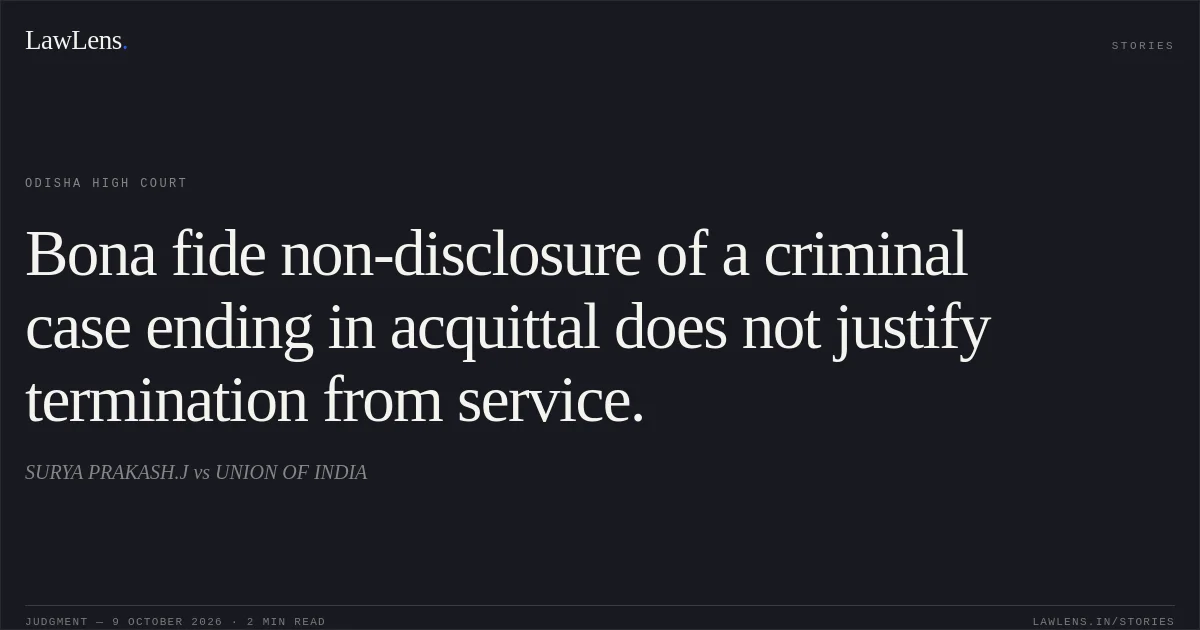
The petitioner was selected as a Constable in the 2011–12 CAPF recruitment process and appointed to the CISF in April 2012.
Source reference: pp. 2–5In his attestation form, he answered that he had never been prosecuted. The authorities later learned that he had been involved in a 2010 criminal case under Sections 376/511/506 IPC, in which he had been acquitted on 1 July 2011.
Source reference: pp. 2–5After issuing a show-cause notice, the CISF terminated his service on the ground that he had suppressed material information; his appeal was rejected.
Source reference: pp. 2–5He challenged the termination and appellate orders under Articles 226 and 227 of the Constitution.
Source reference: pp. 10–15Issues
Whether the petitioner’s negative answer in the attestation form, despite his prior prosecution and subsequent acquittal, amounted to intentional suppression warranting termination
Source reference: pp. 4–6, 14–15Whether termination was sustainable and proportionate in the circumstances, and whether the petitioner was entitled to reinstatement and consequential service benefits
Source reference: pp. 6, 15–16Law Applied
Under Article 226, the High Court may review the legality of administrative decisions concerning appointment and termination.
Source reference: pp. 6–9, 12–13The Court relied on Mohammad Imran v. State of Maharashtra (2019) 17 SCC 696 and Ravindra Kumar v. State of Uttar Pradesh (2024) 5 SCC 264 for the principle that non-disclosure or an incorrect answer concerning a past criminal case should not be treated mechanically as a conclusive bar; the circumstances, including the candidate’s acquittal and whether the answer was deliberate, must be assessed.
Source reference: pp. 6–9, 12–13It also considered Commissioner of Police, New Delhi v. Mehar Singh, Civil Appeal No. 4842 of 2013, cited by the respondents, concerning the need to assess the suitability of candidates seeking to join a disciplined police force and the relevance of criminal antecedents.
Source reference: pp. 6–9, 12–13The show-cause notice invoked Rule 26(4) of the CISF Rules, 2001.
Source reference: p. 3Reasoning
The Court found that the petitioner had been acquitted before the recruitment process and before completing the attestation form.
Source reference: pp. 14–16It accepted his explanation that, in light of the acquittal and his understanding of the term “prosecuted,” he answered in the negative without intending to conceal the case.
Source reference: pp. 14–16On those facts, the Court held that deliberate suppression had not been established and that the non-disclosure was not fatal to his appointment.
Source reference: pp. 14–16It further held that termination was disproportionate and that the termination and appellate orders could not stand.
Source reference: pp. 14–16Holding
The Court allowed the challenge to the extent of quashing the termination order and the order rejecting the appeal.
It directed the CISF to reinstate the petitioner by an appropriate order within four weeks of receipt of the judgment.
Source reference: p. 16The break in service was to be regularised notionally; the petitioner was not entitled to financial benefits for that period, save for service benefits otherwise due and admissible.
Source reference: p. 16Acts & Sections Cited
10 provisions across 1 statute referred to in this judgment. Each provision opens on LawLens.
Original Court PDF
SURYA PRAKASH.JvsUNION OF INDIA
Click to open original judgment
Original judgment, available to read, download and summarize on LawLens.in