Facts
The appellants entered into two registered agreements with the respondent-promoters on 4 October 2016 for purchase of flats in the “Sodah Sadan” project, with possession agreed to be delivered by 31 December 2018.
Source reference: para. 5Upon delay, they filed a complaint before the Maharashtra Real Estate Regulatory Authority (MahaRERA) seeking possession, interest, compensation and other reliefs.
Source reference: para. 5By order dated 30 June 2025, MahaRERA rejected the claim for possession but directed the promoters to pay interest for delayed possession from 1 January 2019 until the offer of possession with an occupancy certificate, at SBI MCLR plus 2%; payment was made conditional upon obtaining the full occupancy certificate.
Source reference: para. 6The appellants stated that they pursued the promoters in good faith for obtaining the occupancy certificate and compliance with the order, but later concluded that there was no realistic prospect of such compliance.
Source reference: para. 7They thereafter filed an appeal before the Maharashtra Real Estate Appellate Tribunal along with an application for condonation of 143 days’ delay.
Source reference: para. 7The Appellate Tribunal dismissed the condonation application on 6 April 2026, holding that the appellants had failed to establish sufficient cause and had not accounted for each day’s delay.
Source reference: para. 9The present Second Appeal challenged that order.
Source reference: para. 4Issues
Whether the Appellate Tribunal applied the correct principles while deciding the appellants’ application for condonation of delay and thereby erred in rejecting the application?
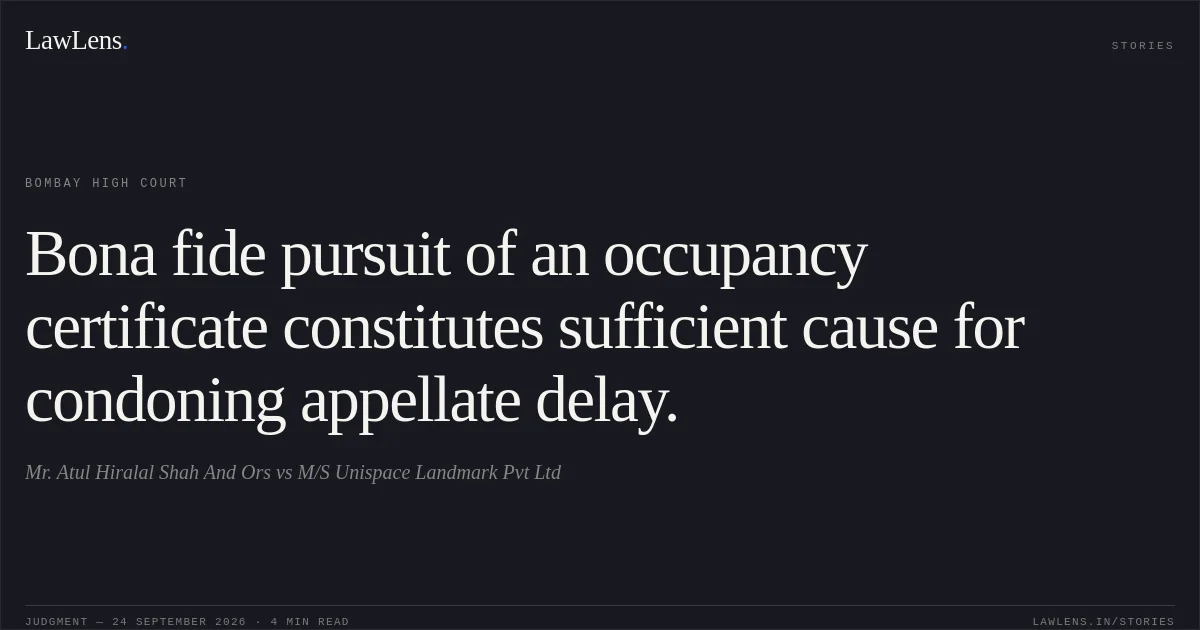
Source reference: para. 2Whether the appellants’ bona fide pursuit of the promoters for obtaining the occupancy certificate and securing compliance with the MahaRERA order constituted “sufficient cause” for condoning the 143-day delay?
Source reference: paras. 14–15, 22–26Law Applied
The Court applied Sections 3 and 5 of the Limitation Act, 1963: Section 3 embodies the mandatory rule that time-barred proceedings must ordinarily be rejected, while Section 5 permits condonation where “sufficient cause” is established.
Source reference: no citationLimitation law is founded on public policy and the principle that litigation must eventually attain finality, as recognised in Pundlik Jalan Patil v. Executive Engineer, Jalgaon Medium Project, (2008) 17 SCC 448.
Source reference: para. 18The expression “sufficient cause” is elastic and must be assessed contextually, with regard to bona fides, diligence, negligence, inaction and prejudice; it should receive a liberal, justice-oriented construction where the delay is genuine, but cannot justify gross negligence or deliberate inaction.
Source reference: para. 19Relying on the principles reproduced from Shivamma (dead) by LRs v. Karnataka Housing Board, 2025 SCC OnLine SC 1969, and Pathapati Subba Reddy (Died) by LRs v. Special Deputy Collector (LA), 2024 SCC OnLine SC 513, the Court held that Section 5 may be construed liberally, but not so as to defeat the discipline of Section 3; courts must assess whether the explanation is real, bona fide and free from negligence.
Source reference: para. 20The Court also held that the requirement to explain each day’s delay does not demand mathematical precision.
Source reference: para. 26Reasoning
The Court held that although non-compliance with the MahaRERA order might, in isolation, appear unrelated to delay in filing an appeal, the explanation had to be assessed in the factual context and circumstances of the parties.
Source reference: paras. 14–15The appellants were allottees, and enforcement of the interest direction had been made contingent upon the promoters obtaining the occupancy certificate—a matter substantially within the promoters’ control and not the appellants’ control.
Source reference: paras. 23–24Their continued pursuit of the promoters in the reasonable expectation that the occupancy certificate would be obtained and the order would become enforceable could not, in the circumstances, be characterised as negligence or deliberate inaction.
Source reference: para. 25The Appellate Tribunal adopted an unduly rigid approach by insisting upon an exact day-to-day explanation, despite the relatively moderate delay of 143 days.
Source reference: paras. 22, 26The Court found no gross negligence, deliberate inaction or blatant indifference warranting refusal of condonation.
Source reference: no citationIt also noted that the occupancy certificate had still not been obtained, making enforcement of the MahaRERA order premature under its existing terms and reinforcing the practical predicament faced by the appellants.
Source reference: paras. 27–28Holding
The Court answered the substantial question of law in the affirmative, holding that the Appellate Tribunal had adopted an overly rigid approach and had failed to apply the correct principles governing condonation of delay.
The Tribunal’s order dated 6 April 2026 was quashed and set aside; the appellants’ application for condonation of delay was allowed, and the 143-day delay in filing the appeal was condoned subject to payment of ₹20,000 as costs to the respondents within four weeks of uploading of the judgment.
Source reference: para. 30The Appellate Tribunal was directed to decide the appeal in accordance with law.
Source reference: para. 30Acts & Sections Cited
3 provisions across 2 statutes referred to in this judgment. Each provision opens on LawLens.
Real Estate (Regulation and Development) Act, 2016.1
Original Court PDF
Mr. Atul Hiralal Shah And OrsvsM/S Unispace Landmark Pvt Ltd
Click to open original judgment
Original judgment, available to read, download and summarize on LawLens.in