Facts
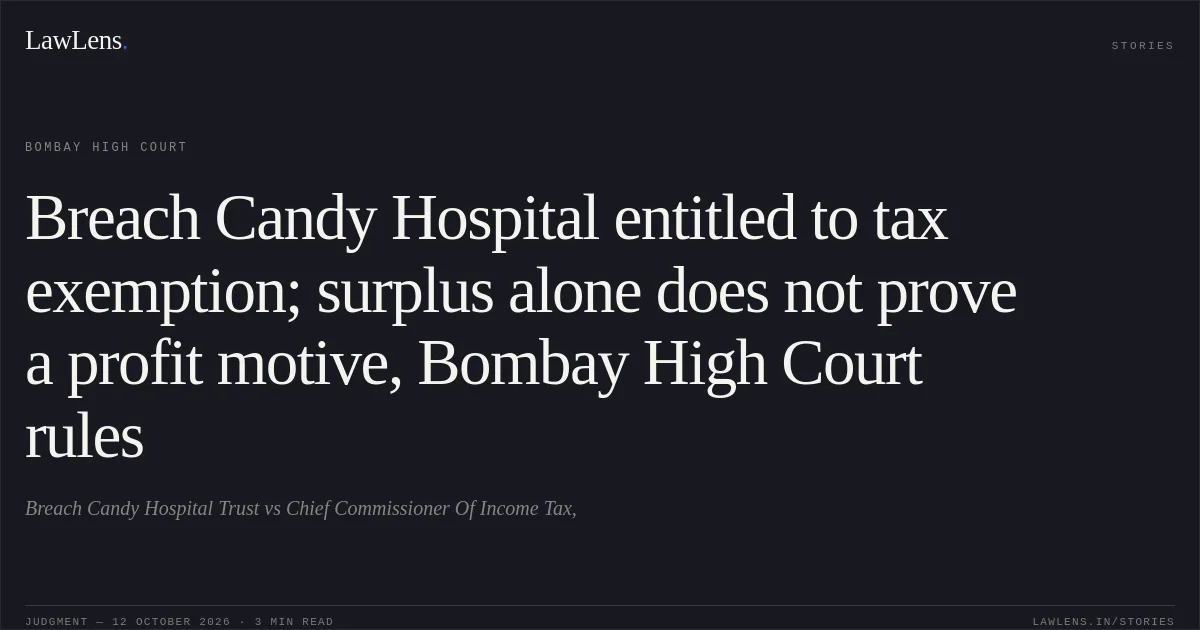
Breach Candy Hospital Trust, a company and public trust operating a hospital, applied for approval under Section 10(23C)(via) of the Income-tax Act, 1961.
Source reference: paras. 2; p. 2The Chief Commissioner rejected its applications for AYs 2002–03 to 2010–11 and AY 2011–12 onwards, relying principally on recurring surpluses, the proportion of treatment provided free or at concessional rates, and the Hospital’s arrangements with consultant doctors and its OPD.
Source reference: paras. 5(s), 5(w); pp. 10–11The Hospital challenged both orders. It relied on its governing documents prohibiting distribution of profits, its use of funds for hospital facilities, its compliance with a court-approved scheme requiring free and concessional treatment, and its earlier tax approvals.
Source reference: paras. 7–10, 20–25; pp. 13–15, 19–22The High Court considered the petitions together.
Source reference: paras. 4, 89; pp. 3, 53Issues
1. Whether the Hospital existed “solely for philanthropic purposes and not for purposes of profit” under Section 10(23C)(via), notwithstanding its charges to patients and any annual surplus.
Source reference: paras. 3, 72, 78; pp. 2, 43, 472. Whether the Chief Commissioner’s reliance on the Hospital’s financial results, expenditure on poor and indigent patients, and consultant-fee and OPD arrangements justified refusing approval.
Source reference: paras. 40–50, 61–71; pp. 27–423. Whether the impugned orders should be quashed and approval directed for the relevant assessment years.
Source reference: paras. 85–89; pp. 51–54Law Applied
Section 10(23C)(via), as applicable to the relevant years, required a hospital to exist solely for philanthropic purposes and not for purposes of profit, with approval by the prescribed authority; the authority could examine accounts and activities to assess their genuineness.
Source reference: paras. 72–74; pp. 43–45The Court held that medical relief is not confined to free treatment of the poor, and that charging for services or earning a surplus does not, by itself, establish a profit purpose; the source, scale and use of the surplus, and the institution’s actual activities, must be considered.
Source reference: paras. 75–79; pp. 45–47New Noble Educational Society v. CCIT requires “solely” to be applied strictly, while recognising that surplus arising in the course of the qualifying activity is not, by itself, disqualifying.
Source reference: para. 80; pp. 47–48Tolani Education Society, Framjee Cawasjee Institute, Institute of Banking Personnel Selection and Rajasthan and Gujarati Charitable Foundation supported considering relevant capital expenditure and allowing depreciation under the law applicable to the years in question.
Source reference: paras. 42–45; pp. 28–30The Court also relied on Pulikkal Medical Foundation and its earlier decision in the Hospital’s case for the proposition that philanthropy may include wider provision of medical care and is not limited to treating the poor free of charge.
Source reference: paras. 76–77; pp. 45–46Reasoning
For AYs 2002–03 to 2010–11, the Court accepted that capital expenditure on hospital equipment and facilities was relevant and that depreciation could not be disregarded as an impermissible double deduction.
Source reference: paras. 40–50; pp. 27–32On the Hospital’s figures, even retaining treasury income and investment profits, depreciation and capital expenditure resulted in an aggregate deficit of Rs. 21,87,28,218; the Chief Commissioner’s contrary surplus finding was therefore unsustainable.
Source reference: paras. 40–50; pp. 27–32Independently, the Hospital’s objects prohibited distribution of profits and dedicated its assets to charitable purposes on dissolution; the record disclosed no diversion of funds or unrelated commercial activity.
Source reference: paras. 51–55; pp. 32–35The Court found that the OPD facilities and collection of consultants’ fees formed part of the Hospital’s medical services, with no finding of payments unrelated to services or private appropriation.
Source reference: paras. 61–64; pp. 37–39It also held that the absence of a statutory minimum for free or concessional treatment, together with the Hospital’s obligations and reported compliance under the court-approved scheme, meant that the proportion of such treatment did not determine its philanthropic character.
Source reference: paras. 65–71; pp. 39–43For AY 2011–12, although one computation showed a surplus of Rs. 3,45,87,549, the Court held that surplus alone did not establish a profit purpose, given the Hospital’s objects, activities and use of funds.
Source reference: paras. 86–87; pp. 51–52Holding
The High Court held that the Hospital satisfied Section 10(23C)(via) and that the grounds relied on in both rejection orders did not justify refusal of approval.
It made both Rules absolute, quashed the orders dated 15 April 2010 and 28 September 2012, and directed the competent authority to grant approval for AYs 2002–03 to 2010–11 and AYs 2011–12 to 2021–22, respectively, within eight weeks of upload of the judgment. No order as to costs was made.
Source reference: para. 89(a)–(e); pp. 53–54Acts & Sections Cited
1 provisions across 1 statute referred to in this judgment. Each provision opens on LawLens.
Maharashtra Public Trusts Act.1
Original Court PDF
Breach Candy Hospital TrustvsChief Commissioner Of Income Tax,
Click to open original judgment
Original judgment, available to read, download and summarize on LawLens.in