01Facts
The Petitioners (original plaintiffs) filed a summary suit for ₹2,30,00,000/- based on a 2009 agreement regarding flat compensation
¶ 5The trial court granted the Respondents (defendants) conditional leave to defend, subject to furnishing a solvent surety equal to the claim amount
¶ 1Respondent No. 2 submitted a solvency certificate for Gat No. 775
¶ 2Despite court orders clarifying that the surety must continue during the pendency of the suit, the Respondents executed a registered sale deed for the secured property in favor of a third party on June 13, 2023
¶ 3/6The Respondents admitted the breach but tendered an unconditional apology, citing financial distress and medical needs of Respondent No. 2, a 91-year-old
¶ 4/8They offered to replace the surety or deposit the principal amount only after contempt notices were issued
¶ 2502Issues
i.1. Whether the disposal of property furnished as a solvent surety, without court permission, constitutes "civil contempt" under Section 2(b) of the Contempt of Courts Act, 1971
¶ 18ii.2. Whether an unconditional apology and an offer to replace the surety/deposit the principal amount are sufficient to discharge the contemnors from liability
¶ 10/1103Law Applied
Section 2(b) of the Contempt of Courts Act, 1971, which defines "civil contempt" as willful disobedience of any judgment, decree, or order of a court
¶ 10/18Section 12 regarding punishment and the standard for accepting apologies, specifically the requirement of bona fides
¶ 10/21Supreme Court precedent in Balwantbhai Somabhai Bhandari v. Hiralal Somabhai Contractor, which established that a solvent surety carries an implicit undertaking to keep the property unencumbered and that an apology is not a "legal trick" to escape responsibility
¶ 12/15/19/22Section 145 of the CPC regarding the enforcement of liability of a surety
¶ 15Provisions in the judgment · 5 · Linked ones open on LawLens
Code of Civil Procedure, 1908 Section 145Section 37
Contempt of Courts Act, 1971 Section 2Section 12
Transfer of Property Act, 1882 Section 52
04Reasoning
The Court reasoned that furnishing a solvent surety as a condition for leave to defend is a solemn assurance to the court that the property will remain available to satisfy a potential decree
¶ 15/16Disposing of such property without prior permission defeats the very purpose of Order XXXVII of the CPC and constitutes a willful breach of the court’s trust
¶ 15/17The Court rejected the Respondents' initial excuse—that they believed interim orders expired with the suit's transfer—calling it "arrogance"
¶ 26Following Balwantbhai, the Court found the apology was not bona fide but rather a "calculated risk" taken to pocket sale proceeds
¶ 23/27During the sentencing session, the Court noted a change in conduct: Respondent No. 1 tendered a fresh undertaking to settle the entire suit for ₹4,60,00,000/- (principal plus interest) via specific installments
¶ 31Given the settlement terms and the age/health of Respondent No. 2, the Court determined that a fine rather than imprisonment was appropriate
¶ 32/3505Holding
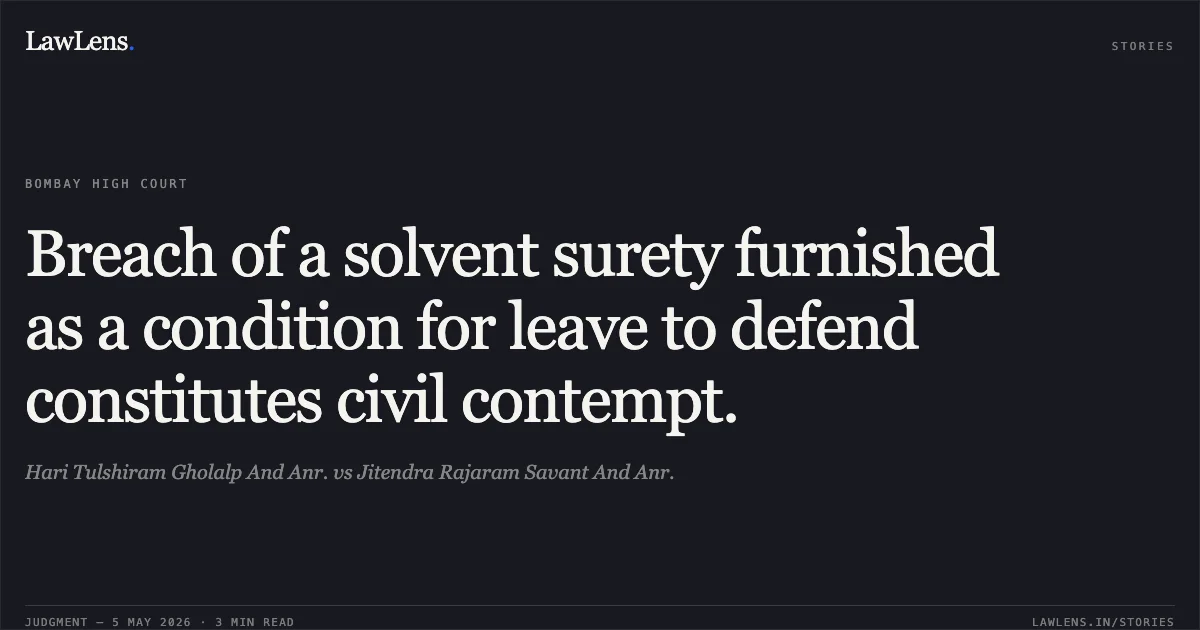
The Court held the Respondents guilty of civil contempt but showed leniency following their undertaking to settle the suit
¶ 18/35The Court ordered: (i) Respondents to pay a fine of ₹2,000/-; (ii) Accepted the undertaking to pay ₹4,60,00,000/- as a full and final settlement of the suit, with ₹2.30 crores to be deposited by May 8, 2026, and the balance in four monthly installments; (iii) Petitioners permitted to withdraw deposits without condition; and (iv) On full compliance, the trial court shall dispose of the suit in terms of the signed Consent Terms
¶ 31/37Original Court PDF
Hari Tulshiram Gholalp And Anr.vsJitendra Rajaram Savant And Anr.
Click to open original judgment
Original judgment, available to read, download and summarize on LawLens.in