Facts
The petitioner invoked Article 227 of the Constitution to challenge the trial court’s order dated 20 March 2026 below Exh. 43 in Special Civil Suit No. 27 of 2025, seeking dismissal of the application and interim protection concerning the suit land
Source reference: paras. 5; p. 2The underlying suit involved, among other matters, specific performance of an agreement to sell and cancellation of a registered sale deed dated 19 June 2025
Source reference: para. 8; p. 4The parties clarified that the land had been purchased by Salibhadra Infracon LLP, although its partner had been named as respondent No. 7; the petitioner was directed to amend the cause title
Source reference: para. 2; p. 1During the hearing, the parties, including respondent No. 7, agreed to resolve their disputes through arbitration, and the petitioner did not seek a reasoned decision on the petition
Source reference: paras. 6–7; p. 3Issues
Whether the parties’ agreement to resolve the disputes in Special Civil Suit No. 27 of 2025 through arbitration should be accepted in disposing of the Article 227 petition
Source reference: paras. 6–7; p. 3Whether respondent No. 7 could participate in the arbitration and be precluded from objecting to the arbitrator’s jurisdiction over the disputes concerning specific performance and cancellation of the sale deed
Source reference: para. 8; p. 4Law Applied
Article 227 of the Constitution was the basis on which the petitioner sought supervisory relief against the trial court’s order
Source reference: para. 5; p. 2Section 11 of the Arbitration and Conciliation Act, 1996, was identified as the available route for seeking appointment of an arbitrator if the parties could not agree on the arbitrator’s name; the respondents’ counsel assured the Court that such an application would not be opposed
Source reference: para. 9; p. 4No precedent or broader rule of law was relied upon; the Court acted on the parties’ consensus to arbitrate
Source reference: paras. 6–7; p. 3Reasoning
The Court did not decide the merits of the challenge to the order below Exh. 43.
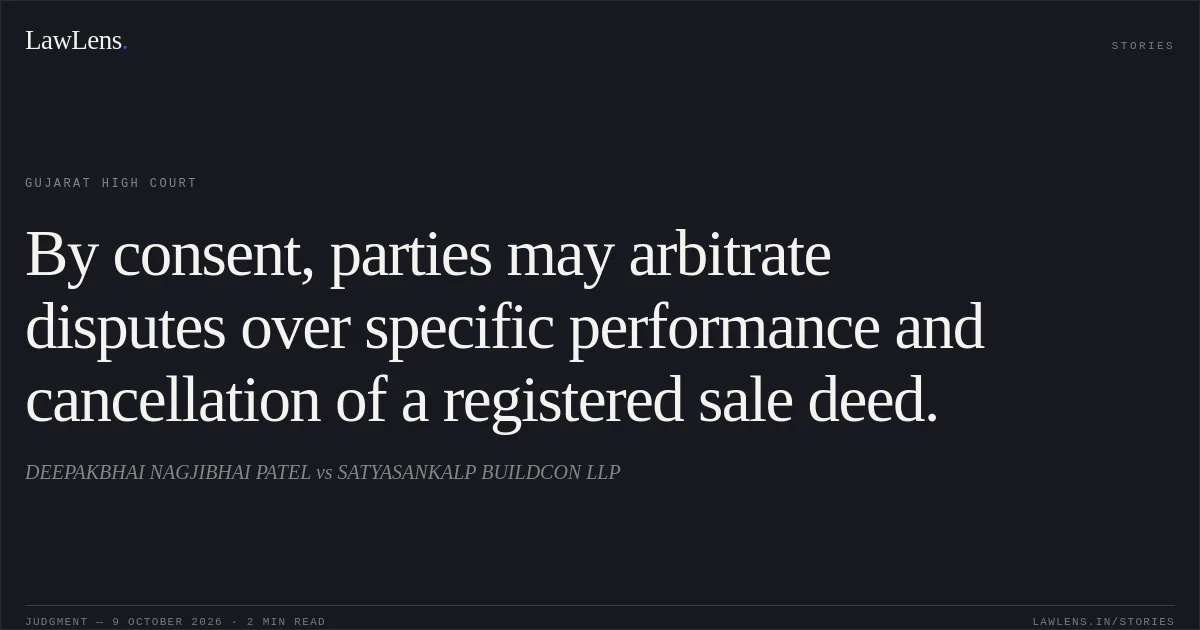
Source reference: paras. 6–7; p. 3Instead, because all parties, including respondent No. 7, agreed to arbitrate the disputes forming the subject matter of the suit, it accepted their request and permitted them to appoint an arbitrator.
Source reference: paras. 6–7; p. 3To give effect to that consensus, the Court recorded that respondent No. 7 could participate and would not object that the arbitrator lacked jurisdiction to decide the specific-performance and sale-deed-cancellation disputes.
Source reference: para. 8; p. 4If the parties could not agree on an arbitrator, the petitioner could apply under Section 11.
Source reference: para. 9; p. 4Holding
The petition was disposed of on the parties’ consensus, without any examination of the merits.
The parties were permitted to appoint an arbitrator, with liberty to the petitioner to seek appointment under Section 11 if they could not agree; respondent No. 7 was permitted to participate and would not raise the specified jurisdictional objection.
Source reference: paras. 7–10; pp. 3–4No order as to costs was made.
Source reference: para. 12; p. 5Acts & Sections Cited
1 provisions across 1 statute referred to in this judgment. Each provision opens on LawLens.
Arbitration and Conciliation Act, 19961
Original Court PDF
DEEPAKBHAI NAGJIBHAI PATELvsSATYASANKALP BUILDCON LLP
Click to open original judgment
Original judgment, available to read, download and summarize on LawLens.in