01Facts
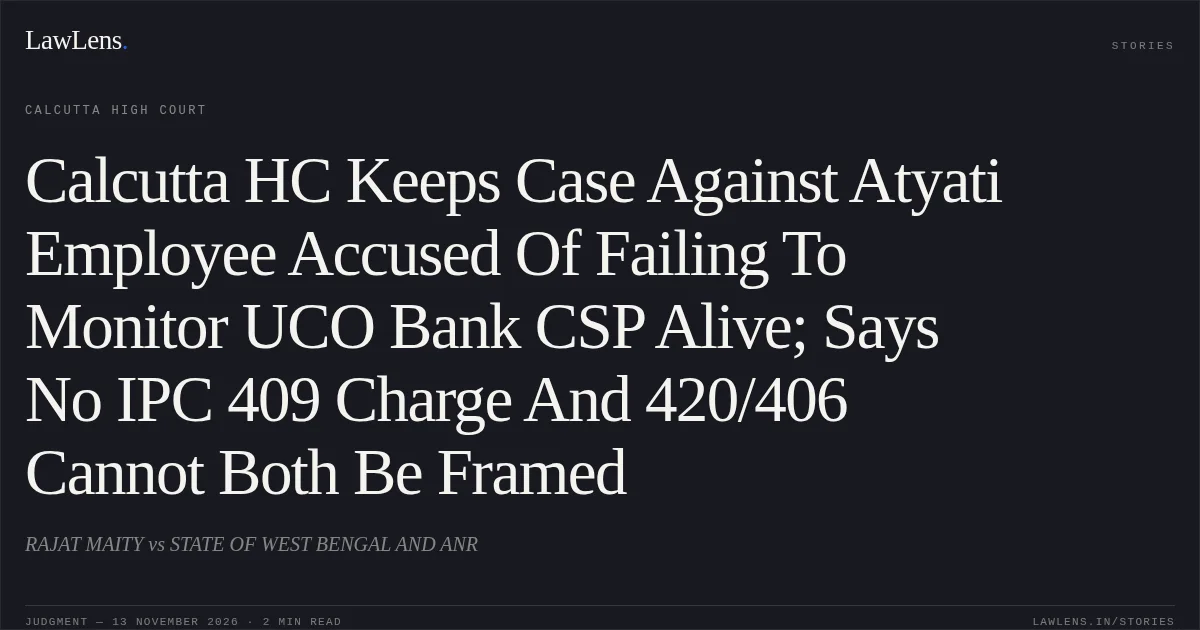
The petitioner, employed by Adecco India Pvt. Ltd. and deputed to Atyati Technologies Pvt. Ltd., was appointed as a process associate in October 2021. His responsibilities included looking after a UCO Bank customer service point (CSP) operated by Amit Sahoo.
¶ 2, 11–12A customer alleged that deposits made through the CSP had been misappropriated; an investigation into the alleged fraud resulted in a charge sheet naming the petitioner, whose alleged role was failure to monitor the CSP properly.
¶ 3–5, 12The petitioner sought quashing under Section 482 CrPC, contending that the materials disclosed neither his participation in the alleged offences nor any basis for the charges.
¶ 6–8The case had been committed to the Sessions Court, but charges had not yet been framed.
¶ 5, 1402Issues
i.Whether the proceedings against the petitioner should be quashed under Section 482 CrPC when the material attributed to him principally concerned failure to supervise the CSP.
¶ 15–18, 20–22ii.Whether charges under Sections 420 and 406 IPC could proceed simultaneously on the alleged facts, and whether Section 409 IPC could apply to the petitioner.
¶ 14, 2103Law Applied
Section 482 CrPC empowers the High Court to prevent abuse of the process of court or secure the ends of justice; the power is to be exercised cautiously and sparingly.
¶ 20–21Under Delhi Race Club (1940) Ltd. v. State of Uttar Pradesh, (2024) 10 SCC 690, as reiterated in Arshad Neyaz Khan v. State of Jharkhand & Anr., 2025 INSC 1151, cheating requires dishonest or fraudulent inducement from the inception, whereas criminal breach of trust involves entrustment followed by dishonest misappropriation; the judgment states that these offences cannot co-exist on the same set of facts.
¶ 14Under Haji Iqbal v. State of U.P., (2023) 20 SCC 209, a court considering quashing must examine the complaint, surrounding circumstances and investigation materials with care, particularly where vexatious proceedings are alleged.
¶ 17–18The Court also observed that Section 409 IPC was not applicable to the petitioner because he was not a public servant, banker, merchant or agent.
¶ 21Provisions in the judgment · 15 · Linked ones open on LawLens
Code of Criminal Procedure, 1973 Section 482Section 209Section 207
Indian Penal Code, 1860 12 provisions
Section 420Section 406Section 409Section 467Section 468Section 471Section 472Section 473Section 474Section 475Section 413Section 3404Reasoning
The Court considered the investigation materials indicating that the petitioner and another employee had responsibility for looking after the CSP, and that the petitioner was alleged to have failed to discharge that responsibility adequately.
¶ 12, 16Given the scale of the alleged fraud and the material collected, the Court held that the petitioner’s complicity could not be ruled out at the quashing stage, and found no basis to treat the complaint as frivolous or vexatious.
¶ 15–18, 21It nevertheless identified legal questions for the Sessions Court at charge-framing: whether Section 409 IPC could apply and whether Sections 420 and 406 could both be charged on the facts.
¶ 2105Holding
The High Court declined to quash the proceedings and rejected the revisional application without costs.
¶ 22, 24It directed the Trial Judge to hear the parties on charge-framing and decide the matter in accordance with law, leaving the petitioner at liberty to raise all available points and directing that the Trial Judge not be influenced by the High Court’s observations.
¶ 21, 23Original Court PDF
RAJAT MAITYvsSTATE OF WEST BENGAL AND ANR
Click to open original judgment
Original judgment, available to read, download and summarize on LawLens.in