Facts
The complainant alleged that petitioner no. 1 concealed his name, religion and existing marriage, represented himself as an unmarried Hindu, and induced her into a relationship and a temple ceremony.
Source reference: para. 2–8, 28She further alleged subsequent sexual assault, confinement, threats and physical assault by petitioner no. 1 and his relatives.
Source reference: para. 2–8, 28On her application under Section 156(3) Cr.P.C., Nimta P.S. Case No. 885/2021 was registered.
Source reference: para. 2–8, 28After investigation, a charge sheet was filed under Sections 419, 420, 498A, 323, 416, 120B, 506 and 34 IPC; Section 313 IPC was not included in the charge sheet.
Source reference: para. 2–8, 28The petitioners sought quashing under Section 482 Cr.P.C., relying, among other grounds, on the alleged consensual nature of the relationship, the invalidity of the marriage, the complainant’s alleged suppression of her own marital status, and the outcome of departmental proceedings against petitioner no. 1.
Source reference: para. 9–20Issues
Whether the allegations and materials in the case diary and charge sheet disclosed a basis to quash the criminal proceedings under Section 482 Cr.P.C.
Source reference: para. 29–31, 40Whether the alleged invalidity of the temple marriage warranted quashing, particularly of the charge under Section 498A IPC, or the proceedings as a whole.
Source reference: para. 32Whether the departmental enquiry’s findings that certain allegations were not proved required the criminal proceedings to be quashed.
Source reference: para. 35–36Law Applied
Section 482 Cr.P.C. confers inherent power to prevent abuse of process and secure the ends of justice, but that power must be exercised sparingly; at the quashing stage, the court does not assess the reliability of allegations or conduct a mini-trial (*Neeharika Infrastructure Pvt. Ltd. v. State of Maharashtra*).
Source reference: para. 37Under *Rajiv Thapar v. Madan Lal Kapoor*, quashing may be justified by defence material only where it is unimpeachable and of sterling quality.
Source reference: para. 30Sections 416, 419 and 420 IPC concern cheating by personation and cheating; whether consent was obtained through a material misrepresentation is a fact-dependent question, including in light of Section 90 IPC.
Source reference: para. 31A departmental enquiry and criminal prosecution differ in purpose, forum and standard of proof; the enquiry’s result does not bind the criminal court.
Source reference: para. 36A possible failure of one charge, including Section 498A IPC, does not by itself require quashing the entire proceeding where other allegations independently disclose cognizable offences.
Source reference: para. 32Reasoning
The Court found that the parties’ relationship, temple ceremony and cohabitation were prima facie supported by the case materials, while whether petitioner no. 1 deliberately misrepresented his identity, religion and marital status—and whether the complainant’s consent was obtained on that basis—required evidence.
Source reference: para. 29, 31, 34The petitioners’ documents and factual defences were not shown to be unimpeachable, and their competing account could not be resolved in a Section 482 proceeding.
Source reference: para. 30, 40The allegations against petitioner nos. 2 to 11 of assaulting the complainant at the Murshidabad residence, considered alongside the injury report, were not inherently improbable or merely omnibus.
Source reference: para. 33Even if the applicability of Section 498A IPC remained open for the trial court, the allegations of deception, assault and intimidation independently prevented quashing of the proceedings as a whole.
Source reference: para. 32The departmental enquiry did not determine the criminal allegations against all petitioners and did not establish that the prosecution was an abuse of process.
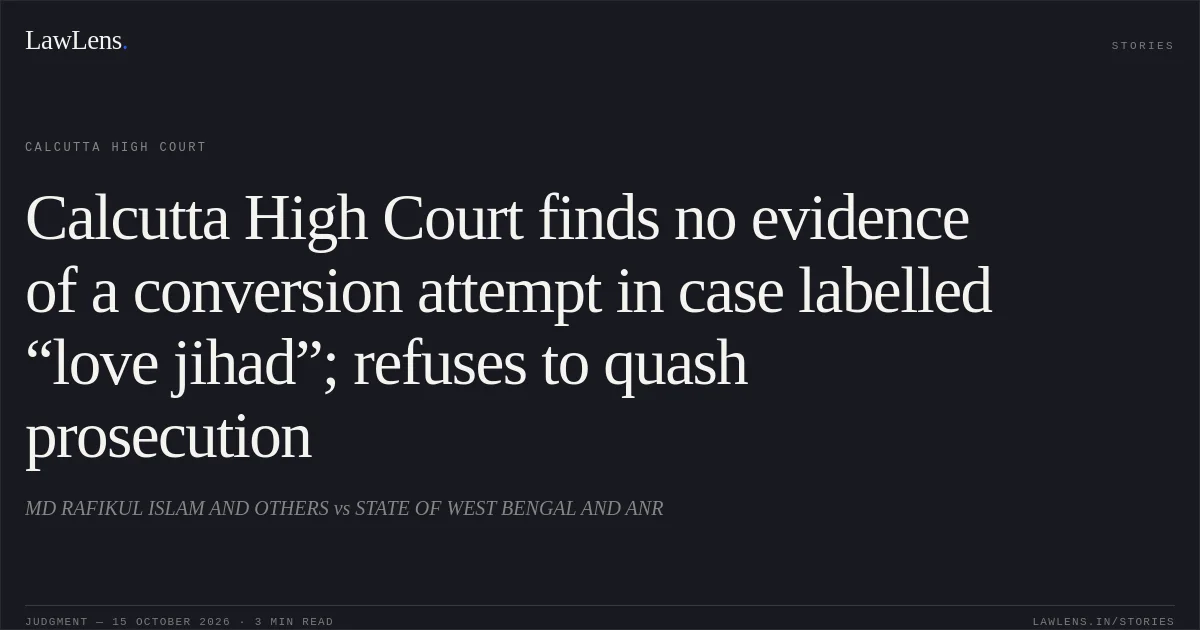
Source reference: para. 36The Court also held that the “love jihad” characterisation was unsupported by the materials and did not affect its assessment of the alleged deception.
Source reference: para. 39Holding
The Court held that the allegations, read with the case diary and charge sheet, prima facie disclosed cognizable offences and that the petitioners’ defences required assessment at trial.
It dismissed CRR No. 3501 of 2022 and disposed of CRAN 3 of 2023 and CRAN 4 of 2023; any interim order was vacated.
Source reference: para. 40–45Acts & Sections Cited
13 provisions across 2 statutes referred to in this judgment. Each provision opens on LawLens.
Code of Criminal Procedure, 19734
Original Court PDF
MD RAFIKUL ISLAM AND OTHERSvsSTATE OF WEST BENGAL AND ANR
Click to open original judgment
Original judgment, available to read, download and summarize on LawLens.in